Showing posts with label women. Show all posts

Thursday, March 14, 2024

What You Need to Know About the Gender Wage Gap

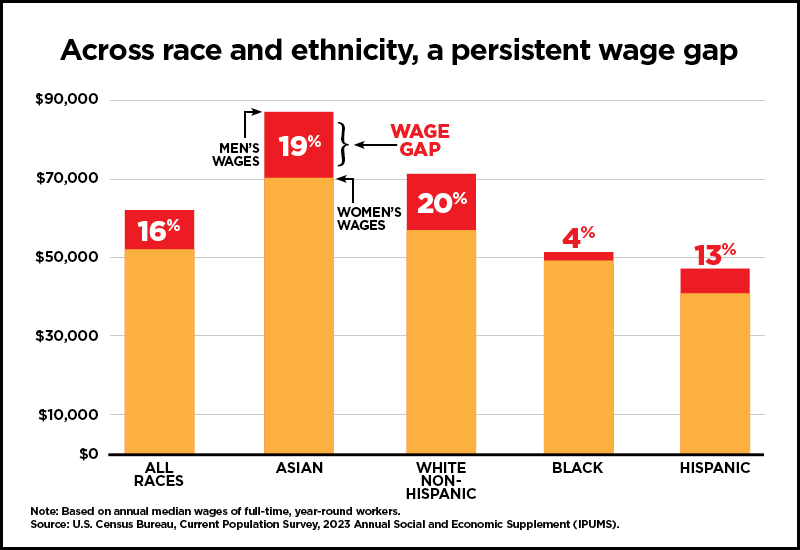
"Bar graph title: Across race and ethnicity, a persistent wage gap. A graph depicting the wage gap between race and gender compared to the average white male: All races - 16%; Asian - 19%; White Non-Hispanic - 20%; Black - 4%; Hispanic - 13%.

March 12 is Equal Pay Day – which represents the date into the year women must work in order to earn the same amount as the average man the previous year. But what does that mean? And what can we say about the gender wage gap today? 

Here are five fast facts: 

  • Overall, women are paid less than men. On average, women working full-time, year-round are paid 84% of what men are paid. In other words, the typical woman working full-time would need to work from January 1, 2023, until March 12, 2024, to make what the typical man working full-time made in 2023. This wage gap also persists within all major race and ethnic groups. For instance, Hispanic women ($41,137 median annual salary) make 13% less than Hispanic men ($47,420 median annual salary). This inequity is even greater for Black and Hispanic women when compared to white, non-Hispanic men.   

  • The largest identifiable causes of the gender wage gap are differences in the occupations and industries where women and men are most likely to work. In 2023, Black women lost $42.7 billion and Hispanic women lost $53.3 billion in wages as compared to white men due to the impact of occupational segregation. However, even within the same occupation, women make less on average than men. 

View our new fact sheet on lost wages due to occupational segregation for Black and Hispanic women.

  • A woman must complete at least one additional educational degree to earn as much as a man with less education. For instance, on average, a woman with an advanced degree earns less than a man with a bachelor’s degree. Were it not for the fact that women attain a greater number of degrees than men, the gender wage gap would be even larger. 

  • The wage gap is larger for mothers and results in employment-related losses of more than $295,000 over a lifetime. This results in women having lower average incomes in retirement and less financial stability in old age. 

  • Discrimination remains a likely leading cause of the gender wage gap. Just since Fiscal Year 2022, the Department of Labor’s Office of Federal Contract Compliance Programs, the Equal Employment Opportunity Commission and the Department of Justice have collectively recovered over $20 million in monetary relief for women who have experienced pay discrimination in the workplace... 

View our Equal Pay webpage..."
Gender Wage Gap 

Tuesday, May 9, 2023

Cancer and Women

"You can take steps every day to lower your chance of getting certain kinds of cancer.

Most cancers take years to develop. Many things can affect your chance of getting cancer. Things that raise your chance of getting cancer are called risk factors.

You can’t control some risk factors, like getting older. But you can control many others. In fact, there are things you can do every day to avoid getting cancer. Two of the most important things you can do are making healthy choices and getting the screening tests that are right for you.

Healthy Choices

Quitting smoking is one of the best ways to lower your cancer risk. Smoking can cause cancer almost anywhere in the body. If you don’t smoke, make sure you stay away from other people’s smoke.

The link between smoking and cancer is well-known. But you may be surprised by other things that can lead to cancer.

  • Ultraviolet (UV) rays from the sun or artificial sources like a tanning bed, booth, or sunlamp can cause skin cancer, the most common cancer.
  • Drinking alcohol raises your risk of getting six kinds of cancer, including breast cancer and colorectal cancer.
  • About 40% of all cancers are associated with overweight and obesity.."
    Cancer and Women 

Tuesday, March 23, 2021

Eight Facts to Know about Women's Health

"Women and girls face unique health challenges across their lifespans. Learn how some of these health conditions affect millions of women and girls each year.

lite icon

Two out of every three caregivers in the United States are women. Women who are caregivers have a greater risk for poor physical and mental health, including depression and anxiety. The COVID-19 pandemic can add even more stressors to the role of caregiving. Maintaining healthy behaviors, managing stress, and seeking extra support, are important, especially during COVID-19.

  • Simple ways to maintain healthy behaviors include participating in regular exercise, practicing good sleep habits, and avoiding excessive alcohol.
  • To help manage stress, caregivers should take breaks, make time to unwind, and consider respite careexternal icon as needed.
  • Recognize when more help is needed. Support groups provide a safe place for people in similar situations to find comfort. Learn more about coping with stress during COVID-19.
lite icon

Asthma occurs more often in women than men. In 2019, the asthma rate was higher among non-Hispanic Black women, and lower among Hispanic women compared with non-Hispanic white women.

  • Changing hormone levels during the menstrual cycle, pregnancy, or menopause may make asthma symptoms worse in womenexternal icon. Asthma can also cause problems for women and their baby during pregnancy.
  • Women’s lungs are smaller than men’s, which may make women more sensitive to asthma triggers and make it harder for women to breathe during an asthma attack.
  • Persons with asthma should avoid asthma triggers. Known asthma triggers include but are not limited to pets, outdoor air pollution, mold, and tobacco smoke.
  • Work with a doctor or health provider to develop an asthma action plan that will help to prevent and control asthma attacks..."
    Women's health
     

Tuesday, June 25, 2019

Minorities and Women Are at Greater Risk for Alzheimer's Disease

"Are you more likely to get Alzheimer’s disease? Read about who is at risk and what you can do.


Hispanic and African Americans in the United States will see the largest increases in Alzheimer’s disease and related dementias between 2015 and 2060.1 Dementia is not a specific disease but rather a general term for the impaired ability to remember, think, or make decisions that interferes with doing everyday activities.
Alzheimer’s disease is the most common type of dementia. Current estimates are that about 5.8 million people in the United States have Alzheimer’s disease and related dementias, including 5.6 million aged 65 and older and about 200,000 under age 65 with younger-onset Alzheimer’s.2
By 2060, the number of Alzheimer’s disease cases is predicted to rise to an estimated 14 million people, with minority populations being affected the most.1
  • Cases among Hispanics will increase seven times over today’s estimates.
  • Cases among African Americans will increase four times over today’s estimates.
Health conditions such as heart disease and diabetes may account for these differences, as they are more common in the Hispanic and African American populations. Lower levels of education, higher rates of poverty, and greater exposure to adversity and discrimination may also increase risk of Alzheimer’s disease.2
Among all races, women are nearly two times more likely to be affected by Alzheimer’s disease than men.1,2 The difference is due primarily to women living longer.2
Understanding the disparities in Alzheimer’s disease and related dementias is the first step toward developing prevention strategies and targeting services to those most at risk for developing the disease..."
Alzheimer disease

Monday, March 18, 2019

Women and Hemophilia

"Women Can Have Hemophilia, Too

Learn how hemophilia is passed in families, and read Shellye’s inspirational story about her journey toward a diagnosis and treatment plan for hemophilia.
Hemophilia is an inherited bleeding disorder primarily affecting males—but females can also have hemophilia. Learn how hemophilia is passed in families, and read Shellye’s inspirational story about her journey toward a diagnosis and treatment plan for hemophilia.

What is hemophilia?

Hemophilia is a bleeding disorder in which the blood does not clot properly. It is caused by a lack of clotting factor proteins in the blood. As a result, people with hemophilia may experience excessive and longer-than-usual bleeding after physical injury or trauma, but they can also experience bleeding without injury or any obvious trigger. People with hemophilia can use treatments called clotting factor concentrates (also known as “factor”) to replace the missing clotting factor proteins in their blood to stop bleeding. This is typically done by injecting factor into a person’s vein. Often, the best choice for good, quality medical care for people with hemophilia is from a comprehensive hemophilia treatment center (HTC). Find an HTC near you.

What causes hemophilia?

Hemophilia is caused by a mutation (change) in one of the genes that provides instructions within cells for making clotting factor proteins in the blood. This mutation results in hemophilia by preventing the clotting factor protein from working properly or causing it to be missing altogether. These genes are located on the X chromosome. Males have one X and one Y chromosome (XY) and females have two X chromosomes (XX). A male inherits his X chromosome from his mother and his Y chromosome from his father. A females inherits one X chromosome from each parent. A male can have hemophilia if he inherits an affected X chromosome (an X chromosome with a mutation in the gene that causes hemophilia) from his mother.

Hemophilia can affect women, too

Females can also have hemophilia, but it is much rarer. When a female has hemophilia, both X chromosomes are affected or one is affected and the other is missing or non-functioning. In these females, bleeding symptoms can be similar to males with hemophilia. When a female has one affected X chromosome, she is a “carrier” of hemophilia. Being a female carrier of hemophilia is not the same as having hemophilia, although female carriers may experience symptoms of hemophilia. A female carrier can also pass the affected X chromosome on to her children..."
Hemophilia

Monday, February 25, 2019

Lower Your Risk for the Number 1 Killer of Women

"Learn about heart disease and women and what you can do to keep a healthy heart.
Heart attacks and strokes can be catastrophic, life-changing events that are all too common. Heart disease and stroke are preventable, yet they remain leading causes of death, disability, and healthcare spending in the US. Alarmingly, many of these events happen to adults ages 35-64—over 800,000 in 2016.

Get Informed: Facts on Women and Heart Disease

High blood pressure, high LDL (low-density lipoprotein) cholesterol, diabetes, and smoking are key risk factors for heart disease. LDL is considered the “bad” cholesterol because having high levels can lead to buildup in your arteries and result in heart disease and stroke. Controlling your blood pressure, managing your cholesterol, not smoking, and regular physical activity will reduce your chances for heart disease.
Some conditions and lifestyle choices increase a person’s chance for heart disease, including diabetes, overweight and obesity, poor diet, physical inactivity, and excessive alcohol use.
Black women are about 60 percent more likely than white women to have heart attacks, primarily because of socioeconomic factors such as poor insurance coverage, lack of quality care and insufficient prenatal counseling.
Top heart attack predictors included congestive heart failure, anemia and pregnancy-related complications such as preeclampsia, gestational high blood pressure, and an imbalance of fluids and electrolytes..."
Heart disease

Tuesday, September 19, 2017

5 Facts About Working Women and Retirement

"1) Women live longer but often have less saved for retirement.
You probably knew women tend to live a little longer than men, but did you know they also tend to have less saved for retirement? On average, a woman retiring at age 65 can expect to live another 21 years, nearly three years longer than a man retiring at the same age. The median balance of women’s retirement accounts in 2016 was only $20,680 compared to $31,371 for men, as reported by Vanguard.
2) Many women aren’t saving for retirement at work.
Approximately 54 percent of working women are not participating in an employer-sponsored retirement plan either by choice (7 percent), ineligibility (9 percent), or because none was offered (37 percent), according to the National Institute for Retirement Security.
3) Mothers’ wages are increasingly important to the economic security of their families.
Almost 60 percent of all women over age 16 were in the workforce in 2015. For mothers with children under 18, the participation rate jumps to nearly 70 percent. Additionally, the number of mothers who are the sole or primary earner has increased significantly in the past few decades. Mothers provide at least half of the family’s income in 40.9 percent of households with children under age 18, up from 11.3 percent in 1960.
4) Mothers are nearly five times more likely to work part-time than fathers.
Despite strides in women’s earnings over the past decades, employed mothers are nearly five times more likely to work part-timethan fathers, due in part to caregiving duties. Part-time workers are less likely to be covered by an employer-provided retirement savings plan, and may have less money to save on their own.
5) Women are at greater risk of experiencing poverty in retirement.
Women face a higher risk of poverty in retirement and are much more likely than men to depend on Social Security payments. For 27.4 percent of women age 65 and over, Social Security benefits comprise 90 percent of their total income. Forty-six percent of all elderly unmarried women (including widows) who received Social Security benefits in 2014 relied on it for 90 percent or more of their income..."

Working women

Wednesday, June 7, 2017

Celebrating 97 Years of Advocacy for Working Women

"First created during World War I to study women’s employment during and after the war, the Women’s Bureau became a permanent federal government fixture in 1920. Ninety-seven years later, the Bureau remains the sole federal agency designed to advocate on behalf of working women.
Since its inception, the bureau has supported innovative policies and programs designed to address emerging issues affecting working women and create a positive environment for working women and their families.
Women have made great progress over the course of the bureau’s 97-year history, as seen in higher education levels and higher earnings. As it has for nearly a century, the Women’s Bureau will continue working to address the challenges working women experience and raise awareness on key issues and developments affecting women in the workforce
Tracie Sanchez is a policy analyst for the Women’s Bureau.
Editor's note: Photo credits clockwise from top left - Library of Congress, U.S. Labor Department, Library of Congress, Library of Congress and the National Archives. 


Working Women

Thursday, May 18, 2017

Cancer and Women

"Every year, cancer claims the lives of more than a quarter of a million women in America. You can lower your cancer risk in several ways.

What You Can Do

  • Don’t smoke, and avoid secondhand smoke. More women in the United States die from lung cancer than any other kind of cancer, and cigarette smoking causes most cases.
  • Get recommended screening tests for breast, cervical, colorectal, and lung cancer. Screening tests are the best way to find these cancers early, when they are easier to treat. Lung cancer screening is recommended only for certain people who are at high risk.
  • Protect your skin from the sun and avoid indoor tanning. Skin cancer is the most common cancer in the United States. Most cases of melanoma, the deadliest kind of skin cancer, are caused by exposure to ultraviolet (UV) light from the sun and indoor tanning devices.
  • Stay active and eat healthfully. Making healthy choices like eating a diet rich in fruits and vegetables, getting regular physical activity, and limiting alcohol consumption can help lower your risk for several kinds of cancer.

.."Cancer and women

Tuesday, March 28, 2017

12 Stats About Working Women

"Women are Integral to Today’s Workforce
  • There are 74.6 million women in the civilian labor force.
  • Almost 47 percent of U.S. workers are women.
  • More than 39 percent of women work in occupations where women make up at least three-quarters of the workforce.
  • Women own close to 10 million businesses, accounting for $1.4 trillion in receipts.
  • Female veterans tend to continue their service in the labor force: About 3 out of 10 serve their country as government workers...."

Women and Work

Tuesday, March 14, 2017

U.S. Census Bureau Honors Women's History Month

"The roots of National Women’s History Month go back to March 8, 1857, when women from various New York City factories staged a protest over working conditions. International Women’s Day was first observed in 1909, but it was not until 1981 that Congress established National Women’s History Week to be commemorated annually the second week of March. In 1987, Congress expanded the week to a month. Every year since, Congress has passed a resolution for Women’s History Month, and the president has issued a proclamation..."
Women's History Month

Friday, February 10, 2017

Women, Minorities, and Persons with Disabilities in Science and Engineering

"Women, Minorities, and Persons with Disabilities in Science and Engineering provides statistical information about the participation of these three groups in science and engineering education and employment. A formal report, in the form of a digest, is issued every 2 years...."
"Women, minorities, disabled in science

Monday, January 23, 2017

The Original Women's March on Washington and the Suffragists Who Paved the Way

"Following on the heels of President Donald Trump's inauguration this Friday, at least 3.3 million Americans gathered for marches around the country, rallying behind calls for a Women's March on Washington—though the rallies ultimately spready to many cities worldwide. In Washington, D.C., alone, crowd estimates were around 500,000, with protestors calling for gender equality, protection for immigrants, minority and LGBTQ rights and access to women's health services.
But it wasn't the first time huge crowds of women turned out to make demands of the government. On March 3, 1913, one day before the inauguration of Woodrow Wilson, more than 5,000 women descended on Washington to fight for the vote. Some came on foot, some on horseback, some in wagons. There were costumes and placards and about half-a-million spectators lined the streets. Among the marchers were journalist Nellie Bly, activist Helen Keller and actress Margaret Vale—who was also the niece of the incoming president (who was by no means an ally of the suffrage movement; he once said women who spoke in public gave him a “chilled, scandalized feeling”). Despite being heckled and harassed by the crowd, the march was enormously memorable; six years later Congress passed the 19th Amendment, extending the franchise to women nationwide.
Women's March on Washington(1913)

Tuesday, November 29, 2016

Health Insurance Marketplace and Women

"The Marketplace is now open for 2017! Get health insurance through the Health Insurance Marketplace until January 31, 2017 and learn about free preventive services available to women. If you already have coverage through the Marketplace, learn about Coverage to Care and other resources to help you navigate the health care system.
In the Marketplace, you can:
  • Compare different plans based on price, benefits, quality, and other features important to you
  • Choose a combination of price and benefits that fit your budget and meet your needs.."

Health Insurance and women

Tuesday, June 14, 2016

EEOC Issues New Resource Documents for White House United State of Women Summit

"Today, leaders from the U.S. Equal Employment Opportunity Commission (EEOC) will participate in the White House United State of Women Summit. The Summit gathers experts, advocates, and grassroots and business leaders who work in both domestic and international arenas to highlight key issues affecting women and girls and best practices to carry on into the future. The Summit's plenary and breakout sessions will address topics including economic empowerment, health and wellness, educational opportunity, violence against women, entrepreneurship and innovation, and leadership and civic engagement. The Summit will be livestreamed at www.theunitedstateofwomen.org.
To coincide with the Summit, EEOC released the following new resource documents that address the equal employment opportunity rights of women in the workplace:

EEOC

Friday, April 1, 2016

Shift Toward Greater Educational Attainment for Women Began 20 Years Ago

"Statistics from the American Community Survey show women now lead men in college completion (see Women Now at the Head of the Class, Lead Men in College Attainment). Colleges have been graduating more women than men for more than 20 years, but what is new is that the advantage is no longer limited to new graduates and young women. Counting the entire population 25 and older, even women and men who are retired, women are ahead of men in college graduation. That is to say, the average adult woman in the U.S. is more likely to be a college graduate than the average adult man.
In order to better understand this change, the report “Educational Attainment in the United States: 2015” assembles statistics on historical trends in men’s and women’s college graduation. The Current Population Survey has collected data on Americans’ educational attainment since 1967 and provides an unparalleled data set for looking at the education level of the population over a broad period of time..."
Educational attainment

Sunday, January 17, 2016

Women's earnings 83 percent of men's, but vary by occupation

"In 2014, women who worked full time in wage and salary jobs had median usual weekly earnings of $719, which was 83 percent of men's median weekly earnings ($871). Women's earnings as a percentage of men's varied by occupation. Women's median usual weekly earnings in construction and extraction occupations ($691) were 91 percent of the earnings of their male counterparts..."
Women's pay

Friday, December 11, 2015

Women in Combat: Issues for Congress(12/2015)

"Over the past two decades of conflict, women have served with valor and continue to serve on combat aircraft, naval vessels, and in support of ground combat operations. The expansion of roles for women in the Armed Forces has evolved since the early days of the military when women were restricted by law and policy from serving in certain occupations and units. Women are not precluded by law from serving in any military unit or occupational specialty. However, a 1994 Department of Defense (DOD) policy prevented women from being assigned to units below brigade level where the unit’s primary mission was to engage directly in ground combat. This policy barred women from serving in infantry, artillery, armor, combat engineers, and special operations units of battalion size or smaller. On January 24, 2013, then-Secretary of Defense Leon Panetta rescinded the rule that restricted women from serving in combat units and directed the military departments to review their occupational standards and assignment policies for implementation no later than January 1, 2016.

On December 3, 2015, Secretary of Defense Ashton Carter ordered the military to open all combat jobs to women with no exceptions. This most recent policy change followed extensive studies that were completed by the military departments and by the Special Operations Command (SOCOM) on issues such as unit cohesion, women’s health, equipment, facilities modifications, propensity to serve, and international experiences with women in combat. By law (10 U.S.C.652), the Secretary of Defense is required to report to Congress on any proposed changes that would open any units or positions that were previously closed to women. The Secretary’s report is required to include justification for the proposed change and analysis of the implications for the Military Selective Service Act. Congress then has a 30-day period for the review of the justification for the changes and to consider the implications of this decision prior to the implementation of the policy..."
Women in combat

Monday, December 7, 2015

The World's Women: 2015

Find the  latest data on the population of women in the world published by the United Nations Statistics Division.
World's women

Monday, October 19, 2015

DOL Resources for Women

"This is a central, comprehensive and searchable repository of Department of Labor resources, tools, and publications of interest to women..."
Resources for Women