Showing posts with label DOL. Show all posts

Thursday, March 14, 2024

What You Need to Know About the Gender Wage Gap

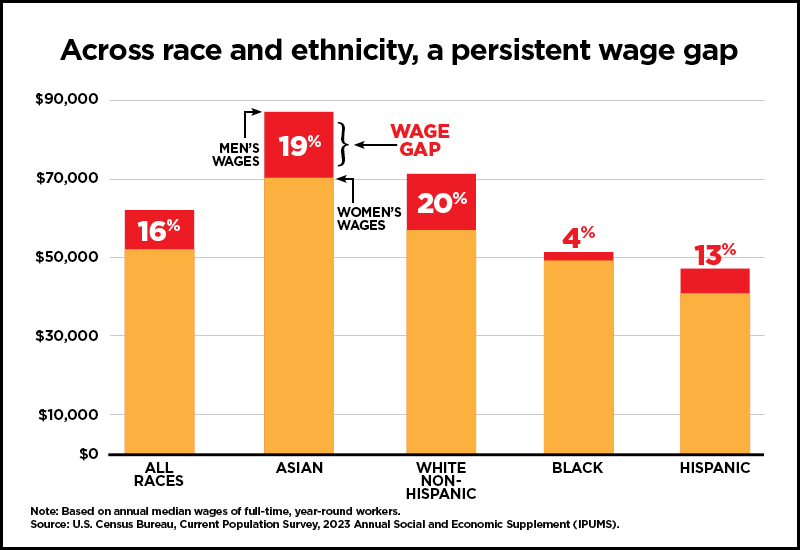
"Bar graph title: Across race and ethnicity, a persistent wage gap. A graph depicting the wage gap between race and gender compared to the average white male: All races - 16%; Asian - 19%; White Non-Hispanic - 20%; Black - 4%; Hispanic - 13%.

March 12 is Equal Pay Day – which represents the date into the year women must work in order to earn the same amount as the average man the previous year. But what does that mean? And what can we say about the gender wage gap today? 

Here are five fast facts: 

  • Overall, women are paid less than men. On average, women working full-time, year-round are paid 84% of what men are paid. In other words, the typical woman working full-time would need to work from January 1, 2023, until March 12, 2024, to make what the typical man working full-time made in 2023. This wage gap also persists within all major race and ethnic groups. For instance, Hispanic women ($41,137 median annual salary) make 13% less than Hispanic men ($47,420 median annual salary). This inequity is even greater for Black and Hispanic women when compared to white, non-Hispanic men.   

  • The largest identifiable causes of the gender wage gap are differences in the occupations and industries where women and men are most likely to work. In 2023, Black women lost $42.7 billion and Hispanic women lost $53.3 billion in wages as compared to white men due to the impact of occupational segregation. However, even within the same occupation, women make less on average than men. 

View our new fact sheet on lost wages due to occupational segregation for Black and Hispanic women.

  • A woman must complete at least one additional educational degree to earn as much as a man with less education. For instance, on average, a woman with an advanced degree earns less than a man with a bachelor’s degree. Were it not for the fact that women attain a greater number of degrees than men, the gender wage gap would be even larger. 

  • The wage gap is larger for mothers and results in employment-related losses of more than $295,000 over a lifetime. This results in women having lower average incomes in retirement and less financial stability in old age. 

  • Discrimination remains a likely leading cause of the gender wage gap. Just since Fiscal Year 2022, the Department of Labor’s Office of Federal Contract Compliance Programs, the Equal Employment Opportunity Commission and the Department of Justice have collectively recovered over $20 million in monetary relief for women who have experienced pay discrimination in the workplace... 

View our Equal Pay webpage..."
Gender Wage Gap 

Wednesday, January 31, 2024

Combating Labor Trafficking At Home and Around the World

"January is Human Trafficking Prevention Month, a month when we turn special attention to raising awareness about human trafficking, but every day the Department of Labor is working to combat labor exploitation and human trafficking

Human trafficking is a crime involving the exploitation of someone to compel their labor or a commercial sex act through force, fraud or coercion. If anyone under 18 is induced to perform a commercial sex act, it is a crime regardless of whether there is force, fraud or coercion. 

In 2021, the department helped expose a trafficking case where more than 100 workers from Mexico, Guatemala and Honduras were fraudulently brought to the U.S. through the H-2A agricultural work visa program. They were coerced into performing physically demanding work in Georgia, Florida and Texas, including being required to dig onions with their bare hands. Workers toiled for little or no pay – in some cases just 20 cents for each bucket harvested. Traffickers threatened the workers or their families with violence and deportation, forced the workers to pay illegal fees, and held them in cramped, unsanitary work camps. 

Traffickers exploit a worker’s vulnerabilities. Although anyone can be subjected to forced labor, some groups are at heightened risk, including foreign workers on temporary visas, people experiencing poverty and economic hardship, and undocumented workers, among others. 

These examples also illustrate many of the signs of trafficking: poor living conditions, debt owed to an employer or recruiter, a worker feeling pressure to stay in a work situation that they would like to leave, and more.

The Department of Labor, through our work to enforce federal labor laws such as minimum wage, overtime and workplace safety laws, is often the first law enforcement agency on a worksite and in a unique position to detect and refer instances of potential human trafficking.

Staff in the department’s Wage and Hour Division and the Occupational Safety and Health Administration are trained to look for indicators of trafficking and make referrals to other agencies. The Wage and Hour Division also calculates restitution for victims of trafficking when requested by the Department of Justice. The Department of Labor’s enforcement work is also a critical tool in addressing labor abuses and exploitation before the situation deteriorates into labor trafficking.

The Wage and Hour Division and OSHA also have tools to aid workers and strengthen our enforcement work, including completing U and T visa certifications for workers who have been victims of certain crimes, including trafficking.."
Human Trafficking 

Wednesday, July 26, 2023

21st Century Trafficking: Emerging Hotspots for Forced Labor

"According to the International Labor Organization, 28 million people around the world are trapped in forced labor. Some are compelled to work in dangerous conditions. Many are isolated, held in debt bondage, threatened, or have their passports and documents confiscated, making it nearly impossible to seek help or flee. Many become victims of trafficking because they are in desperate need of economic opportunities or trying to escape difficult life circumstances.

Where is this happening?

In nearly every country and in the supply chains of products and services you encounter daily. Here are three places where you should know that trafficking is occurring.

Palm oil plantations

If you have shopped at a grocery store, chances are you have bought something containing palm oil. Palm oil is an ingredient in countless products we use daily, from makeup and shampoo to baked goods and cooking oils. Palm oil comes from the fruit of the oil palm tree, 85% of which is harvested in Malaysia and Indonesia. Workers on palm plantations, many of whom are migrant workers lured by the false promises of good jobs, are often vulnerable to child labor and forced labor. Children and adults are subjected to dangerous working conditions, sexual violence and excessive work hours to meet steep work quotas. Palm oil from this part of the world – along with the myriad of products made with palm oil – is shipped globally to destinations including China, India and the U.S.

The U.S. Department of Labor is raising awareness about the risk of child labor and forced labor in the supply chains of products containing palm oil. Our latest List of Goods Produced by Child Labor or Forced Labor warns of multiple palm oil products that contain ingredients tainted by labor exploitation, and we’ve made recommendations to both governments and the private sector on how to address these abuses.

Southeast Asia scam call centers

Nearly everyone with a cell phone has received a scam call or text. A friendly voice on the line asks you about your day and begins to pitch you a false investing opportunity, a bogus extended car warranty or a fake trial of a new computer virus protection service. You might not know that these calls and texts are increasingly coming from people in forced labor in Southeast Asia.

There are growing reports of workers from Thailand, Taiwan, Vietnam and Indonesia, among others, who are promised good jobs by unscrupulous recruiters, only to find themselves trapped in forced labor in makeshift call centers that are heavily guarded. Their passports are confiscated, and they are forced to work long hours and meet daily targets for successful scams. There are even reports of workers being moved or traded among other illegal call centers in the region.

The U.S. Department of Labor is continuing to monitor these situations in order to more effectively engage with the governments of countries in which such fraud is escalating.."
Trafficking 

Thursday, July 13, 2023

Four Ways to Cool Down Heat Illness

"July is Extreme Heat Awareness Month. One of the biggest hazards at this time of year is overheating. Outdoor and indoor heat exposure may cause heat-related illnesses and can lead to preventable fatalities. This means that mine workers, from heavy equipment operators to blasting experts, working on surface mines or underground mines, are all at risk of heat-related illnesses.

High air temperatures, humidity and low wind combined with the heat produced from machinery will make it harder to cool down. Any heat stress illness or injury must be reported to the Mine Safety and Health Administration (MSHA) to meet 30 CFR Part 50.20 requirements. In 2022, 37 incidents of heat-related illness were reported to MSHA. In many of these situations, miners were dehydrated and felt dizzy and nauseous before receiving medical treatment at a hospital.

Heat illnesses or injuries happen when the body is not able to cool itself. While the body normally cools itself by sweating, during extreme heat, sweating may not be enough. When your body temperature rises to a point where it can’t cool down, it can lead to heat stroke, which is a life-threatening condition that needs immediate medical attention to prevent damage to your brain and vital organs.  

A miner may first feel symptoms like thirst and a heat rash. If your mind is focused on working, you may not be aware of your health condition until you are dizzy and then collapse. 

Heat-related injuries and fatalities are preventable. Here are four ways to keep cool when you are working in a hot environment:

  • Hydrate. Drink before you feel thirsty. Being hydrated when you start work makes it easier to stay hydrated through the day.
  • Rest. Take enough time to give your body time to cool.
  • Find shade. Take breaks in a shady or cool area.
  • Wear personal protective gear. Clothing should be loose fitting and “wick” wetness away from your body. Ice vests, cooling neck wraps, and wetted clothing are effective at lowering your body temperature when they can safely be worn while working.."
    Cool Down Heat Illness 

Tuesday, March 14, 2023

5 Fast Facts: The Gender Wage Gap

"5 Fast Facts: The Gender Wage Gap

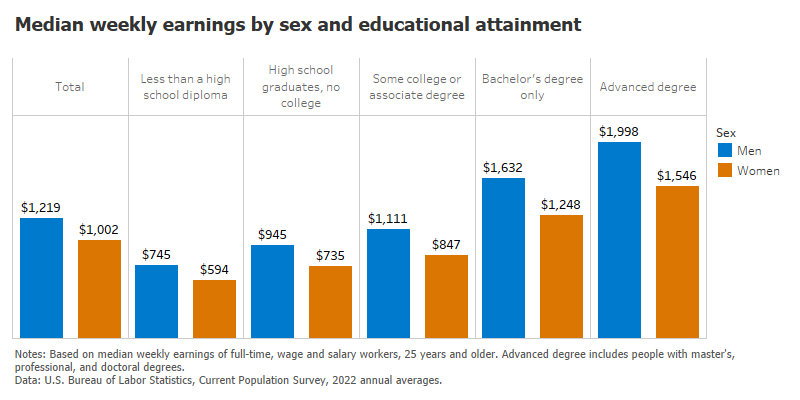
Median weekly earnings by sex and educational attainment. A bar chart shows that while average wages rise for men and women with education, men are paid more than women at every educational level.
On average, men are paid $1,219 per week and women $1,002. Earnings increase with education. With less than a high school diploma, men receive $745/week and women $594. With an advanced degree, men are paid $1,998 and women $1,546. 

March 14 is Equal Pay Day. Here are five fast facts about the gender wage gap.

  1. Stats. Overall, women are not paid as much as men, even when working full time and year round. On average, women working full time, year round are paid 83.7% of what men are paid. This inequity is even greater for Black and Hispanic women.

  2. Causes. Women’s labor is undervalued. Most of the disparity in women and men’s pay cannot be explained by measurable differences between them. Out of the causes of the wage gap that we can measure, the main contributor is that women are more likely than men to work in low-paying jobs that offer fewer benefits.

  3. Education. Education is not enough to eliminate the gender wage gap. On average, women have more years of education and are more likely than men to have completed Associate’s, Bachelor’s or Master’s degrees. Yet there is a significant gender wage gap at every level of education. Overall, women must complete one additional degree in order to be paid the same wages as a man with less education.

  4. Age. The gender wage gap does not resolve itself as women age and develop further in their careers. In fact, the wage gap for older women workers is larger than for younger women, and older Black and Hispanic women have the most extreme differences in pay.

  5. Occupations. The largest identifiable causes of the gender wage gap are differences in the occupations and industries where women and men are most likely to work. Women are 2 out of every 3 full-time workers in occupations that pay less than $30,000 per year, and fewer than 1 in 3 full-time workers in jobs paying an average of $100,000 or more. However, even within the same occupations, women earn less on average than men..."
    Gender Wage Gap
     

Thursday, March 2, 2023

Protecting Workers and Safeguarding Religious Freedom

"Today, the Office of Federal Contract Compliance Programs (OFCCP) acted to protect workers from discrimination and safeguard principles of religious freedom by rescinding the rule, “Implementing Legal Requirements Regarding the Equal Opportunity Clause’s Religious Exemption.” Published in December 2020 at the end of the Trump administration and effective Jan. 8, 2021, the rule adopted new standards for applying the religious exemption in Executive Order 11246 that were at odds with the weight of legal authority. The 2020 rule also weakened nondiscrimination protections for employees of federal contractors, objectives of Executive Order 11246 to ensure economy and efficiency in federal contracting and to promote equal employment opportunity. With the rescission of the rule, we are returning to a longstanding policy in place for more than 17 years, under the administrations of both George W. Bush and Barack Obama, to determine the applicability of the religious exemption by applying established case law and principles to the facts and circumstances of particular cases.

What is the Executive Order 11246 religious exemption?

Since 2002, Executive Order 11246 has contained a religious exemption, based on the religious exemption in Title VII of the Civil Rights Act of 1964, which permits federal contractors that are qualifying religious organizations to hire individuals of a particular religion. Under Title VII, courts have overwhelmingly held, consistent with the view of the Department of Justice, that those employers are not permitted to make employment decisions that amount to discrimination based on other protected characteristics, such as race or sex.

What was the 2020 rule and why is OFCCP rescinding it?

The 2020 rule purported to clarify the scope and application of the Executive Order 11246 religious exemption. On balance, however, it increased confusion and uncertainty about the religious exemption because it diverged from the approach to the Title VII religious exemption taken by courts, the Equal Employment Opportunity Commission, and the Department of Justice, as well as from OFCCP’s past practice.

In November 2021, OFCCP proposed rescinding the rule. We received 761 unique comments and 4,464 form letter comments. We carefully considered the comments and decided to finalize the rescission.

What does the rescission mean?

OFCCP is rescinding the entire rule to return to the agency’s prior approach of aligning the Executive Order 11246 religious exemption with Title VII case law as applied to the facts and circumstances of each case. The rescission preserves the Executive Order 11246 religious exemption and does not change religious entities’ ability to pursue federal contracts.

We remain committed to protecting workers from discrimination and safeguarding religious freedom in accordance with applicable legal authority. We will continue to provide any needed compliance assistance on the religious exemption, including issuing frequently asked questions and responding to stakeholders’ questions. For more information, visit dol.gov/agencies/ofccp/religious-exemption..."
Workers and Religious Freedom 

Friday, February 24, 2023

Family Caregivers: Information on the Family and Medical Leave Act

"When you need to take time off from work to care for a family member, the Family and Medical Leave Act is here to help. 

Under the Family and Medical Leave Act (FMLA), eligible employees are entitled to unpaid, job-protected leave to provide care for a family member, including:

  • Twelve workweeks of leave in a 12-month period to care for the employee’s spouse, child, or parent who has a serious health condition or for any qualifying exigency arising out of the fact that the employee’s spouse, son, daughter, or parent is a covered military member on “covered active duty;” or
  • Twenty-six workweeks of leave during a single 12-month period to care for a covered servicemember with a serious injury or illness if the eligible employee is the servicemember’s spouse, son, daughter, parent, or next of kin (military caregiver leave).

This webpage provides resources to help family caregivers understand and exercise their rights to job-protected leave under the FMLA.


Guides for Employees

Wednesday, September 28, 2022

A Deep Dive into the Labor Exploitation Behind Everyday Products

"Before products like cell phones or baby formula show up on store shelves, countless workers are engaged in their production. Far from the eyes of inspectors and shoppers, too many children and adults toil in exploitation harvesting crops, extracting minerals, and assembling parts into final products. Today, there are an estimated 160 million child laborers and nearly 28 million people in forced labor, the majority of whom work at the bottom of global supply chains, invisible to the outside world.

The U.S. Department of Labor is amplifying the voices of these workers to ensure companies are held accountable for exploitative labor conditions throughout their supply chains.

The department’s flagship reports and resources contain the most rigorous examination yet of child labor and forced labor. Our reporting shows how the behaviors and decisions of businesses, consumers and governments affect horrific conditions of labor abuse and exploitation around the world. Leveraging an expanded mandate, the Bureau of International Labor Affairs’ 2022 List of Goods Produced by Child Labor or Forced Labor not only raises awareness of goods produced directly with child labor or forced labor but also draws attention to goods produced with inputs made by child labor or forced labor. For example:

Our cutting-edge approach to tracing labor exploitation in these supply chains, brought to life through our new "Exposing Exploitation in Global Supply Chains" series, helps us shine a light on abuses we might not otherwise see if we looked at finished products alone.

This work is just the beginning – we’ll be expanding our supply chain research and enforcement support in the coming year. ILAB is also funding projects to pilot new ways of tracing complex global supply chains and investing in efforts to lift up the voices of workers whose labor powers these global goods. We demand that other governments and companies join us to end labor exploitation and stand up for workers’ rights..."
Child labor 

Monday, September 12, 2022

You Have the Right to Form and Join a Union

"Unions improve the well-being of workers and support the mission of the U.S. Department of Labor in many ways – by improving job security and benefits, strengthening labor-management partnerships and advocating for safer workplaces. Union workers also earn more than their nonunion counterparts and enjoy better benefits. In short, unions have major economic benefits for workers and families

Following Labor Day, the department is launching the You Have the Right to Form and Join a Union campaign, an effort to inform people of their right to organize a union. Most workers in the private sector, with some exceptions, have the right to form and join a union. Unions are for every worker in every sector, from teachers to retail workers to engineers and more. 

As part of this campaign, we’re pleased to share two new resources we hope will help workers understand their right to form a union: 

The Worker Organizing Resource and Knowledge Center (WORK Center), developed by the department as part of the White House Taskforce on Worker Organizing and Empowerment, is a brand new one-stop shop to learn: 

  • Who has the right to form a union 

  • The process for forming a union and negotiating a contract 

  • The union advantage in pay, benefits, health and safety, pay equity and more 

  • What your employer can and cannot do during a union organizing effort 

Worker.gov is a newly updated website about ALL your major workplace rights and your right to not be retaliated against when exercising them, including: 

  • Organizing a workers’ committee or a union 

  • Voicing safety concerns 

  • What to do if you think you may be facing retaliation 

There is also a workplace concerns feature that allows you to learn about your rights and how to report or address the issue. 

Are you interested in improving your workplace? If so, you may be interested in these downloadable resources:  

Thursday, June 23, 2022

50 Years of Title IX

"As a college athlete playing soccer, I learned some important lessons from working towards a common goal with my teammates and navigating our wins and losses together. We were afforded those meaningful experiences on the field because of the impact of Title IX, which dramatically increased participation in – and available funding for – women's athletics in publicly funded schools.

June 23 marks the 50th anniversary of the day that Title IX of the Education Amendments was signed into law. What began as a series of hearings to explore the discrimination women faced at educational institutions grew into a movement for equal opportunity in classrooms, playing fields and boardrooms. Until that day not so long ago, it was perfectly legal for federally funded schools and education programs and activities to discriminate against women and girls on the basis of sex. Title IX made this illegal, and in doing so, opened up a new world of opportunity for the generations of women since – including me.

Many of us see Title IX’s impact in women’s sports as a significant accomplishment, and it is. But there are still areas for improvement and progress – namely, ensuring real equal funding for women’s sports and protecting the rights of transgender women and girl athletes. Title IX’s reach has gone much further than sports, impacting gender inclusivity in education and society at large.

When Title IX passed, women were still the minority at college graduations. In 1972 only 44% of bachelor’s, 40% of master’s, and 11% of doctorate degrees were awarded to women. Just 10 years later in 1982, women reached parity with men in obtaining undergraduate degrees. By the 2019-2020 school year, women far outpaced men at every level of educational attainment. Women earned 58% of bachelor’s, 61% of master’s, and 55% of doctorate degrees awarded that year..."
Title 1X
 

Saturday, April 23, 2022

Growing Jobs in Environmentally Focused Occupations

"If your career plan involves caring for the planet, there’s good news. The U.S. Bureau of Labor Statistics projects job growth in many occupations related to helping the environment or conserving natural resources.

In fact, two of the occupations that BLS projects to have the fastest employment growth from 2020 to 2030, wind turbine service technicians (68% increase) and solar photovoltaic installers (52% increase), involve “green” work. However, as the data show, the total number of new jobs is projected to be relatively small in these and some other green occupations.

Data chart on select green jobs with projected growth.

Chart 1 data below

Each of these occupations had a median annual wage that was higher than the $45,760 median for all workers in 2021. The typical education required to enter these occupations varies.

Workers in green occupations focus on the environment in different ways. Wind turbine service technicians and solar photovoltaic installers, for example, build and maintain systems that create energy from sources that don’t become depleted. Other workers help to monitor the environment and investigate sources of pollution. Still others advise organizations or individuals on ways to protect and preserve natural resources.

Wednesday, April 6, 2022

Five Facts About Davis-Bacon and Related Acts

"With President Biden’s signing of the Bipartisan Infrastructure Law on Nov. 15, 2021, our nation is poised to address our aging infrastructure and at the same time create an estimated 800,000 good paying jobs in construction and related industries. Most of the construction projects funded or assisted through the Bipartisan Infrastructure Law will be subject to Davis-Bacon prevailing wage labor standards. That means construction workers on these projects must be paid at least the locally prevailing wage and fringe benefits required for the work they perform...

  1. Davis-Bacon is a federal law that requires local prevailing wages be paid on most federal and federally funded construction contracts. The Davis-Bacon Act ensures that federal government funds elevate labor standards for construction workers across the country, and that taxpayer dollars are used to ensure local wage and benefit standards, allowing responsible contractors to compete for federally funded or assisted construction contracts.

  2. If it’s a Davis-Bacon project, it requires Davis-Bacon wages. Construction workers working on Davis-Bacon covered construction contracts must be paid no less than the locally prevailing wages for all hours worked in each labor classification. If a construction worker on a Davis-Bacon project works in more than one labor classification, the contractor or subcontractor must pay the highest applicable wage rate for all hours worked or different wage rates based on the actual hours worked in each labor classification. Local wage determinations that list labor classification and wage rates are issued by the Wage and Hour Division of the U.S. Department and can be found at sam.gov.

  3. Understand the wages owed to construction workers. Contractors and subcontractors on Davis-Bacon projects must pay their construction workers not less than the wages and fringe benefits listed on the wage determination for the work performed. To help ensure workers are paid the proper rates, workers, contractors and subcontractors should familiarize themselves with:

    1. where the work is being performed,

    2. the type of construction (building, residential, highway, or heavy), and

    3. the applicable labor classifications for the work being performed..."
      Davis-Bacon Act
       

Wednesday, March 30, 2022

Honoring and Protecting Farmworkers, Always Essential

"Our Wage and Hour Division has prioritized agricultural stakeholders throughout its ongoing Essential Workers – Essential Protections outreach initiative. These efforts will continue beyond this week with outreach events in English and Spanish for farmworkers, advocates and employers. We’ll be educating agricultural stakeholders on essential worker protections we enforce, such as:

Farmworkers deserve to live in safe and sanitary housing. And the vehicles used to transport these workers must be maintained in safe operating conditions. When farmworkers’ safety is at risk, the Wage and Hour Division will not hesitate to act, as evidenced by our recent investigation in Missouri and another in Idaho.

We are equally dedicated to protecting farmworkers who are victims of human trafficking. As a partner in the National Action Plan to Combat Human Trafficking, the department works aggressively with other federal law enforcement agencies to bring labor traffickers to justice, as we did recently in Georgia.

Over the past three years, the Wage and Hour Division has recovered over $21.5 million in wages owed to agricultural workers and assessed over $20 million in civil money penalties against employers, including those who intentionally or repeatedly failed to comply with the law, pay workers their hard-earned wages and ensure their housing and transportation safety. We use every available tool, including litigation, to protect workers from harassment, abuse and retaliation for asserting their rights. Agricultural workers are at higher risk for exploitation for several reasons, such as the migratory and seasonal nature of the work, their reliance on employer-provided housing, the physical demands of the job and typically low wages..."
Farm workers