"The United States Department of Transportation National Roadway Safety Strategy (NRSS) outlines the Department's comprehensive approach to significantly reducing serious injuries and deaths on our Nation's highways, roads, and streets. This is the first step in working toward an ambitious long-term goal of reaching zero roadway fatalities. Safety is U.S. DOT"s top priority, and the NRSS represents a Department-wide approach to working with stakeholders across the country to achieve this goal.."
Roadway safety strategy
Showing posts with label transportation. Show all posts
Showing posts with label transportation. Show all posts
Friday, January 28, 2022
National Roadway Safety Strategy


Thursday, April 15, 2021
Legal Issues Related to Transportation Mask-Wearing Mandates
"On January 21, 2021, President Joe Biden issued an executive order directing federal agencies to require
mask wearing in a range of transportation contexts nationwide. In response, the Centers for Disease
Control and Prevention (CDC) issued an order (Mask Order) requiring mask wearing on commercial and
public transportation. A number of other federal agencies have since taken additional actions to support
the enforcement of these mask-wearing requirements. This Legal Sidebar provides a brief overview of the
CDC’s Mask Order and the role of other federal agencies in enforcing its requirements. It then discusses a
number of related legal considerations for Congress, including the scope of the federal government’s
authority to impose mask-wearing requirements in transportation contexts.
CDC Mask Order
The Mask Order requires passengers and personnel on covered modes of transportation and at
transportation hubs to wear masks that cover the mouth and nose. The CDC also has issued guidance
listing the specific attributes of masks that satisfy CDC requirements. The Mask Order applies broadly
across commercial and public transportation, such as aircraft, trains, buses, ferries, and taxis, as well as at
transportation hubs, such as airports and train stations. Operators of covered modes of transportation and
transportation hubs must use “best efforts” to ensure that individuals comply with the mask-wearing
requirements. The Mask Order contains a number of exclusions, such as exempting certain people with
disabilities and children under two years of age from the mask mandate. The order does not apply in
states or localities that enforce mask-wearing requirements providing “the same level of public health
protection” as the CDC’s requirements.
Enforcement
The CDC states that it may enforce the mask-wearing requirements through criminal penalties, but that it
“does not intend to rely primarily on these criminal penalties.” Instead, the CDC expects widespread
voluntary compliance, as well as support from other federal agencies in implementing civil enforcement
measures. A number of federal agencies have now taken such action..."
Transportation mask-wearing
Friday, May 26, 2017
Transit and Ground Passenger Transportation Increased in 2015
“The Transportation and Warehousing sector reached 1.5 million nonemployer establishments in 2015 leading all sectors in both rate of change (with a 22.2 percent increase) and number of establishments gained (277,383),” said Jenny Tran, chief of the Business Statistics branch. “By comparison, when looking across all sectors covered, the number of establishments rose by 494,466 or 2.1 percent to 24.3 million from 2014 to 2015.”..."
Transportation statistics
Transportation statistics
Tuesday, February 14, 2017
Transportation Statistics Annual Report 2016
"The Transportation Statistics Annual Report describes the Nation’s transportation system, the system’s performance, its contributions to the economy, and its effects on people and the environment. This 21st edition of the report is based on information collected or compiled by the Bureau of Transportation Statistics (BTS), a principle Federal statistical agency at the U.S. Department of Transportation.
Nearly 4.2 million miles of roads, more than 19,000 public and private use airports, about 140,000 miles of freight and passenger railroads, 25,000 miles of navigable waterways, and nearly 2.7 million miles of oil and gas pipelines connect the Nation’s people and businesses across the continent and with the rest of the world.
The estimated value of U.S. transportation assets in 2014 was approximately $8.1 trillion. The public owns 50.5 percent of the total transportation asset value, mostly highways and streets, but also publicly held transit facilities, airports, and numerous seaports, inland ports and terminals, and other facilities related to water transportation. Private companies own 31.5 percent of transportation assets, including railroads, pipelines, trucks, planes, and ships. Personal motor vehicles account for the remaining 18.0 percent...."
Transportation statistics
Friday, August 19, 2016
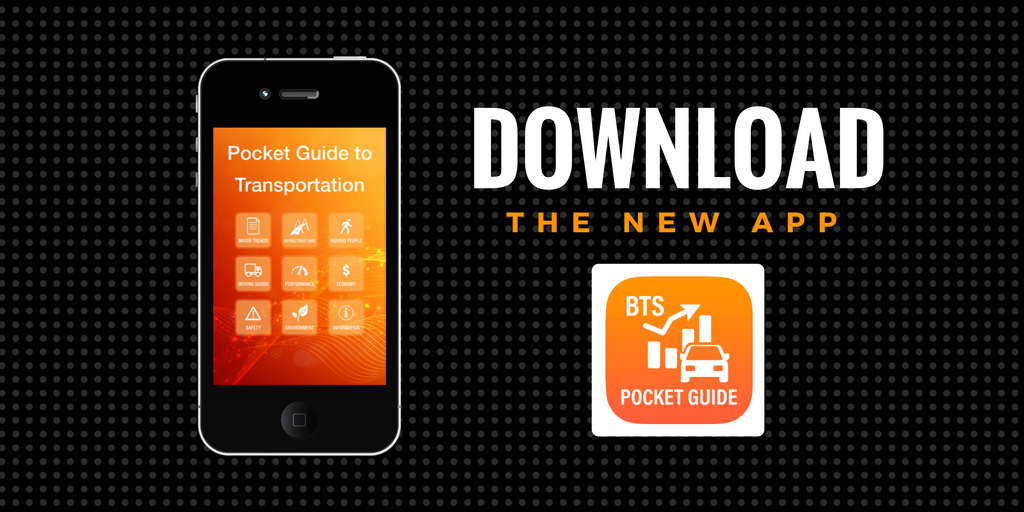
Introducing the Pocket Guide to Transportation App
"If you need transportation statistics at a moment’s notice – for example, if you want to see a list of the most congested urban areas or if you want to find the busiest Amtrak stations – the Bureau of Transportation Statistics has a solution for you.
As we mark the 50th anniversary of the U.S. Department of Transportation, BTS is introducing its most innovative product yet – a smartphone app for the Pocket Guide to Transportation.
 .."
.."Transportation app
Thursday, May 12, 2016
Transportation Security: Issues for the 114 th Congress
"The nation’s air, land, and marine transportation systems are designed for accessibility and
efficiency, two characteristics that make them highly vulnerable to terrorist attack. While
hardening the transportation sector from terrorist attack is difficult, measures can be taken to
deter terrorists. The dilemma facing Congress is how best to construct and finance a system of
deterrence, protection, and response that effectively reduces the possibility and consequences of
another terrorist attack without unduly interfering with travel, commerce, and civil liberties.
Aviation security has been a major focus of transportation security policy since the terrorist attacks of September 11, 2001. In the aftermath of these attacks, the 107th Congress moved quickly to pass the Aviation and Transportation Security Act (ATSA; P.L. 107-71) creating the Transportation Security Administration (TSA) and mandating a federalized workforce of security screeners to inspect airline passengers and their baggage. Recent events, such as the destruction of a Russian passenger jet above the Sinai Peninsula on October 31, 2015, apparently by a bomb aboard the aircraft, have renewed concerns about the adequacy of passenger and cargo screening. Similarly, bombings in Brussels, Belgium, on March 22, 2016, renewed concerns over the security vulnerabilities of airport terminals and mass transit stations..."
Transportation security
Aviation security has been a major focus of transportation security policy since the terrorist attacks of September 11, 2001. In the aftermath of these attacks, the 107th Congress moved quickly to pass the Aviation and Transportation Security Act (ATSA; P.L. 107-71) creating the Transportation Security Administration (TSA) and mandating a federalized workforce of security screeners to inspect airline passengers and their baggage. Recent events, such as the destruction of a Russian passenger jet above the Sinai Peninsula on October 31, 2015, apparently by a bomb aboard the aircraft, have renewed concerns about the adequacy of passenger and cargo screening. Similarly, bombings in Brussels, Belgium, on March 22, 2016, renewed concerns over the security vulnerabilities of airport terminals and mass transit stations..."
Transportation security
Thursday, May 7, 2015
Transportation Alternative by Census Region
From the 2013 American Housing Survey comes recent inforamtion on transportation use by Census region.
Transportation and Census regions
Transportation and Census regions
Tuesday, April 14, 2015
Transportation Statistics Annual Report
"The Transportation Statistics Annual Report
describes the Nation’s transportation system,
the system’s performance, its contributions to
the economy, and its effects on people and the
environment. This 18th edition of the report is
based on information collected or compiled by
the Bureau of Transportation Statistics (BTS),
a Federal statistical agency within the U.S.
Department of Transportation (USDOT).
Over 4 million miles of roads, more than 19,000 public and private use airports, about 140,000 miles of freight and passenger railroads, 25,000 miles of navigable waterways, and 2 million miles of pipelines connect the Nation’s people and businesses across the continent and with the rest of the world.."
Transportation statistics
Over 4 million miles of roads, more than 19,000 public and private use airports, about 140,000 miles of freight and passenger railroads, 25,000 miles of navigable waterways, and 2 million miles of pipelines connect the Nation’s people and businesses across the continent and with the rest of the world.."
Transportation statistics
Tuesday, March 10, 2015
Public Spending on Transportation and Water Infrastructure, 1956 to 201
"Public spending—spending by federal, state, and local governments—on transportation and water infrastructure totaled $416 billion in 2014. Most of that spending came from state and local governments: They provided $320 billion, and the federal government accounted for $96 billion. This report provides information on spending for six types of transportation and water infrastructure: Highways, Mass transit and rail, Aviation, Water transportation, Water resources, and Water utilities..."
Transportation spending
Transportation spending
Friday, March 6, 2015
State Transportation by the Numbers Profiles
"The Bureau of Transportation Statistics (BTS) presents a profile of transportation that covers the 50 states and the District of Columbia. This collection of transportation information from BTS, other federal government agencies, and other national sources provides a picture of the state’s infrastructure, freight movement and passenger travel, safety, vehicles, economy and finance, and energy and environment..."
State transportation statistics
State transportation statistics
Thursday, July 24, 2014
Proposed rulemaking promises increased rail safety for crude oil, other flammable materials
"...And now, today, we're building on that progress by proposing a rulemaking
to improve the safe transportation of large quantities of flammable
materials by rail, particularly crude oil and ethanol. The new,
comprehensive rulemaking will open for public comment once published in
the Federal Register at www.regulations.gov, and I urge you to read it and provide your feedback..."
Transportation crude oil
Transportation crude oil
Saturday, June 14, 2014
U.S. Rail Transportation of Crude Oil
"North America is experiencing a boom in crude oil supply, primarily due to growing production
U.S. rail/crude transportation
in the Canadian oil sands and the recent expansion of shale oil production from the Bakken fields
in North Dakota and Montana as well as the Eagle Ford and Permian Basins in Texas. Taken
together, these new supplies are fundamentally changing the U.S. oil supply-demand balance. The
United States now meets 66% of its crude oil demand from production in North America,
displacing imports from overseas and positioning the United States to have excess oil and refined
products supplies in some regions..."
U.S. rail/crude transportation
Thursday, May 8, 2014
Who Bikes to Work in America?
From U.S. Census Bureau's Random Samplings blog (5/8/2014)
"As cities take steps to increase transportation options, many people choose to ride a bike to work or walk. Timed with National Bike to Work Month, the Census Bureau has released its first-ever report on biking and walking to work. If you have ever wondered who chooses this form of commuting, this report highlights annual American Community Survey information on biking and walking but also offers new information about these travel modes for specific populations.
Although changes in rates of bicycle commuting vary across U.S. communities, many cities have experienced relatively large increases in bicycle commuting in recent years. The total number of bike commuters in the U.S. increased from about 488,000 in 2000 to about 786,000 during the period from 2008 to 2012, a larger percentage increase than that of any other commuting mode.."Bikes to work
"As cities take steps to increase transportation options, many people choose to ride a bike to work or walk. Timed with National Bike to Work Month, the Census Bureau has released its first-ever report on biking and walking to work. If you have ever wondered who chooses this form of commuting, this report highlights annual American Community Survey information on biking and walking but also offers new information about these travel modes for specific populations.
Although changes in rates of bicycle commuting vary across U.S. communities, many cities have experienced relatively large increases in bicycle commuting in recent years. The total number of bike commuters in the U.S. increased from about 488,000 in 2000 to about 786,000 during the period from 2008 to 2012, a larger percentage increase than that of any other commuting mode.."Bikes to work
Friday, August 2, 2013
Monday, April 8, 2013
National Distracted Driving Awareness Month
Find safety information from the U.S. Department of Transportation on distracted driving.
National Distracted Driving Awareness Month
National Distracted Driving Awareness Month
Thursday, June 21, 2012
Veterans Transportation Career Center
"The Department of Transportation (DOT) is partnering with the Department of Veterans Affairs (VA) to help military personnel and veterans transition from military training and job specialty skills acquired in the service to exciting careers in the transportation industry..."
Wednesday, November 2, 2011
Faces of Distracted Driving
U.S. Department of Transportation's campaign against distracted driving.
Tuesday, July 26, 2011
FMCSA Announces Redesigned "Protect Your Move" Web Site
"The U.S. Department of Transportation's Federal Motor Carrier Safety Administration (FMCSA) has launched a newly designed Web site with resources to help consumers protect themselves from fraudulent or unscrupulous interstate household goods moving companies.
The Web site - www.ProtectYourMove.gov - includes a user-friendly database that allows visitors to look up interstate moving companies by state or by name and to review both the consumer complaint history as well as the company's on-road safety performance records. A new feature of the Web site allows state consumer protection agencies to easily update state contact information for shippers who have questions about household goods movers.
The www.ProtectYourMove.gov Web site features a new public service announcement, "Don't Be a Victim," that focuses on ways consumers can prevent moving fraud..."
"The U.S. Department of Transportation's Federal Motor Carrier Safety Administration (FMCSA) has launched a newly designed Web site with resources to help consumers protect themselves from fraudulent or unscrupulous interstate household goods moving companies.
The Web site - www.ProtectYourMove.gov - includes a user-friendly database that allows visitors to look up interstate moving companies by state or by name and to review both the consumer complaint history as well as the company's on-road safety performance records. A new feature of the Web site allows state consumer protection agencies to easily update state contact information for shippers who have questions about household goods movers.
The www.ProtectYourMove.gov Web site features a new public service announcement, "Don't Be a Victim," that focuses on ways consumers can prevent moving fraud..."
Saturday, January 22, 2011
SPENDING AND FUNDING FOR HIGHWAYS
"The nation's network of highways plays a vital role in the U.S. economy; private commercial activity and people's daily lives depend on that transportation infrastructure. In 2007, the public sector spent $146 billion to build, operate, and maintain highways in the United States. About three-quarters of that total was provided by state and local governments. One-quarter was provided by the federal government, primarily through the Safe, Accountable, Flexible, Efficient Transportation Equity Act: A Legacy for Users (SAFETEA-LU). The initial authorization for that law has expired; as the Congress considers the future role of the federal government in providing highway infrastructure, it faces three important questions: how to structure decisionmaking about highway projects, how much money to spend on highways, and how to pay for that spending..."
"The nation's network of highways plays a vital role in the U.S. economy; private commercial activity and people's daily lives depend on that transportation infrastructure. In 2007, the public sector spent $146 billion to build, operate, and maintain highways in the United States. About three-quarters of that total was provided by state and local governments. One-quarter was provided by the federal government, primarily through the Safe, Accountable, Flexible, Efficient Transportation Equity Act: A Legacy for Users (SAFETEA-LU). The initial authorization for that law has expired; as the Congress considers the future role of the federal government in providing highway infrastructure, it faces three important questions: how to structure decisionmaking about highway projects, how much money to spend on highways, and how to pay for that spending..."
Saturday, November 27, 2010
U.S. Transportation Secretary Ray LaHood Unveils Study Showing Dramatic Gains in Seat Belt Use from Tougher Laws and Stiffer
"In urging Americans to buckle up and drive safely over the Thanksgiving holiday, U.S. Transportation Secretary Ray LaHood today released new research that shows that states that strengthen belt laws and increase fines for unbuckled motorists see substantially increased seatbelt use.
"We want everyone to have a safe and happy holiday travel season," said Secretary LaHood. "For the sake of your loved ones and everyone else on the road, please remember to buckle up and put away your cell phone every time you get behind the wheel."
The National Highway Traffic Safety Administration (NHTSA) study confirms that states that upgrade from a secondary to primary seat belt law show belt use gains of 10 to 12 percentage points. It also shows that states that increase the fine for a belt use violation from $25, the national median, to $60 show gains of 3 to 4 percentage points in belt use. Those that raise the penalty to $100 show 6- to 7-percent point gains..."
View the full report
"In urging Americans to buckle up and drive safely over the Thanksgiving holiday, U.S. Transportation Secretary Ray LaHood today released new research that shows that states that strengthen belt laws and increase fines for unbuckled motorists see substantially increased seatbelt use.
"We want everyone to have a safe and happy holiday travel season," said Secretary LaHood. "For the sake of your loved ones and everyone else on the road, please remember to buckle up and put away your cell phone every time you get behind the wheel."
The National Highway Traffic Safety Administration (NHTSA) study confirms that states that upgrade from a secondary to primary seat belt law show belt use gains of 10 to 12 percentage points. It also shows that states that increase the fine for a belt use violation from $25, the national median, to $60 show gains of 3 to 4 percentage points in belt use. Those that raise the penalty to $100 show 6- to 7-percent point gains..."
View the full report
Subscribe to:
Posts (Atom)

