Showing posts with label face_masks. Show all posts

Tuesday, March 1, 2022

Dane County Face Covering Order to Expire March 1

"posted 

Effective at 12:00am on March 1, 2022, Public Health Madison & Dane County will no longer require face coverings in public indoor spaces in light of steadily decreasing COVID-19 case rates and hospitalizations.

The seven-day average of cases peaked on January 12 when 1,491 people were diagnosed with COVID-19. The seven-day average of hospitalizations peaked on January 15 with an average of 195 people hospitalized with COVID-19. Today, cases have fallen to a seven-day average of 340 cases, less than 25% of peak levels and are continuing to decline. Hospitalizations are also down substantially to a seven-day average of 110, which is 44% lower than the peak 7-day average of hospitalizations in January 2022 caused by Omicron.

Additionally, high case levels did not translate to as high of hospitalization levels as they did before vaccination was readily available. Currently, an estimated 58% of Dane County residents are up to date  on their vaccines, meaning a person has received all recommended COVID-19 vaccines, including boosters, when eligible.

“Letting the face covering order expire doesn’t mean that the pandemic is over. Rather, it signals that we have made it through the Omicron surge and are entering a new stage of the pandemic,” said Janel Heinrich, Director of Public Health Madison & Dane County. “The most important thing you can do now is to stay up-to-date on our vaccines as they have proven to be highly effective in protecting you from becoming severely ill, ending up in the hospital, or dying from COVID-19.”

Vaccines are safe, free, and widely available throughout Dane County, including the community vaccination clinic at the Alliant Energy Center, recurring mobile clinics , local pharmacies, or at your healthcare provider. Everyone ages 5 and older are now eligible to receive a COVID-19 vaccine, and many are eligible for boosters, with approval for children ages 6 months-4 years expected this Spring.

“As we move forward in this pandemic, community testing and vaccination options will remain readily available to those who need them, and people are encouraged to continue to wear masks if it makes them feel more comfortable,” said Satya Rhodes-Conway, City of Madison Mayor. “Wearing masks, especially well-fitting masks in indoor public settings, has been proven to reduce the risk of contracting or spreading COVID-19.”

Dane County’s public health order expiration does not affect the federal requirement for face coverings on public transportation , including public transit networks, airplanes, buses and school buses, trains, taxis, Ubers and Lyfts.

“I want to thank everyone in the community for your commitment to keeping yourselves and your neighbors safe throughout the pandemic,” said Dane County Executive Joe Parisi. “It hasn’t been easy, that’s for sure; but your diligence, combined with the amazing work of Public Health and our many community partners, is the reason we have come through the pandemic with one of the lowest per-capita death rates in the nation. Thank you.”

Public Health will continue case investigation efforts to prevent spread and strongly encourages everyone to stay home when sick, and follow the latest isolation and quarantine guidance to prevent transmission, which can include masking recommendations.

“Together, healthcare workers and Public Health staff have worked tirelessly to meet the ever-changing demands of this pandemic by following the latest science and applying it to their response,” said Jerry Halverson, MD, Chair of the Board of Health. “This decision is no different. Now is the time we rely on folks to make good decisions when it comes to their own health, and the health of their neighbors.”

For more information about COVID-19 in Dane County, visit publichealthmdc.com/coronavirus. You can also follow @publichealthmdc on Facebook , Twitter , and Instagram ..."
Face coverings
 

Monday, January 17, 2022

How to tell if your N95 Respirator is NIOSH Approved

"Defining “NIOSH Approved”


The National Institute for Occupational Safety and Health (NIOSH) is the federal agency responsible for testing and approving respirators used in U.S. workplace settings.

A NIOSH-approved N95 is the most common type of filtering facepiece respirator (FFR), which is a type of disposable respirator meant to form a tight seal to the face, removing particles from the air as you breathe through it. This includes all types of particles, such as bacteria, viruses, and dust. When used in an occupational setting, NIOSH-approved respirators, including N95s, are meant to be used as part of a workplace’s respiratory protection program. These programs are regulated by the Occupational Safety and Health Administration (OSHA) and must include specific elements such as medical evaluations, fit testing, and training. If your respirator has been approved by NIOSH, you can be confident that it is working as expected to protect you as long as:

• It is properly maintained
• It is worn and used correctly
• It fits properly
• It is replaced as recommended by the manufacturer

NIOSH only approves respirators that pass its strict quality assurance and performance requirements. As part of these tests, NIOSH uses a near worst-case penetrating aerosol size (i.e., particles that are best able to make it through a filter), and an N95 respirator must not allow more than 5% of these particles to penetrate through. This ensures that every respirator that passes these tests will filter potentially hazardous particles as expected when used in real-world situations.

How to tell if an N95 is NIOSH Approved

The easiest way to tell if your N95 is NIOSH approved is to search for it on the NIOSHCertified Equipment List (CEL). All NIOSHapproved respirators have a testing and certification (TC) approval number (e.g., TC 84A-XXXX), which must be printed on the respirator. The CEL has an option to search by the TC approval number, which will also help identify any private labels (alternate brand names) associated with that approval number. If you search a NIOSH TC approval number and no results are found within the CEL, that means it is not a valid NIOSH approval number and the product is not NIOSH approved. NIOSH also provides frequently updated lists of all approved FFRs by type (including N95s) and model/part numbers, which include the manufacturer’s instructions describing how to put the respirator on correctly.

Additionally, respirators that have earned NIOSH approval will have specific labeling printed on the facepiece. You may see some respirators on the market labeled as “N95,” but if a respirator does not contain all of the components of the required label, it is not a NIOSH-approved respirator and, therefore, cannot be relied on to provide the same level of respiratory protection..."
N95 mask approval 

Sunday, January 16, 2022

Types of Masks and Respirators, January 14, 2022

"Summary of Recent Changes

  • Added information to present similar content for masks and respirators
  • Clarified that people can choose respirators such as N95s and KN95s, including removing concerns related to supply shortages for N95s
  • Clarified that “surgical N95s” are a specific type of respirator that should be reserved for healthcare settings
  • Clarified that some types of masks and respirators provide more protection to the wearer than others

View Previous Updates

Key Messages:

  • Masking is a critical public health tool for preventing spread of COVID-19, and it is important to remember that any mask is better than no mask.
  • To protect yourself and others from COVID-19, CDC continues to recommend that you wear the most protective mask you can that fits well and that you will wear consistently.
  • Masks and respirators are effective at reducing transmission of SARS-CoV-2, the virus that causes COVID-19, when worn consistently and correctly.
  • Some masks and respirators offer higher levels of protection than others, and some may be harder to tolerate or wear consistently than others. It is most important to wear a well-fitted mask or respirator correctly that is comfortable for you and that provides good protection.
  • While all masks and respirators provide some level of protection, properly fitted respirators provide the highest level of protection. Wearing a highly protective mask or respirator may be most important for certain higher risk situations, or by some people at increased risk for severe disease.
  • CDC’s mask recommendations provide information that people can use to improve how well their masks protect them.

This page describes different types of masks and respirators that you can use to protect yourself and others from getting and spreading COVID-19. Masks and respirators can provide varying degrees of protection, with well-fitting National Institute for Occupational Safety and Health (NIOSH)-approved respirators offering the most protection. Masking is a critical public health tool for preventing spread of COVID-19, and it is important to remember that any mask is better than no mask.  This page presents options in order of least to most protective. To protect yourself and others from COVID-19, CDC continues to recommend that you wear the most protective mask you can that fits well and that you will wear consistently.

Types of Masks and Respirators

Masks are made to contain droplets and particles you breathe, cough, or sneeze out. If they fit closely to the face, they can also provide you some protection from particles spread by others, including the virus that causes COVID-19.

Respirators are made to protect you by filtering the air and fitting closely on the face to filter out particles, including the virus that causes COVID-19. They can also contain droplets and particles you breathe, cough, or sneeze out so you do not spread them to others.

Choosing a Mask or Respirator for Different Situations

Masks and respirators (i.e., specialized filtering masks such as “N95s”) can provide different levels of protection depending on the type of mask and how they are used. Loosely woven cloth products provide the least protection, layered finely woven products offer more protection, well-fitting disposable surgical masks and KN95s offer even more protection, and well-fitting NIOSH-approved respirators (including N95s) offer the highest level of protection.

Whatever product you choose, it should provide a good fit (i.e., fitting closely on the face without any gaps along the edges or around the nose) and be comfortable enough when worn properly (covering your nose and mouth) so that you can keep it on when you need to. Learn how to improve how well your mask protects you by visiting CDC’s Improve How Your Mask Protects You page.

A respirator has better filtration, and if worn properly the whole time it is in use, can provide a higher level of protection than a cloth or procedural mask. A mask or respirator will be less effective if it fits poorly or if you wear it improperly or take it off frequently. A respirator may be considered in certain situations and by certain people when greater protection is needed or desired.

*Note: The options listed on this page may be used to fulfill the requirements of CDC’s Mask Order for public transportation. Learn more about attributes of masks needed to fulfill the requirements of the Order at this website.

Masks

When choosing a mask, look at how well it fits. Gaps can let air with respiratory droplets leak in and out around the edges of the mask. Gaps can be caused by choosing the wrong size or type of mask and when a mask is worn with facial hair.

It is important to check that it fits snugly over your nose, mouth, and chin.

  • Check for gaps by cupping your hands around the outside edges of the mask.
  • Make sure no air is flowing from the area near your eyes or from the sides of the mask.
  • If the mask has a good fit, you will feel warm air come through the front of the mask and may be able to see the mask material move in and out with each breath.

Cloth Masks

Cloth Masks can be made from a variety of fabrics and many types of cloth masks are available.

Wear cloth masks with

  • A proper fit over your nose, mouth, and chin to prevent leaks
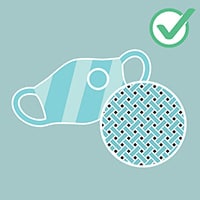
  • Multiple layers of tightly woven, breathable fabric
  • Nose wire
  • Fabric that blocks light when held up to bright light source
mask considerations tightly woven

Do NOT wear cloth masks with

  • Gaps around the sides of the face or nose
  • Exhalation valves, vents, or other openings (see example)
  • Single-layer fabric or those made of thin fabric that don’t block light
  • Wet or dirty material.

    Procedure Masks

    Disposable procedure masks are widely available. They are sometimes referred to as surgical masks or medical procedure masks.

    Wear procedure masks with

    • A proper fit over your nose, mouth, and chin to prevent leaks
    • Multiple layers of non-woven material
    • A nose wire
    Disposable masks are widely available.

    Do NOT wear procedure masks with

    • Gaps around the sides of the face or nose (see example)
    • Wet or dirty material.."
      Face masks
       

Thursday, September 30, 2021

Types of Masks and Respirators

"Summary of Recent Changes, Updates as of September 23, 2021

  • Added section on considerations for children

Updates as of September 10, 2021

  • Made minor updates to the sections on Cloth Masks and Disposable Masks
  • Updated the section on Masks that Meet a Standard
  • Added section about Respirators that Meet International Standards (e.g., KN95s)
  • Added considerations for use of NIOSH-approved respirators because the availability of NIOSH-approved N95 respirators has increased significantly over the last several months
  • Added section on Alternative Masks for Special Situations
  • Updated section on Choosing a Mask or Respirator for Different Situations

This page describes different types of masks and respirators you can use to protect yourself and others from getting and spreading COVID-19.

Masks are designed to contain your respiratory droplets and particles. They also provide you some protection from particles expelled by others.

Respirators are designed to protect you from particles, including the virus that causes COVID-19, and in doing so they also contain your respiratory droplets and particles so you do not expose others.

CDC continues to learn more about the effectiveness of different types of masks and respirators for preventing COVID-19.

Masks

Cloth Masks

Cloth Masks can be made from a variety of fabrics and many types of cloth masks are available.

Wear cloth masks with

  • A proper fit over your nose and mouth to prevent leaks
  • Multiple layers of tightly woven, breathable fabric
  • Nose wire
  • Fabric that blocks light when held up to bright light source
mask considerations tightly woven

Do NOT wear cloth masks with

  • Gaps around the sides of the face or nose
  • Exhalation valves, vents, or other openings (see example)
  • Single-layer fabric or those made of thin fabric that don’t block light
  •  

 Disposable Masks

Disposable face masks are widely available. They are sometimes referred to as surgical masks or medical procedure masks.

Wear disposable masks with

  • A proper fit over your nose and mouth to prevent leaks
  • Multiple layers of non-woven material
  • Nose wire
Disposable masks are widely available.

Do NOT wear disposable masks with

Wednesday, September 15, 2021

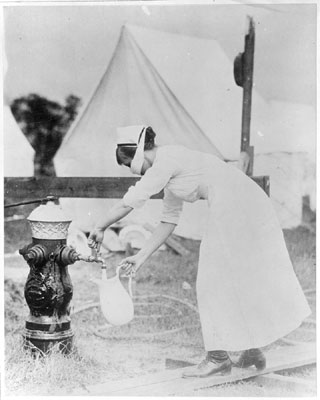
urse wearing a mask as protection against influenza. September 13, 1918."

"
The influenza epidemic of 1918 first emerged without warning in late spring of 1918, and was known as the "three-day fever." Few deaths were reported and victims recovered after a few days. When the disease surfaced again that fall, it was far more severe. One fifth of the world's population was attacked by this deadly virus. Within months, it had killed more people than any other illness in recorded history..."
Influenza 1918 

Thursday, September 9, 2021

Face Covering Emergency Order #2

"ORDER OF PUBLIC HEALTH MADISON & DANE COUNTY
DATE OF ORDER: September 9, 2021 Goes into effect September 10, 2021 at 12:01 a.m.
FACE COVERING EMERGENCY ORDER #2

Reducing the spread of illness, preventing severe outcomes, and preventing death are foundational public health goals of managing the pandemic. Due to the prevalent spread of the Delta variant of COVID-19, the Centers for Disease Control and Prevention (CDC) released guidance which indicated individuals in areas with a substantial or high transmission rate of COVID-19 should wear face coverings whenever they are indoors in public places. Madison and Dane County have a high transmission rate of COVID-19. While Dane County has a high vaccination rate, evidence has emerged from the CDC and locally that fully vaccinated people who do become infected with the Delta variant can be infectious and can spread the virus to others. The rate of cases in Dane County has risen rapidly since the Delta variant became dominant; on July 19, our 7-day average number of cases was 19, and on August 12, the 7-day average increased by 382% to 91.6. Since August 12, the rate of increase has slowed, but the 7- day average still increased by 13% to 103.9.

Vaccines are still highly effective in preventing severe outcomes from COVID, even with the Delta variant, and are also still effective, but less so, in preventing infection. Over the past four weeks (August 8 to September 4), cases among unvaccinated people have increased significantly by 21%, whereas cases among vaccinated people have been stable. Considering the high transmissibility of the Delta variant, masking, distancing, and ventilation remain key prevention tools. In order to prevent more severe outcomes and to protect those who are unable to be vaccinated, such as children under the age of 12, and those for whom vaccination may be less effective, such as people who are immunocompromised, face coverings will be required in most indoor situations in Dane County.

Based upon the foregoing, I, Janel Heinrich, Public Health Officer of Madison and Dane County, by the authority vested in me by the Laws of the State, including, but not limited to, Wis. Stats. Page 2 Secs. 252.03(1), (2) and (4), order the following as necessary to prevent, suppress, and control the spread of COVID-19:

1. Face Coverings. Face covering means a piece of cloth or other material that is worn to cover the nose and mouth completely. A face covering must be secured to the head with ties, ear loops, or elastic bands that go behind the head and must fit snuggly but comfortably against the side of the face. Cloth face coverings must be made with two or more layers of breathable fabric that is tightly woven (i.e., fabrics that do not let light pass through when held up to a light source). A face covering does not include bandanas, single layer neck gaiters, face shields, goggles, scarves, ski masks, balaclavas, shirt or sweater collars pulled up over the mouth and nose, or masks with slits, exhalation valves, or punctures.

a. Face Covering Required. Every individual, age two (2) and older, shall wear a face covering when:

i. In any enclosed space open to the public where other people, except for members of the person’s own household or living unit are present.
ii. Driving or riding in any form of public transportation.

b. Exceptions. Individuals who are otherwise required to wear a face covering may remove the face covering in the following situations:
i. While eating or drinking.
ii. When communicating with an individual who is deaf or hard of hearing and communication cannot be achieved through other means.
iii. While obtaining a service that requires the temporary removal of the face covering, such as dental services.
iv. While sleeping.
v. While swimming or on duty as a lifeguard.
vi. When engaging in work where wearing a face covering would create a risk to the individual, as determined by government safety guidelines.
vii. When necessary to confirm the individual’s identity, including when entering a financial institution.
viii. When federal or state law or regulations permit the removal of a face covering. 
ix. When actively playing a wind instrument that has a fabric bell cover, or similar cover, that acts as a face covering over the instrument, as long as individuals are spaced at least six (6) feet apart at all times.
x. While presenting or performing a religious, political, media, educational, artistic, cultural, musical, theatrical or any other type of presentation for an audience, as long as:

A. Everyone at the presentation or event is fully vaccinated. Fully vaccinated means: Two (2) weeks after an individual’s second dose in a 2-dose vaccine series for COVID-19 (such as Pfizer-BioNTech’s or Moderna’s vaccine) or two (2) weeks after their first dose in a single-dose vaccine series for COVID-19 (such as Johnson & Johnson’s Janssen vaccine); and B. The presenters and performers maintain at least six (6) feet distance from all attendees at all times

B. The presenters and performers maintain at least six (6) feet distance from all attendees at all times.
 

 c. The following individuals are exempt from the face covering requirement in Section 1.a. of this Order: i. Children under the age of two (2). ii. Individuals who are unconscious, incapacitated, or otherwise unable to remove the face covering without assistance. iii. Individuals with medical conditions, intellectual or developmental disabilities, mental health conditions, or other sensory sensitivities that prevent the individual from wearing a face covering..."
Face covering/Public Health Madison&Dane County 

Wednesday, August 18, 2021

PUBLIC HEALTH MADISON & DANE COUNTY: FACE COVERING EMERGENCY ORDER

"DATE OF ORDER: August 17, 2021 Goes into effect August 19, 2021 at 12:01 a.m.

Reducing the spread of illness, preventing severe outcomes, and death are foundational public health goals of managing the pandemic. Due to the prevalent spread of the Delta variant of COVID-19, the Centers for Disease Control and Prevention (CDC) released guidance which indicated individuals in areas with a substantial or high transmission rate of COVID-19 should wear face coverings whenever they are indoors in public places. Madison and Dane County have a high transmission rate of COVID-19. While Dane County has a high vaccination rate, evidence has emerged from the CDC and locally that fully vaccinated people who do become infected with the Delta variant can be infectious and can spread the virus to others. The rate of cases in Dane County has risen rapidly since the Delta variant became dominant; on July 19, our 7-day average number of cases was 19, and on August 12, the 7-day average increased by 382% to 91.6.

Vaccines are still highly effective in preventing severe outcomes from COVID, even with the Delta variant, and are also still effective, but less so, in preventing infection. Considering the high transmissibility of the Delta variant, masking, distancing, and ventilation remain key prevention tools. In order to prevent more severe outcomes and to protect those who are unable to be vaccinated, such as children under the age of 12, and those for whom vaccination may be less effective, such as people who are immunocompromised, face coverings will be required in most indoor situations in Dane County.

Based upon the foregoing, I, Janel Heinrich, Public Health Officer of Madison and Dane County, by the authority vested in me by the Laws of the State, including, but not limited to, Wis. Stats. Secs. 252.03(1), (2) and (4), order the following as necessary to prevent, suppress, and control the spread of COVID-19:

 Face Coverings.


Face covering means a piece of cloth or other material that is worn to cover the nose and mouth completely. A face covering must be secured to the head with ties, ear loops, or elastic bands that go behind the head and must fit snuggly but comfortably against the side of the face. Cloth face coverings must be made with two or more layers of breathable fabric that is tightly woven (i.e., fabrics that do not let light pass through when held up to a light source). A  face covering does not include bandanas, single layer neck gaiters, face shields, goggles, scarves, ski masks, balaclavas, shirt or sweater collars pulled up over the mouth and nose, or masks with slits, exhalation valves, or punctures.

a. Face Covering Required.

Every individual, age two (2) and older, shall wear a face covering when:
i. In any enclosed space open to the public where other people, except for members of the person’s own household or living unit are present.
ii. Driving or riding in any form of public transportation.

b. Exceptions.

Individuals who are otherwise required to wear a face covering may remove the face covering in the following situations:
i. While eating or drinking.
ii. When communicating with an individual who is deaf or hard of hearing and communication cannot be achieved through other means.
iii. While obtaining a service that requires the temporary removal of the face covering, such as dental services.
iv. While sleeping.
v. While swimming or on duty as a lifeguard.
vi. When engaging in work where wearing a face covering would create a risk to the individual, as determined by government safety guidelines.
vii. When necessary to confirm the individual’s identity, including when entering a financial institution.
viii. When federal or state law or regulations permit the removal of a face covering..."
Madison/Dane County Face Covering 

Wednesday, May 19, 2021

Public Health Will Lift All Dane County Orders June 2

"Remarks from 5/18/2021 news conference, video is available here .
Today, we announced that effective on June 2, all public health orders in Dane County, including mask requirements and gathering and capacity limits, will be lifted.


Good afternoon. It is with great hope and excitement that I am here to announce that we will not be issuing a new order once the current order expires on June 2. We have come to this decision because of our county’s steep decline in COVID activity, incredible progress in vaccination, and the science that shows how effective COVID vaccines are. Dane County is doing incredibly well. We are one of the most highly vaccinated counties in the entire country.  As of this morning--- 63% of Dane County residents have had at least one dose. Our case counts have dropped dramatically—our seven day average of cases per day is at 25, levels which we haven’t seen since last June—even as variants have become more predominant. We have been in a stable or declining state of COVID activity, with daily increasing vaccine coverage, for almost all of 2021. There is simply less and less COVID virus circulating in our communities, thanks to the incredible effectiveness of the COVID-19 vaccines. Our public health order and will end on June 2nd.  At that time we estimate that nearly 75% of our eligible Dane County population will be vaccinated—meaning all those ages 12 and up.
 

It has been a long road of restrictions during this pandemic—restrictions that were necessary to keep Dane County residents safe and healthy, but that also have been incredibly difficult. The pandemic started with decisions no one wanted to make—to shut down and stay home to stop the spread of the virus. One year ago today, on May 18th, 2020, we put out our first Forward Dane plan—a framework to navigate this pandemic locally. And finally, one year later, we can see the end in sight.

By staying home, social distancing, and wearing masks, we were able to protect each other and care for each other. Thanks to your incredible efforts, we have one of the lowest death rates in the state despite being a population center, and we are now leaders in vaccine coverage. Our community has been supported with a robust network of testing and vaccine providers, as well as an amazing contact tracing team. Although orders will end, these efforts will continue. We will continue to make testing available, support vaccine access, and follow up with people who test positive to prevent the spread of COVID to others.

We hope that one by one, as people continue to make the choice to get the vaccine, we will see the pandemic fade out. As we transition into this new time of widespread vaccination, we are able to move past policy requirements and into a time of joy and celebration--  hugging or sharing a meal with loved ones; listening to live music; or taking a trip. We are not yet back to normal, but we are at a point where we the light is growing brighter every day.

I am deeply grateful for all that the people of Dane County have given this past year. Thank you for caring for each other, for doing the hard work to get us to this place of celebration. And, thank you to everyone who has gotten vaccinated so far. If you haven’t had the chance, I encourage those who are not yet vaccinated to head to the Alliant Energy Center or find another accessible vaccine clinic today to get your dose. Together, through getting vaccinated, we will have a summer of celebration and joy after a long year of isolation. Thank you.."
Dane County lifts face masks 

Wednesday, May 5, 2021

Dane County Public Health Requirements for May 5, 2021

"Public Health Madison & Dane County has released Emergency Order #16 PDF . An order overview is below, but please check the full order PDF  for details.


Face Coverings

Requirements for face coverings are mostly unchanged from Order #15, except one bullet point was added to the exceptions:

  • Face coverings are required for people ages five and older when in any enclosed building with people you don’t live with, in line to enter any enclosed building, and while driving or riding in vehicles with people you don’t live with.
  • Certain exceptions exist for fully vaccinated people. Details are below.
  • Face coverings are recommended but not required in all other settings, including outdoors when it’s not possible to maintain six feet of physical distancing.
  • Face coverings are not required indoors when actively playing an instrument that has a bell cover or, similar cover, that acts as a face covering over the instrument, as long as individuals are spaced at least six feet apart at all times.

Gatherings

Indoor gathering limits increased but requirements for outdoor gatherings are unchanged from Order #15.

  • Indoor gatherings. Indoor gatherings are limited to 350 people or less, not including employees if food or drink is offered or provided. Indoor gatherings are limited to 500 people or less, not including employees if food or drink is not offered or provided. Indoor gatherings must also comply with the percentage capacity caps. In addition, gatherings must allow for 6 feet distancing between individuals not from the same household or living unit, except when in transit. Face coverings are required.
  • Outdoor gatherings. Numbers must be limited to ensure people who don’t live together can maintain six feet physical distancing at all times, except when in transit.

Schools, Childcare, and Youth Activities

Requirements for schools and childcare are unchanged from Order #15.  Youth activities have been added to this section.

Public and private schools, childcare, and youth activities  must develop and implement a written hygiene, cleaning, and protective measures policies (see page 3 of order for details on what must be included in those policies). Entities must document staff receipt, acknowledgement, or training of these policies. Schools must implement Public Health Madison & Dane County’s action plan for COVID-19 cases PDF  at a school.


Sports

Requirements related to sports unchanged from Order #15.

  • Distancing is required at all times between people who don’t live together except when actively participating in the sport.
  • Face coverings are required when sports are played indoors.
  • Sports must follow gathering limit requirements.
  • Sports must develop and implement written hygiene, cleaning, and protective measure policies and the organizing entity must document their receipt, acknowledgement, or training.
  • Organizations must implement Public Health Madison & Dane County’s sports action plan PDF  for COVID-19 cases.

Businesses

Capacity limits increased for businesses, but all other requirements are the same from Order #15.

  • Businesses are limited to up to 75% of approved capacity levels indoors. Actual capacity level must still allow for 6 feet distancing between individuals not from the same household or living unit.
  • Businesses must develop and implement written hygiene, cleaning, and protective measure policies and must document staff receipt, acknowledgement, or training on these policies.
  • All businesses should, to the greatest extent possible, facilitate remote work and other measures that limit the number of individuals present at an office..."
    Dane County Public Health Requirements