"Summary of Recent Changes
Key Messages:
- Masking is a critical public health tool for preventing spread of COVID-19, and it is important to remember that any mask is better than no mask.
- To protect yourself and others from COVID-19, CDC continues to recommend that you wear the most protective mask you can that fits well and that you will wear consistently.
- Masks and respirators are effective at reducing transmission of SARS-CoV-2, the virus that causes COVID-19, when worn consistently and correctly.
- Some masks and respirators offer higher levels of protection than others, and some may be harder to tolerate or wear consistently than others. It is most important to wear a well-fitted mask or respirator correctly that is comfortable for you and that provides good protection.
- While all masks and respirators provide some level of protection, properly fitted respirators provide the highest level of protection. Wearing a highly protective mask or respirator may be most important for certain higher risk situations, or by some people at increased risk for severe disease.
- CDC’s mask recommendations provide information that people can use to improve how well their masks protect them.
This page describes different types of masks and respirators that you can use to protect yourself and others from getting and spreading COVID-19. Masks and respirators can provide varying degrees of protection, with well-fitting National Institute for Occupational Safety and Health (NIOSH)-approved respirators offering the most protection. Masking is a critical public health tool for preventing spread of COVID-19, and it is important to remember that any mask is better than no mask. This page presents options in order of least to most protective. To protect yourself and others from COVID-19, CDC continues to recommend that you wear the most protective mask you can that fits well and that you will wear consistently.
Types of Masks and Respirators
Masks are made to contain droplets and particles you breathe, cough, or sneeze out. If they fit closely to the face, they can also provide you some protection from particles spread by others, including the virus that causes COVID-19.
Respirators are made to protect you by filtering the air and fitting closely on the face to filter out particles, including the virus that causes COVID-19. They can also contain droplets and particles you breathe, cough, or sneeze out so you do not spread them to others.
Choosing a Mask or Respirator for Different Situations
Masks and respirators (i.e., specialized filtering masks such as “N95s”) can provide different levels of protection depending on the type of mask and how they are used. Loosely woven cloth products provide the least protection, layered finely woven products offer more protection, well-fitting disposable surgical masks and KN95s offer even more protection, and well-fitting NIOSH-approved respirators (including N95s) offer the highest level of protection.
Whatever product you choose, it should provide a good fit (i.e., fitting closely on the face without any gaps along the edges or around the nose) and be comfortable enough when worn properly (covering your nose and mouth) so that you can keep it on when you need to. Learn how to improve how well your mask protects you by visiting CDC’s Improve How Your Mask Protects You page.
A respirator has better filtration, and if worn properly the whole time it is in use, can provide a higher level of protection than a cloth or procedural mask. A mask or respirator will be less effective if it fits poorly or if you wear it improperly or take it off frequently. A respirator may be considered in certain situations and by certain people when greater protection is needed or desired.
- When caring for someone who is sick with COVID-19.
- If you are at increased risk for severe illness, for example, people who are immunocompromised, older adults, and people with certain underlying medical conditions.
- When working at a job where you interact with large numbers of the public, especially when not everyone is consistently wearing a mask. For example, bus drivers and grocery store workers.
- When riding on planes, buses, trains, or other forms of public transportation*, especially if it is for a long period of time on crowded conveyances.
- When physical distancing is not possible or when you are in crowded indoor or outdoor public settings.
- If you are not up to date on COVID-19 vaccinations.
*Note: The options listed on this page may be used to fulfill the requirements of CDC’s Mask Order for public transportation. Learn more about attributes of masks needed to fulfill the requirements of the Order at this website.
Masks
When choosing a mask, look at how well it fits. Gaps can let air with respiratory droplets leak in and out around the edges of the mask. Gaps can be caused by choosing the wrong size or type of mask and when a mask is worn with facial hair.
It is important to check that it fits snugly over your nose, mouth, and chin.
- Check for gaps by cupping your hands around the outside edges of the mask.
- Make sure no air is flowing from the area near your eyes or from the sides of the mask.
- If the mask has a good fit, you will feel warm air come through the front of the mask and may be able to see the mask material move in and out with each breath.
Cloth Masks
Cloth Masks can be made from a variety of fabrics and many types of cloth masks are available.
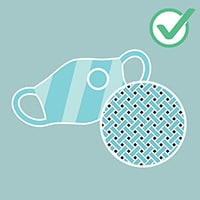
Wear cloth masks with
- A proper fit over your nose, mouth, and chin to prevent leaks
- Multiple layers of tightly woven, breathable fabric
- Nose wire
- Fabric that blocks light when held up to bright light source
Do NOT wear cloth masks with
- Gaps around the sides of the face or nose
- Exhalation valves, vents, or other openings (see example)
- Single-layer fabric or those made of thin fabric that don’t block light
- Wet or dirty material.
Procedure Masks
Disposable procedure masks are widely available. They are sometimes referred to as surgical masks or medical procedure masks.
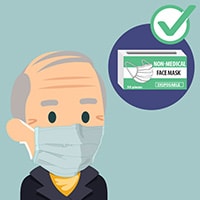
Wear procedure masks with
- A proper fit over your nose, mouth, and chin to prevent leaks
- Multiple layers of non-woven material
- A nose wire
Do NOT wear procedure masks with
- Gaps around the sides of the face or nose (see example)
- Wet or dirty material.."
Face masks


