Showing posts with label mask_wearing. Show all posts

Wednesday, April 28, 2021

Interim Public Health Recommendations for Fully Vaccinated People

"Summary of Recent Changes

  • Guiding principles for fully vaccinated people are now provided.
  • Underscores that immunocompromised people need to consult their healthcare provider about these recommendations, even if fully vaccinated.
  • Fully vaccinated people no longer need to wear a mask outdoors, except in certain crowded settings and venues.
  • Clarification that fully vaccinated workers no longer need to be restricted from work following an exposure as long as they are asymptomatic.
  • Fully vaccinated residents of non-healthcare congregate settings no longer need to quarantine following a known exposure.
  • Fully vaccinated asymptomatic people without an exposure may be exempted from routine screening testing, if feasible.

Key Points

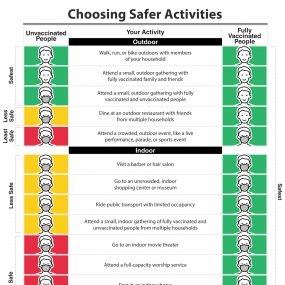
choosingSaferActivities

This set of public health recommendations for fully vaccinated people will be updated and expanded based on the level of community spread of SARS-CoV-2, the proportion of the population that is fully vaccinated, and the rapidly evolving science on COVID-19 vaccines.

For the purposes of this guidance, people are considered fully vaccinated for COVID-19 ≥2 weeks after they have received the second dose in a 2-dose series (Pfizer-BioNTech or Moderna), or ≥2 weeks after they have received a single-dose vaccine (Johnson and Johnson (J&J)/Janssen).±

± This guidance applies to COVID-19 vaccines currently authorized for emergency use by the U.S. Food and Drug Administration: Pfizer-BioNTech, Moderna, and Johnson and Johnson (J&J)/Janssen COVID-19 vaccines.  This guidance can also be applied to COVID-19 vaccines that have been authorized for emergency use by the World Health Organization (e.g. AstraZeneca/Oxford).

The following recommendations apply to non-healthcare settings. For related information for healthcare settings, visit Updated Healthcare Infection Prevention and Control Recommendations in Response to COVID-19 Vaccination.

Fully vaccinated people can:

  • Visit with other fully vaccinated people indoors without wearing masks or physical distancing
  • Visit with unvaccinated people (including children) from a single household who are at low risk for severe COVID-19 disease indoors without wearing masks or physical distancing
  • Participate in outdoor activities and recreation without a mask, except in certain crowded settings and venues
  • Resume domestic travel and refrain from testing before or after travel or self-quarantine after travel
  • Refrain from testing before leaving the United States for international travel (unless required by the destination) and refrain from self-quarantine after arriving back in the United States
  • Refrain from testing following a known exposure, if asymptomatic, with some exceptions for specific settings
  • Refrain from quarantine following a known exposure if asymptomatic
  • Refrain from routine screening testing if asymptomatic and feasible

For now, fully vaccinated people should continue to:

  • Take precautions in indoor public settings like wearing a well-fitted mask
  • Wear well-fitted masks when visiting indoors with unvaccinated people who are at increased risk for severe COVID-19 disease or who have an unvaccinated household member who is at increased risk for severe COVID-19 disease
  • Wear well-fitted masks when visiting indoors with unvaccinated people from multiple households
  • Avoid indoor large-sized in-person gatherings
  • Get tested if experiencing COVID-19 symptoms
  • Follow guidance issued by individual employers
  • Follow CDC and health department travel requirements and recommendations.."
    Recommendations for fully vaccinated
     

Thursday, April 15, 2021

Legal Issues Related to Transportation Mask-Wearing Mandates

"On January 21, 2021, President Joe Biden issued an executive order directing federal agencies to require mask wearing in a range of transportation contexts nationwide. In response, the Centers for Disease Control and Prevention (CDC) issued an order (Mask Order) requiring mask wearing on commercial and public transportation. A number of other federal agencies have since taken additional actions to support the enforcement of these mask-wearing requirements. This Legal Sidebar provides a brief overview of the CDC’s Mask Order and the role of other federal agencies in enforcing its requirements. It then discusses a number of related legal considerations for Congress, including the scope of the federal government’s authority to impose mask-wearing requirements in transportation contexts.

CDC Mask Order

The Mask Order requires passengers and personnel on covered modes of transportation and at transportation hubs to wear masks that cover the mouth and nose. The CDC also has issued guidance listing the specific attributes of masks that satisfy CDC requirements. The Mask Order applies broadly across commercial and public transportation, such as aircraft, trains, buses, ferries, and taxis, as well as at transportation hubs, such as airports and train stations. Operators of covered modes of transportation and transportation hubs must use “best efforts” to ensure that individuals comply with the mask-wearing requirements. The Mask Order contains a number of exclusions, such as exempting certain people with disabilities and children under two years of age from the mask mandate. The order does not apply in states or localities that enforce mask-wearing requirements providing “the same level of public health protection” as the CDC’s requirements.

Enforcement


The CDC states that it may enforce the mask-wearing requirements through criminal penalties, but that it “does not intend to rely primarily on these criminal penalties.” Instead, the CDC expects widespread voluntary compliance, as well as support from other federal agencies in implementing civil enforcement measures. A number of federal agencies have now taken such action..."
Transportation mask-wearing