Showing posts with label immigration. Show all posts

Thursday, August 5, 2021

DHS Statement on Updated CDC Order

"“As part the United States’ COVID-19 mitigation efforts, DHS will continue to process individuals in accordance with the CDC’s updated Title 42 Order. Title 42 is not an immigration authority, but a public health authority, and its continued use is dictated by CDC and governed by the CDC's analysis of public health factors.

“Under Title 42, DHS continues to expel the majority of single adults, and, to the extent possible, families encountered at the Southwest Border.

“While we continue to defer to public health experts on decisions related to Title 42, the Biden-Harris Administration continues to work to build a fair, orderly, and humane immigration system, including by expanding lawful pathways to the United States and discouraging irregular migration. DHS recently expanded the Central American Minors program and made 6,000 H-2B visas available for Central Americans. DHS last week also resumed expedited removal flights for certain families who recently arrived at the southern border, cannot be expelled under Title 42, and do not have a legal basis to stay in the United States.”
CDC order/ COVID-19

Friday, January 22, 2021

Executive Order on the Revision of Civil Immigration Enforcement Policies and Priorities


"By the authority vested in me as President by the Constitution and the laws of the United States of America, it is hereby ordered as follows:

Section 1.  Policy.

Immigrants have helped strengthen America’s families, communities, businesses and workforce, and economy, infusing the United States with creativity, energy, and ingenuity.  The task of enforcing the immigration laws is complex and requires setting priorities to best serve the national interest.  The policy of my Administration is to protect national and border security, address the humanitarian challenges at the southern border, and ensure public health and safety.  We must also adhere to due process of law as we safeguard the dignity and well-being of all families and communities.  My Administration will reset the policies and practices for enforcing civil immigration laws to align enforcement with these values and priorities. 
 

Sec. 2.  Revocation.

Executive Order 13768 of January 25, 2017 (Enhancing Public Safety in the Interior of the United States), is hereby revoked.  The Secretary of State, the Attorney General, the Secretary of Homeland Security, the Director of the Office of Management and Budget, the Director of the Office of Personnel Management, and the heads of any other relevant executive departments and agencies (agencies) shall review any agency actions developed pursuant to Executive Order 13768 and take action, including issuing revised guidance, as appropriate and consistent with applicable law, that advances the policy set forth in section 1 of this order.."
Civil Immigration Enforcement 

Friday, January 1, 2021

DHS Releases Detailed Immigration Data

"Today the Department of Homeland Security (DHS) released the Fiscal Year 2020 Enforcement Lifecycle Report, which provides a comprehensive analysis of enforcement outcomes for aliens encountered at the Southwest Border during Fiscal Years 2014 through 2019.  Unlike previous DHS reports, the Office of Immigration Statistics (OIS) Enforcement Lifecycle methodology links records across 19 different DHS and Department of Justice (DOJ) source systems to match each unique border encounter to its associated final or most current enforcement outcome and so provides a complete end-to-end view of immigration enforcement.

“The Trump Administration has worked tirelessly to fix our broken immigration system,” said Acting DHS Deputy Secretary Ken Cuccinelli. “With this comprehensive report the Department analyzes the patterns of flow, the demographic backgrounds, and other factors so we can see areas for improvement, where to close loopholes and more effectively enforce the laws that allow for the removal of illegal aliens and those who are trying to game our immigration system.”

The report indicates U.S. Customs and Border Protection (CBP) apprehended 2.8 million aliens between ports of entry along the Southwest Border between Fiscal Year 2014 and 2019 and found an additional 725,000 aliens inadmissible at ports of entry. The report found, significantly, that as of the second quarter of FY 2020, only approximately 8 percent of those encounters had resulted in an alien being granted relief or protection from removal. Further, roughly half of aliens encountered between 2014 and 2019 remained in the United States as of the second quarter of FY 2020. Specifically:

- Only 59 percent of the 3.5 million Southwest Border encounters between 2014 and 2019 had been resolved through a final outcome of repatriation or relief/protection from removal as of FY 2020 Q2..."
Immigration statistics 

Monday, December 23, 2019

Immigration, Citizenship, and the Federal Justice System, 1998-2018

"This report highlights trends in federal arrests and prosecutions by the country of citizenship of persons processed through the federal criminal justice system. It shows changes from 1998 through 2018. The report provides statistics on law enforcement and prosecutions along the U.S.-Mexico border, as well as in non-border areas. It shows the number of suspects arrested and prosecuted for both immigration and non-immigration offenses, including by their citizenship status. It details activities for all 94 federal judicial districts, while also separately detailing activities for the 5 districts along the U.S.-Mexico border..." 
Immigration and federal arrests

Thursday, November 21, 2019

Immigration, Citizenship, and the Federal Justice System, 1998-2018

"This report highlights trends in federal arrests and prosecutions by the country of citizenship of persons processed through the federal criminal justice system. It shows changes from 1998 through 2018. The report provides statistics on law enforcement and prosecutions along the U.S.-Mexico border, as well as in non-border areas. It shows the number of suspects arrested and prosecuted for both immigration and non-immigration offenses, including by their citizenship status. It details activities for all 94 federal judicial districts, while also separately detailing activities for the 5 districts along the U.S.-Mexico border. (See map on page 6.)

The statistical findings in this report are based on data from the Bureau of Justice Statistics’ Federal Justice Statistics Program (FJSP). The FJSP receives administrative data from six federal justice agencies: the U.S. Marshals Service, Drug Enforcement Administration, Executive Office for U.S. Attorneys, Administrative Office of the U.S. Courts, U.S. Sentencing Commission, and Federal Bureau of Prisons. BJS links and standardizes this information to maximize comparability and to facilitate analysis across and within agencies over time."
Imigration and citizenship

Wednesday, October 30, 2019

Law of Immigration Detention: A Brief Introduction

"The Immigration and Nationality Act (INA) authorizes— and in some cases requires—the Department of Homeland Security (DHS) to detain non-U.S. nationals (aliens) who are subject to removal from the United States. This detention scheme is multifaceted, with rules that turn on several factors, such as whether the alien is seeking admission or has been lawfully admitted into the country; whether the alien has engaged in certain proscribed conduct; and whether the alien has been issued a final order of removal. This In Focus provides a brief introduction to the immigration detention framework. For a more detailed discussion, see CRS Report R45915, Immigration Detention: A Legal Overview, by Hillel R. Smith..."
Immigration detention

Wednesday, March 6, 2019

Humanitarian and Security Crisis at Southern Border Reaches 'Breaking Point'

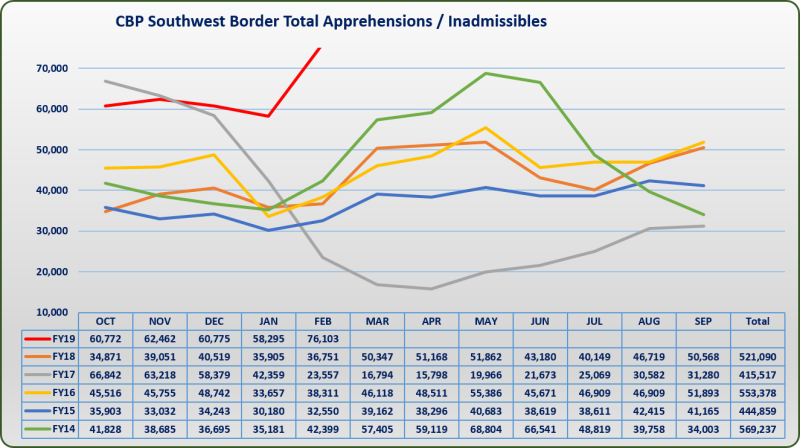
"Illegal Immigration Hits 12-Year High; More than 76,000 Migrants Cross in February

The U.S. Border Patrol is currently encountering illegal immigration at the highest rates since 2007, according to new data. In fact, in February more than double the level of migrants crossed the border without authorization compared to the same period last year, approaching the largest numbers seen in any February in the last 12 years, The New York Times reported.
“The truth is that the politics and policies of open borders have failed the American people. Our broken system endures, and the ongoing humanitarian and security crisis at our Southwest Border leaves many minors and families at extreme risk of being exploited by traffickers, human smugglers, gangs, and other nefarious actors seeking to profit at their expense,” said Secretary of Homeland Security Kirstjen M. Nielsen. “Activist courts, congressional inaction, and criminals intent on breaking our laws stand in the way of confronting illegal and uncontrolled migration threatening our safety and security. What was a crisis, is now a full-fledged emergency.”
“This cannot be a partisan issue,” Nielsen continued. “Every DHS Secretary since the Department’s inception has sounded the alarm about our unsecured border and its consequences. The American people and our law enforcement personnel rightfully demand effective border security: building the wall, strengthening our laws, and giving the men and women serving on the front lines the tools and resources they need to keep Americans safe. To that end, this Department pledges our unwavering resolve to confronting present and ever-evolving future threats to our national security at our Southwest Border.”
CBP Southwest Border Total Apprehensions / Inadmissibles..."Border security

Monday, June 18, 2018

Frequently Asked Questions: Zero Tolerance Immigration Prosecutions

"The Attorney General directed United States Attorneys on the Southwest Border to prosecute all amenable adults who illegally enter the country, including those accompanied by their children, for 8 U.S.C. § 1325(a), illegal entry. Children whose parents are referred for prosecution will be placed with the Department of Health and Human Services (HHS), Office of Refugee Resettlement (ORR). The following are Frequently Asked Questions regarding Zero Tolerance Immigration Prosecutions.

Why Are Parents Being Separated From Their Children?

The Department of Homeland Security (DHS) may separate a parent or legal guardian from his or her child for several reasons, including situations where DHS cannot ascertain the parental relationship, when DHS determines that a child may be at risk with the presumed parent or legal guardian, or if a parent or legal guardian is referred for criminal prosecution, including for illegal entry.

Where Are Children Going?

Alien children who are separated from their parents or legal guardians will be transferred to the Department of Health and Human Services, Office of Refugee Resettlement (HHS ORR).

What Happens to Children in HHS Custody?

HHS ORR provides care for all alien children in its custody, to include medical care, mental health care, educational services, and other services.  HHS also works to locate a sponsor (parent, guardian, other adult relative, or foster care provider) for the children in its custody, for purposes of releasing the child from government custody.

What Happens After Criminal Prosecution?

Parents or legal guardians who are charged with illegal entry will be transferred from DHS to the Department of Justice, where they will be presented to a judge for a hearing on their criminal case.  After completion of criminal proceedings, they will be transferred to U.S. Immigration and Customs Enforcement (ICE) for immigration proceedings.
Any individual who is subject to removal may, in the course of immigration proceedings, seek asylum or other relief or protection from removal.  The fact that an individual was prosecuted for illegal entry does not affect this right.
HHS and ICE can take steps to facilitate family reunification, for purposes of removal, if the potential sponsor is capable of providing for the physical and mental well-being of the child..and comports with the wishes of the parent or legal guardian. 
Children may also present an individual claim for asylum or other relief or protection from removal, and depending on the circumstances, may undergo separate immigration proceedings.

How Can I Communicate With My Child?

For parents or legal guardians detained in ICE custody, ICE and HHS will work to schedule regular communication with their children in HHS custody, through telephone and/or video conferencing.
Additionally, individuals may locate and communicate with their children through the following methods:
  • HHS Parent Hotline (24 hours a day, 7 days a week, in both English and Spanish):
    • If calling from outside an ICE detention facility, call 1-800-203-7001.
    • If calling from an ICE detention facility, dial 699# on the free call platform.
    • Please note that you will need to provide the child’s full name, date of birth, and country of origin.  It is also helpful to provide the child’s alien registration number, if you know it.
  • Email ORR at information@ORRNCC.com.."
    Immigration prosecution

Fact Sheet: Zero Tolerance Immigration Prosecutions - Families

"The risks of crossing the Rio Grande and desert terrain, or hiding in stash houses or tractor trailers, are high for adults and even more deeply concerning for children.  Individuals who seek to enter the United States should do so at ports of entry.
The Attorney General directed United States Attorneys on the Southwest Border to prosecute all amenable adults who illegally enter the country, including those accompanied by their children, for 8 U.S.C. § 1325(a), illegal entry. 
Children whose parents are referred for prosecution will be placed with the Department of Health and Human Services (HHS), Office of Refugee Resettlement (ORR).
The information below provides information about:
  • Care for children
  • Family communication processes
  • The removal process

Additional Information


Thursday, October 26, 2017

Improved Security Procedures for Refugees Entering the United States

"Today, President Donald J. Trump announced the implementation of improved security procedures for refugees entering the United States. These new measures are part of the administration’s effort to raise national security standards for all persons traveling to the United States, and they are designed to intensify screening in order to keep nefarious and fraudulent actors from exploiting the refugee process to enter the United States.  The measures come at the end of a 120-day “pause” on refugee resettlement, while the United States government conducted a thorough review of the existing program.
“The security of the American people is this administration’s highest priority, and these improved vetting measures are essential for American security,” said Acting Secretary of Homeland Security Elaine Duke. “These new, standardized screening measures provide an opportunity for the United States to welcome those in need into our country, while ensuring a safer, more secure homeland.”
In accordance with section 6(a) of Executive Order 13780, the United States government, including the Departments of State (State) and Homeland Security (DHS), in consultation with the Office of the Director of National Intelligence (ODNI), conducted a review of the United States Refugee Admissions Program application and adjudication process. The goal of this review was to determine what additional procedures should be used to ensure that individuals seeking admission as refugees do not pose a threat to the security and welfare of the United States.
As a result of this review, the United States government is implementing program enhancements to raise the bar for vetting and screening procedures, including but not limited to:  increased data collection to more thoroughly investigate applicants, better information sharing between agencies to identify threat actors, and new training procedures to strengthen screener ability to detect fraud and deception..."
Refugees entering U.S.

Tuesday, May 2, 2017

Pursuant to Executive Order on Public Safety, Department of Justice Releases Data on Incarcerated Aliens

"
President Trump’s Executive Order on Public Safety in the Interior of the United States requires the Department of Justice to collect relevant data and provide quarterly reports on data collection efforts. The data in this release shows a significant prison population of incarcerated aliens.
“Illegal aliens who commit additional crimes in the United States are a threat to public safety and a burden on our criminal justice system,” said Attorney General Jeff Sessions. “This is why we must secure our borders through a wall and effective law enforcement, and we must strengthen cooperation between federal, state and local governments as we strive to fulfill our sacred duty of protecting and serving the American people.”
Below is a summary of data collected under Section 16 of the Order, which directs “the Secretary [of Homeland Security] and the Attorney General . . . to collect relevant data and provide quarterly reports” regarding the following subjects: (a) the immigration status of all aliens incarcerated under the supervision of the Bureau of Prisons; (b) the immigration status of all aliens incarcerated as federal pretrial detainees; and (c) the immigration status of all convicted aliens in state prisons and local detention centers throughout the United States..."

Incarcerated Aliens

Friday, April 21, 2017

How Does CBO Estimate the Effects of Proposed Legislation Affecting Immigration?

"When CBO’s Director testified at Congressional hearings at the beginning of February, he was asked some questions about how CBO analyzes potential changes to immigration policy. Because answers during Congressional hearings must be brief, this blog post provides additional information.

What Factors Does CBO Consider When Estimating the Economic Effects of Proposed Legislation Affecting Immigration?

In 2013, CBO published an economic analysis of the Border Security, Economic Opportunity, and Immigration Modernization Act (S. 744). That act would have revised laws governing immigration and the enforcement of those laws, allowing for a significant increase in the number of noncitizens who could lawfully enter the United States permanently or temporarily. The bill also would have created a process for many currently unauthorized residents to gain legal status, subject to their meeting conditions specified in the bill..."

Immigration legislation

Monday, March 20, 2017

DHS Releases U.S. Immigration and Customs Enforcement Declined Detainer Outcome Report

"The Department of Homeland Security today issued the U.S. Immigration and Customs Enforcement (ICE) Declined Detainer Outcome Report required by President Donald J. Trump’s Executive Order, Enhancing Public Safety in the Interior of the United States, signed on January 25.  This report will be issued weekly to highlight jurisdictions that choose not to cooperate with ICE detainers or requests for notification, therefore potentially endangering Americans. ICE places detainers on aliens who have been arrested on local criminal charges or who are in local custody and for whom ICE possesses probable cause to believe that they are removable from the United States, so that ICE can take custody of the alien when he or she is released from local custody...."
Declined detainer outcome report

Tuesday, March 7, 2017

Q&A: Protecting the Nation From Foreign Terrorist Entry To The United States

"Q1. Who is subject to the suspension of entry under the Executive Order?
Per the Executive Order, foreign nationals from Sudan, Syria, Iran, Libya, Somalia, and Yemen, who are outside the United States and who did not have a valid visa at 5 p.m. Eastern Standard Time on January 27, 2017, and do not have a valid visa on the effective date of this order are not eligible to enter the United States while the temporary suspension remains in effect. Thus any individual who had a valid visa either on January 27, 2017 (prior to 5:00 PM) or holds a valid visa on the effective date of the Executive Order is not barred from seeking entry...."
Foreign terrorist and safety

Saturday, January 28, 2017

Executive Authority to Exclude Aliens: In Brief

"The Immigration and Nationality Act (INA) provides that individual aliens outside the United States are “inadmissible”—or barred from admission to the country—on health, criminal, security, and other grounds set forth in the INA. However, the INA also grants the Executive several broader authorities that could be used to exclude certain individual aliens or classes of aliens for reasons that are not specifically prescribed in the INA.

Section 212(f) of the INA is arguably the broadest and best known of these authorities. It provides, in relevant part, that:
    Whenever the President finds that the entry of any aliens or of any class of aliens into the United States would be detrimental to the interests of the United States, he may by proclamation, and for such period as he shall deem necessary, suspend the entry of all aliens or any class of aliens as immigrants or nonimmigrants, or impose on the entry of aliens any restrictions he may deem to be appropriate..."

Executive Authority and aliens

Saturday, December 31, 2016

DHS Releases End of Year Fiscal Year 2016 Statistics

"Today the Department of Homeland Security (DHS) released its end of Fiscal Year (FY) 2016 statistics.  These statistics reflect the Department’s immigration enforcement efforts prioritizing convicted criminals and threats to public safety, border security and national security.
Overall, in FY 2016, the Department apprehended 530,250 individuals nationwide and conducted a total of 450,954 removals and returns. The U.S. Border Patrol (USBP) reported 415,816 apprehensions nationwide, compared to 337,117 in FY 2015; and U.S. Immigration and Customs Enforcement (ICE) arrested 114, 434 individuals, compared to 125,211 in FY 2015. Although apprehensions by the USBP in FY 2016 increased from FY 2015, they remain a fraction of the number of apprehensions routinely observed from the 1980s through 2008.  In addition, the U.S. Customs and Border Protection (CBP) Office of Field Operations (OFO) identified 274,821 inadmissible individuals at ports of entry, compared to 253,509 in FY 2015. ICE removed or returned 240,255 individuals in FY 2016, compared to 235,413 in FY 2015..."
Homeland Security statistics

Monday, September 12, 2016

2014 Yearbook of Immigration Statistics

"Statistical data on immigration have been published annually by the U .S . government since the 1860s . Over the years, the federal agencies responsible for reporting on immigration have changed, as have the content, format, and title of the annual publication . Currently, immigration data are published in the Yearbook of Immigration Statistics by the Office of Immigration Statistics in the Policy Directorate of the Department of Homeland Security.."
Immigration statistics

Friday, August 5, 2016

State Challenges to Federal Enforcement of Immigration Law: From the Mid-1990s to the Present

"States and localities can have significant interest in the manner and extent to which federal officials enforce provisions of the Immigration and Nationality Act (INA) regarding the exclusion and removal of unauthorized aliens. Depending upon the jurisdiction’s specific concerns, this interest can be expressed in various ways, from the adoption of “sanctuary” policies limiting the jurisdiction’s cooperation in federal enforcement efforts to the enactment of measures to deter unauthorized aliens from entering or remaining within the jurisdiction. In some cases, states or localities have also sued to compel federal officials to enforce the INA and other relevant laws.

In the mid-1990s, six states which were then home to over half the unauthorized aliens in the United States—Arizona, California, Florida, New Jersey, New York, and Texas—each filed suit alleging that federal officials’ failure to check unauthorized migration violated the Guarantee and Invasion Clauses of the Constitution, the Tenth Amendment, and provisions of the INA. Concerns regarding standing—or who is a proper party to seek relief from a federal court—were sometimes noted. However, even when standing was assumed, the constitutional claims were seen to involve nonjusticiable “political questions,” or failed on their merits. The states’ statutory claims were similarly seen to involve matters committed to agency discretion by law and, thus, not reviewable by the courts. In three cases, the courts also noted that federal officials’ alleged failure to control unauthorized migration did not constitute a reviewable “abdication” of their statutory duties...:
Immigration law

Wednesday, April 13, 2016

New Data on 637 Detention Facilities Used by ICE in FY 2015

"The U.S. Immigration and Customs Enforcement (ICE) detention system depends on hundreds of jails, prisons, and other facilities largely owned as well as run by others — some by local government agencies and others by private, for-profit companies. Using beds in these facilities that are widely scattered across the country, ICE manages a large complex system with daily flows of individuals both into as well as out of ICE custody. In addition, an even larger number of individuals already in ICE custody are continually being transferred among these facilities.

A total of 325,209 individuals left ICE custody last year, while 39,082 were still detained at the end of FY 2015[1]. The reasons for which individuals were released from ICE custody varied markedly by detention facility. Nationally, the most common reason for leaving ICE custody was because a detainee was being deported; this reason was listed in 55 percent of recorded departures last year. The next largest group were detainees released on bond or on their personal recognizance while their cases were pending. Others were released because their cases had concluded and they had been found to have a lawful right to remain in the country.."

ICE Detention data

Monday, February 8, 2016

State Challenges to Federal Enforcement of Immigration Law: Historical Precedents and Pending Litigation in Texas v. United States

"States and localities can have significant interest in the manner and extent to which federal officials enforce provisions of the Immigration and Nationality Act (INA) regarding the exclusion and removal of unauthorized aliens. Depending upon the jurisdiction’s specific concerns, this interest can be expressed in various ways, from the adoption of “sanctuary” policies limiting the jurisdiction’s cooperation in federal enforcement efforts to the enactment of measures to deter unauthorized aliens from entering or remaining within the jurisdiction. In some cases, states or localities have also sued to compel federal officials to enforce the INA and other relevant laws.

In the mid-1990s, six states which were then home to over half the unauthorized aliens in the United States—Arizona, California, Florida, New Jersey, New York, and Texas—each filed suit alleging that federal officials’ failure to check unauthorized migration violated the Guarantee and Invasion Clauses of the Constitution, the Tenth Amendment, and provisions of the INA. Concerns regarding standing—or who is a proper party to seek relief from a federal court—were sometimes noted. However, even when standing was assumed, the constitutional claims were seen to involve nonjusticiable “political questions,” or failed on their merits. The states’ statutory claims were similarly seen to involve matters committed to agency discretion by law and, thus, not reviewable by the courts. In three cases, the courts also noted that federal officials’ alleged failure to control unauthorized migration did not constitute a reviewable “abdication” of their statutory duties..."
Immigration law