Showing posts with label black_women. Show all posts

Tuesday, February 8, 2022

For Black Women, Implicit Racial Bias in Medicine May Have Far-Reaching Effects

"This past December, Vice President Kamala Harris launched the first Maternal Health Day of Action and announced a White House call to action to reduce maternal mortality and morbidity rates in the United States. Vice President Harris described it as a crisis for Black mothers and stressed the urgency of “pursuing systemic policies that provide comprehensive, holistic maternal health care … free from bias and discrimination.”

Indeed, the U.S. has among the highest maternal mortality rates in the developed world, and much of these deaths – 60%, according to the Centers for Disease Control and Prevention – are preventable. And even within this context, the likelihood of dying from a pregnancy-related cause is 2.5 times higher for a Black woman in this country than for a white woman. In 2019, the maternal mortality rate for non-Hispanic Black women was 44.0 deaths per 100,000 live births, compared with 17.9 deaths among white women.

Why are Black maternal deaths occurring at such alarmingly high rates? One factor is implicit bias within the health system and among some health practitioners. From lack of access to quality care facilities to subpar treatment at the hands of providers, the legacy of racism in America continues to negatively affect Black health outcomes.

In a recent study, the National Institutes of Health found that healthcare providers were less likely to identify pain in the facial expressions of Black faces than on the countenances of non-Black ones. Because they couldn’t see it, they were less likely to believe a Black patient was experiencing severe discomfort or acute pain. This research is echoed in the voices of many Black mothers who recounted stories of being devalued and disrespected by medical providers during pregnancy and childbirth.

Sadly, despite these increasingly common narratives about maternal deaths, the U.S. health care system has been slow to recognize the role of implicit bias and systemic racism in poor health outcomes for Black women, and especially the role it plays in their higher rates of maternal death. It’s telling that this past December, an illustration of a Black baby in utero developed by a Nigerian medical student went viral because of the novelty of the image, with many respondents noting the rarity of darker skin tones in medical illustrations. Representation matters, and the absence of it, in textbooks and elsewhere, has disparate, and sometimes disastrous, consequences.

Medical and academic institutions are examining ways to tackle this crisis. Florida Atlantic University’s Charles E. Schmidt College of Medicine has revised its curriculum to incorporate training on the impact of implicit bias in medicine: “Medical students start learning about racism in health care during their first year, and as they go, they also learn how to communicate with patients from various cultures and backgrounds.” At the state level, Michigan and California have made implicit bias training a requirement for healthcare provider licensure. The National Association of Nurse Practitioners in Women’s Health has developed an action plan to assess their current policies and practices and determine the gaps that exist and the steps they can take to combat bias and discrimination in patient care..."
Black women and health care bias 

Thursday, August 5, 2021

5 Facts About Black Women in the Labor Force

"Black women are an integral part of the American labor force but have long faced a pay gap due to longstanding inequities in education and the labor market. In addition, they have been disproportionately impacted by the pandemic. Black women workers are overrepresented in low-paying service sector jobs, which were among the hardest hit, in terms of job losses.

Aug. 3, 2021, marks Black Women’s Equal Pay Day, a symbolic representation of the number of additional days Black women working full-time, year-round, must work, on average, to earn what white, non-Hispanic men earned the year before.

Here are five facts about Black women in the labor force:

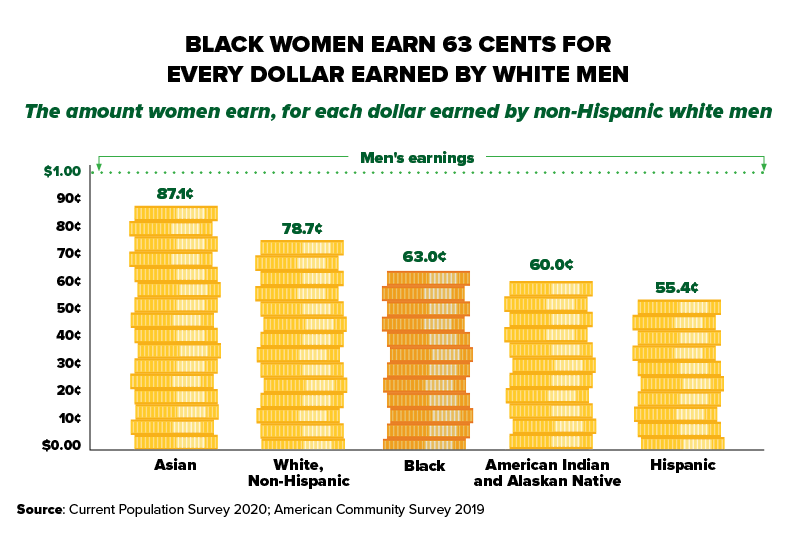
1. Black women earn 63 cents for every dollar earned by white, non-Hispanic men

Black women’s earnings are 63.0% of white, non-Hispanic men’s earnings – the third-widest gap after Native women (60%) and Hispanic women (55.4%). In comparison, white, non-Hispanic women earn 78.7% of white, non-Hispanic men’s earnings, and Asian women earn 87.1%.

Black women’s earnings are 63.0% of white, non-Hispanic men’s earnings – the third-widest gap after Native women (60%) and Hispanic women (55.4%). In comparison, white, non-Hispanic women earn 78.7% of white, non-Hispanic men’s earnings, and Asian women earn 87.1%.

2. This wage gap is not just driven by educational differences

Even controlling for education, Black women still earn less than their white male counterparts. Among those with a bachelor’s degree, Black women only earn 65% of what comparable white men do, for instance. And among people with advanced degrees, Black women earn 70% of what white men do. In fact, Black women with advanced degrees have median weekly earnings less than white men with only a bachelor’s degree..."
Black women and labor force 

Tuesday, February 23, 2021

A More Inclusive Economy is Key to Recovery

"The unemployment rate dropped to 6.3% in January 2021, according to the latest Employment Situation report from the Bureau of Labor Statistics. Many workers are still in crisis and we know that the latest recession hasn’t affected everyone equally.

In addition to major disparities in health impacts, Black Americans have seen disproportionate economic impacts from the pandemic. Among demographic groups, Black women experienced the steepest drop in labor force participation and have had the slowest job recovery since January 2020. It took until 2018 for Black women’s employment to recover from the Great Recession, and now almost all of those hard-won gains have been erased.

In January 2021, 973,000 fewer Black women were employed than in February 2020, a decrease of 9.5% since the COVID-19 pandemic began. The losses in local and state government and leisure and hospitality have disproportionate impacts on Black women’s employment. Black women are nearly one in four public sector workers, and one in eight leisure and hospitality workers. Half a million Black women have left the labor market since January 2020...."
Black women employment 

Thursday, February 13, 2014

Uncovering History’s Black Women Inventors

"Black women throughout American history have impacted and contributed to our nation’s culture of innovation. Patents offer a unique lens through which to view history. By tracing the technologies patents protect—or once protected—as well as the inventors listed on those patents, an image of the past emerges. The United States Patent and Trademark Office has granted patents for more than 200 years. That’s a lot of history, and it contains many stories of successful black women who have changed the technological face of America. Today, black women continue to ignite the spark of genius and make key and meaningful contributions to America’s inventive process.>>"
Black women inventors

Tuesday, November 20, 2012

Disparities in breast cancer continue among U.S. women

"Black women have higher death rates from breast cancer than any other racial or ethnic group. They are 40 percent more likely to die from breast cancer than white women, according to a Vital Signs report from the Centers for Disease Control and Prevention. Despite the decline in breast cancer death rates in the past 20 years, black women had higher death rates even though they had fewer new cases of breast cancer, the report says..."
http://www.cdc.gov/media/releases/2012/p11_14_breast_cancer.html