Saturday, April 27, 2024

Investigating Torture: FBI-HSI Investigation Leads to U.S. Citizen’s Conviction for Human Rights Violations in Iraq

"A U.S. Army veteran who established an illegal weapons facility in the Kurdistan region of Iraq— and who proceeded to both direct and engage in the torture of one of his employees—has been sentenced to 70 years in federal prison for those crimes and for additional crimes linked to his role at the facility.

Ross Roggio of Stroudsburg, Pennsylvania, directed Kurdish soldiers kidnap an employee and hold him hostage at one of their military compounds for 39 days. There, Roggio and the Kurdish military personnel under his corrupt command physically and mentally abused the victim.

The victim was an Estonian national who worked at the factory, but who planned to blow the whistle on the illegal activities going on there, explained Supervisory Special Agent Crystal Stevens of the FBI’s International Human Rights Unit. In response, Roggio not only directed the victim’s abduction and abuse, but also forced fellow employees to watch the abuse as a deterrent tactic.

The abuses first came to light amid a preexisting counterproliferation case against Roggio. After investigators finished interviewing one former factory employee—a woman from Estonia—she turned over a cellphone audio recording of Roggio that implicated him for torture.."
US Tortue in Iraq 

Overtime Rule

"One of the basic principles of the American workplace is that a hard day’s work deserves a fair day’s pay. Simply put, every worker’s time has value. A cornerstone of that promise is the Fair Labor Standards Act’s (FLSA) requirement that when most workers work more than 40 hours in a week, they get paid more. The Department of Labor’s new overtime regulation is restoring and extending this promise for millions more lower-paid salaried workers in the U.S.

Overtime protections have been a critical part of the FLSA since 1938 and were established to protect workers from exploitation and to benefit workers, their families and our communities. Strong overtime protections help build America’s middle class and ensure that workers are not overworked and underpaid.

Some workers are specifically exempt from the FLSA’s minimum wage and overtime protections, including bona fide executive, administrative or professional employees. This exemption, typically referred to as the “EAP” exemption, applies when: 

1. An employee is paid a salary,  

2. The salary is not less than a minimum salary threshold amount, and 

3. The employee primarily performs executive, administrative or professional duties.

While the department increased the minimum salary required for the EAP exemption from overtime pay every 5 to 9 years between 1938 and 1975, long periods between increases to the salary requirement after 1975 have caused an erosion of the real value of the salary threshold, lessening its effectiveness in helping to identify exempt EAP employees.."
Overtime  

Healthier Foods, Healthier Minds

"..Right now, schools across our country are serving breakfasts and lunches to nearly 30 million children every day. Healthy school meals that represent the main source of nutrition for more than half of these students and are an essential part of the educational landscape — like teachers, books, or computers – helping to unlock kids’ full potential in and out of the classroom.

It is no surprise that poor nutrition and diet-related diseases are correlated with lower academic achievement, worse health outcomes, and more behavioral problems for kids. We recognize the tremendous work that educators and school nutrition professionals do every day to ensure our children are fueled to thrive. Healthy school meals are an essential element of a quality education and are a part of the solution to promote children’s health. We know that this work is not easy, which is why the Biden-Harris Administration has made historic investments to help schools provide healthy and nutritious meals to students.

School breakfast offers the jump start to a great day. It sets the tone for the rest of the day, especially for children. It’s why kids who eat breakfast have increased alertness and improved moods throughout the morning, fostering a better learning experience. What’s more, studies find that students who participate in school meal programs consume more whole grains, milk, fruits, and vegetables during mealtimes and enjoy better overall diet quality.

These pivotal updates we are making to school nutrition standards have been shaped by a host of stakeholders, including parents, devoted teachers, school administrators, school nutrition directors, and industry leaders, and are informed by the latest Dietary Guidelines for Americans.

These new standards allow us to take the next step in putting kids’ health at the forefront by:

  • Reducing the amounts of added sugars in school meals, especially at breakfast.
  • Making it easier to offer healthy proteins at breakfast.
  • Scaling back sodium levels over time.
  • Continuing to emphasize fruits and vegetables, as well as whole grains, to give kids the right balance of nutrients for healthy, tasty meals..."
    Healthier Foods 

Wednesday, April 17, 2024

United States Statutes at Large

"About the United States Statutes at Large

The United States Statutes at Large, typically referred to as the Statutes at Large, is the permanent collection of all laws and resolutions enacted during each session of Congress. The Statutes at Large is prepared and published by the Office of the Federal Register (OFR), National Archives and Records Administration (NARA) .

Under the provisions of 1 U.S.C. 112, the printed edition of the Statutes at Large is legal evidence of the laws, concurrent resolutions, proclamations by the President, and proposed and ratified amendments to the Constitution. Read More

Note that appendix volumes are presented with the corresponding main volume: 68A, 70A, 76A, 77A

Browse the United States Statutes at Large.."
Statutes at Large 

Tuesday, April 16, 2024

New Report on the Nation’s Foreign-Born Population

"April 9, 2024 — From 2010 to 2022, the nation’s foreign-born population increased by 15.6%. According to a new report The Foreign-Born Population in the United States: 2022 released by the U.S. Census Bureau today, the foreign-born population was 46.2 million (13.9% of the total population) in 2022 compared to 40.0 million (12.9% of the total population) in 2010.

The report compares 2010 and 2022 American Community Survey (ACS), 1-year estimates to provide insight into the changing composition of the foreign-born population in the United States. The foreign-born population consists of anyone living in the United States who was not a U.S. citizen at birth, including naturalized U.S. citizens, lawful permanent residents (immigrants), temporary migrants such as foreign students, humanitarian migrants (for example, refugees and asylees) and unauthorized migrants.

Other highlights from the report:

  • From 2010 to 2022, the total foreign-born population increased by 15.6%. In Delaware, North Dakota, South Dakota and West Virginia, the foreign-born populations grew by 40% or more.
  • From 2010 to 2022, the median age of the foreign-born population increased by over 5 years (from 41.4 to 46.7), while the median age of the native population rose by only 1 year (from 35.9 to 36.9).
  • A higher percentage of foreign-born individuals completed high school or higher in 2022 (75.1%) than in 2010 (68.3%).

The Census Bureau also released a data visualization, Highlights of the Foreign-Born Population, and related America Counts story, Where Do Immigrants Live? How Immigrants Have Dispersed Throughout the Country. These products feature 2018-2022 ACS, 5-year estimates on the foreign-born population at various levels of geography (national, state and county).."
Foreign-Born Population 

Friday, April 12, 2024

Legal Treatment of Embryos Created Through IVF: Australia • France • Germany • Italy • New Zealand Poland • Portugal • Sweden • United Kingdom

"Comparative Summary
Kelly Buchanan Chief, Foreign, Comparative, and International Law Division II

This report, prepared by staff of the Global Legal Research Directorate of the Law Library of Congress, surveys the rules in select jurisdictions regarding embryos created through artificial reproductive technology treatment cycles, such as those involving in vitro fertilization (IVF). The countries surveyed include Australia and New Zealand, the United Kingdom, and six European countries: France, Germany, Italy, Poland, Portugal, and Sweden.

The individual country surveys examine whether there is a legal limit on the number of embryos that can be created or transferred in a treatment cycle, and the actions that can be taken with respect to the embryos created (apart from transfer to a person’s uterus as part of that cycle), including preimplantation genetic testing, sex selection for nonmedical purposes, cryopreservation and storage, donation to another person or couple, disposal or destruction, and allowing the embryos to be used for research purposes. This is intended to be a high-level survey, and it is recognized that countries may have detailed rules related to, for example, consent and counseling requirements, record-keeping and reporting, the collection and use of donor gametes, surrogacy, and restrictions and requirements related to embryo research.

Aspects of the country surveys are summarized in the table below. The storage time limits relate to the storage of embryos for the purpose of possible use in subsequent treatment cycles; some jurisdictions, such as the United Kingdom and Sweden, have separate time limits where storage is for the purpose of using the embryos for research. In addition, in almost all the countries that have a legal limit on storage duration, extensions may be granted by the relevant authorities.

As shown in the table, Italy, Germany, and Poland have the most restrictive rules of the jurisdictions surveyed. In these countries, the rules limit or discourage the creation of multiple excess embryos. However, while in Italy and Germany the ability to donate embryos to another person or couple is prohibited or highly restricted, such donation is required in Poland after the storage time limit is reached. These three countries do not permit research involving or disposal of excess embryos. Aspects of the laws in Germany are currently under review by a commission established by the government. The law in Italy is complex and there is uncertainty regarding some aspects, with certain restrictions having been declared unconstitutional by the Constitutional Court.

All the other jurisdictions surveyed allow for excess embryos to be discarded, and disposal is required in several jurisdictions when the storage limits have been reached. This includes one Australian state, France, New Zealand, Portugal, Sweden, and the United Kingdom.."
Embryos and IVF 

Wednesday, April 10, 2024

Broadband Consumer Labels

"Broadband Labels (Internet de Banda Ancha Etiquetas - en espaƱol) are designed to provide clear, easy-to-understand, and accurate information about the cost and performance of high-speed internet services. The labels are modeled after the FDA nutrition labels and are intended to help consumers comparison shop for the internet service plan that will best meet their needs and budget. Internet service providers that offer home, or fixed, internet services, or mobile broadband plans are required to have a label for each service plan they offer.

Beginning April 10, 2024, consumers should look for broadband labels at any point of sale, including online and in stores. The labels must disclose important information about broadband prices, introductory rates, data allowances, and broadband speeds. They also include links to information about network management practices and privacy policies.

A glossary (glosario en espaƱol) is available to help consumers better understand the information displayed on the label. To review a sample home internet, or fixed, label created by the FCC, download the home internet label in PDF format. You can also review a sample mobile broadband label in PDF format.

While many providers will begin displaying their labels in April, providers with less than 100,000 subscribers have until Oct. 10, 2024, to comply with the FCC rules to display broadband labels at their points of sale.."
Internet consumer labels 

Monday, April 1, 2024

The Federal Trade Commission 2023 Privacy and Data Security Update

"The past three years have been a tremendously busy period for the Commission, and I am particularly proud of our accomplishments in the areas of privacy and data security. We have worked vigorously to ensure that the law has equal force across the digital ecosystem, rising to the challenges presented by new technologies and seeking meaningful remedies that establish critical standards for protecting consumers’ information, rather than placing the burden on consumers to protect themselves. This is an area that demands an all-hands-on-deck response, and as the examples in the report show, the Commission is using every tool it has to safeguard consumers’ rights. To highlight a few of the agency’s achievements:

• Artificial Intelligence: The Commission has been leading efforts to ensure that AI and similar technologies are not deployed in harmful ways. In addition to obtaining orders against Rite Aid, Ring, and Amazon to ensure that companies are disincentivized from using data that was wrongfully collected or trained to develop AI, we have initiated a market study of social media and video streaming platforms on the use of AI, announced a public contest to develop new approaches to protect consumers from AI-enabled voice cloning harms, proposed rules to crack down on AI-fueled impersonator and fake review fraud, and issued numerous business guidance alerts.

• Children and Teens: The Commission proposed strengthening the Children’s Online Privacy Protection Act to make digital services safer and more secure for children, and to put the onus on providers rather than parents to keep kids’ data secure. The Commission has also been active in the enforcement arena, obtaining a record-breaking civil penalty settlement with Epic Games, and implementing substantive protections for teens as well, by mandating that settings default to protect their privacy. Our work in the educational technology space—including our case against Edmodo and policy statement on education technology—sent a strong message that businesses cannot outsource compliance when it comes to children’s privacy. 1 This Update covers the time period from January 2021 to December 2023. 2023 Privacy and Data Security Update FEDERAL TRADE COMMISSION FTC.GOV 2

• Sensitive Data: As the privacy threats from data collection continue to grow, protecting the privacy and security of consumers' sensitive data has continued to be a top Commission priority. The Commission’s groundbreaking actions to safeguard health, biometric, and geolocation data—including BetterHelp, GoodRx Holdings, Premom, Flo Heath, RiteAid, and Kochava, along with the InMarket, X-Mode, and Avast cases that were filed after the time period covered by this update—demonstrate that our agency will not tolerate failures to protect consumers’ sensitive information at any stage in the data lifecycle

. • Market-wide Protections: The Commission initiated rulemaking initiatives to establish sensible and reasonable baselines that protect consumers and put honest businesses on a level playing field. These included amendments to require financial institutions to notify the FTC of large data breaches, notices of proposed rulemaking to clarify the application of the Health Breach Notification Rule to health apps and strengthen the Children’s Online Privacy Protection Act Rule, and an advanced notice of proposed rulemaking to explore rules that would crack down on harmful commercial surveillance and lax data security.

While the work of the FTC’s attorneys, economists, investigators, technologists, and other specialists has made enormous strides in protecting the privacy and security of consumers’ information, there is much more that needs to be done. The explosive growth in data collection and the rapid pace of technological developments that allow information to be exploited in new ways demands action. The Commission has consistently called on Congress to restore its ability under Section 13(b) of the FTC Act to return money to consumers in federal court, and to pass comprehensive privacy legislation. As the data abuses described in this report makes clear, that ask is more urgent than ever.."
FTC Privacy and Data Security 

Tuesday, March 19, 2024

At-Home OTC COVID-19 Diagnostic Tests

"At-home over-the-counter (OTC) COVID-19 diagnostic tests can show if you have an active COVID-19 infection.

These at-home OTC COVID-19 diagnostic tests are FDA authorized for self-testing at home (or in other locations) without a prescription. Tests are available online or at local stores and  you collect your own sample, perform the test, and read the result yourself without the need to send a sample to a laboratory.

With most at-home OTC COVID-19 diagnostic tests, you should repeat testing following a negative result, whether you have symptoms or not, to reduce your risk of a false negative test result. For additional information on reading and understanding your test results, see Understanding At-Home OTC COVID-19 Antigen Diagnostic Test Results.

For more information, including answers to frequently asked general questions about at-home COVID-19 diagnostic tests, visit At-Home COVID-19 Diagnostic Tests: Frequently Asked Questions.

Authorized At-Home OTC COVID-19 Diagnostic Tests and Expiration Dates

The table below is updated regularly and lists FDA-authorized at-home OTC COVID-19 diagnostic tests, including information on expiration dates, who can use the test, links to home use instructions for each test, and other details that may help you decide what test is right for you. For additional information about each Emergency Use Authorization (EUA), see In Vitro Diagnostics EUAs: Tables of IVD EUAs.

In the table below, the "Expiration Date" column lists where to find the expiration date for that test, and the "Other Details" column lists the shelf-life for the test. The shelf-life is how long the test should work as expected and is measured from the date the test was manufactured. The expiration date is set at the end of the shelf-life and is the date through which the test is expected to perform as accurately as when manufactured. In some cases, the expiration date for a test may be extended.

An extended expiration date means the manufacturer provided data showing that the shelf-life is longer than was known when the test was first authorized. For more information about how the expiration date is determined and why it may be extended, see the At-Home COVID-19 Diagnostic Tests: Frequently Asked Questions.   

To see if the expiration date for your at-home OTC COVID-19 test has been extended, first find the row in the below table that matches the manufacturer and test name shown on the box label of your test. If the expiration date has been extended, then the Expiration Date column states "Extended Expiration Date" and links to a document that lists the lot numbers, original expiration dates, and the extended expiration dates. If your lot number and/or original expiration date do not appear, or if the Expiration Date column states “Expiration Date: See box label,” do not use the test beyond the original expiration date on your test. 

Search the table below by manufacturer, test name, or other details shown in the table to find more information on the test, including if the expiration date has been extended. .."
OVID-19 Diagnostic Tests 

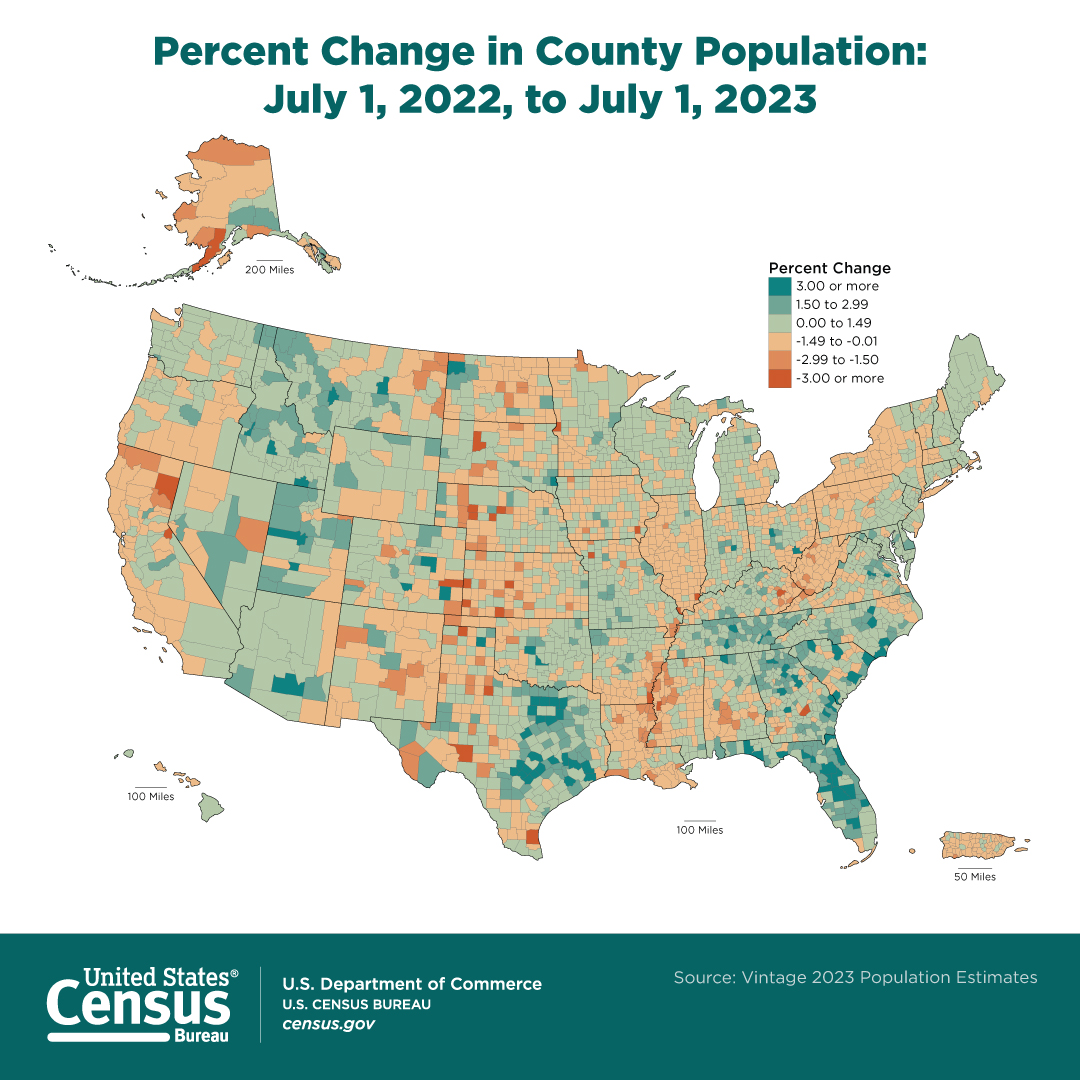
More Counties Saw Population Gains in 2023

"MARCH 14, 2024 – More U.S. counties experienced population gains than losses in 2023, as counties in the South saw faster growth and more Northeast and Midwest counties had population losses turn to gains, according to the U.S. Census Bureau’s Vintage 2023 estimates of population and components of change released today.

Approximately 60% (1,876) of U.S. counties gained population from 2022 to 2023, an increase from the 52% of counties (1,649) that experienced population growth between 2021 and 2022. Among the nation's 3,144 counties, the average change from 2022 to 2023 was 0.29%, up from 0.17% the previous year.

Percent Change in County Population: July 1, 2022, to July 1, 2023

“Domestic migration patterns are changing, and the impact on counties is especially evident,” said Lauren Bowers, chief of the Census Bureau’s Population Estimates Branch. “Areas which experienced high levels of domestic out-migration during the pandemic, such as in the Midwest and Northeast, are now seeing more counties with population growth. Meanwhile, county population growth is slowing down out west, such as in Arizona and Idaho.”

This was the first time since 2020 that more counties in the Midwest had population gains (542) than losses (513), narrowing the average annual change among the region's 1,055 counties to a loss of 0.02% from a loss of 0.09% a year earlier.."
County Population Estimates 2023i 

Saturday, March 16, 2024

Colorectal Cancer Awareness

"Colorectal cancer screening saves lives.

Regular screening, beginning at age 45, is the key to preventing colorectal cancer (cancer of the colon or rectum). If you’re 45 to 75 years old, get screened for colorectal cancer regularly. If you’re younger than 45 and think you may be at high risk of getting colorectal cancer, or if you’re older than 75, talk to your doctor about screening.

Colorectal polyps and colorectal cancer don’t always cause symptoms, especially at first. That is why getting screened regularly for colorectal cancer is so important.

Screening Test Options

Several screening tests can be used to find polyps or colorectal cancer, including some that you can do at home. Each test has advantages and disadvantages. Talk to your doctor about the pros and cons of each test, and how often to be tested

Colorectal Cancer 

Thursday, March 14, 2024

ANNUAL THREAT ASSESSMENT OF THE U.S. INTELLIGENCE COMMUNITY

"This annual report of worldwide threats to the national security of the United States responds to Section 617 of the FY21 Intelligence Authorization Act (Pub. L. No. 116-260). This report reflects the collective insights of the Intelligence Community (IC), which is committed every day to providing the nuanced, independent, and unvarnished intelligence that policymakers, warfighters, and domestic law enforcement personnel need to protect American lives and America’s interests anywhere in the world.

This assessment focuses on the most direct, serious threats to the United States primarily during the next year. The order of the topics presented in this assessment does not necessarily indicate their relative importance or the magnitude of the threats in the view of the IC. All require a robust intelligence response, including those where a near-term focus may help head off greater threats in the future..."
Annual Threat Assessment  

What You Need to Know About the Gender Wage Gap

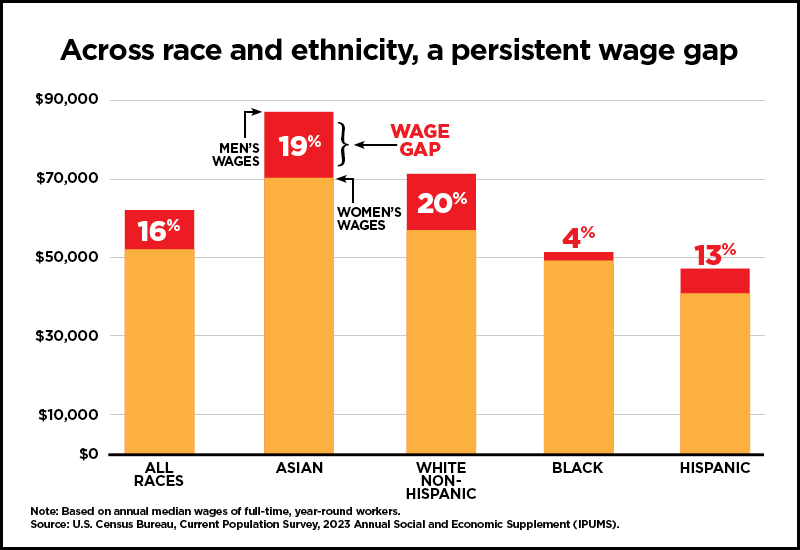
"Bar graph title: Across race and ethnicity, a persistent wage gap. A graph depicting the wage gap between race and gender compared to the average white male: All races - 16%; Asian - 19%; White Non-Hispanic - 20%; Black - 4%; Hispanic - 13%.

March 12 is Equal Pay Day – which represents the date into the year women must work in order to earn the same amount as the average man the previous year. But what does that mean? And what can we say about the gender wage gap today? 

Here are five fast facts: 

  • Overall, women are paid less than men. On average, women working full-time, year-round are paid 84% of what men are paid. In other words, the typical woman working full-time would need to work from January 1, 2023, until March 12, 2024, to make what the typical man working full-time made in 2023. This wage gap also persists within all major race and ethnic groups. For instance, Hispanic women ($41,137 median annual salary) make 13% less than Hispanic men ($47,420 median annual salary). This inequity is even greater for Black and Hispanic women when compared to white, non-Hispanic men.   

  • The largest identifiable causes of the gender wage gap are differences in the occupations and industries where women and men are most likely to work. In 2023, Black women lost $42.7 billion and Hispanic women lost $53.3 billion in wages as compared to white men due to the impact of occupational segregation. However, even within the same occupation, women make less on average than men. 

View our new fact sheet on lost wages due to occupational segregation for Black and Hispanic women.

  • A woman must complete at least one additional educational degree to earn as much as a man with less education. For instance, on average, a woman with an advanced degree earns less than a man with a bachelor’s degree. Were it not for the fact that women attain a greater number of degrees than men, the gender wage gap would be even larger. 

  • The wage gap is larger for mothers and results in employment-related losses of more than $295,000 over a lifetime. This results in women having lower average incomes in retirement and less financial stability in old age. 

  • Discrimination remains a likely leading cause of the gender wage gap. Just since Fiscal Year 2022, the Department of Labor’s Office of Federal Contract Compliance Programs, the Equal Employment Opportunity Commission and the Department of Justice have collectively recovered over $20 million in monetary relief for women who have experienced pay discrimination in the workplace... 

View our Equal Pay webpage..."
Gender Wage Gap 

Breakfast in America: Brought to You by Iowa, Minnesota and Wisconsin

"Now that the 2022 Census of Agriculture data are available, we can take a closer look at updated agricultural statistics in U.S. regions, states and counties.

The U.S. Department of Agriculture's National Agricultural Statistics Service (NASS) divides the U.S. states by region, and we're going to first take a look at the Upper Midwest Region, which includes Iowa, Minnesota and Wisconsin.

Each of these states has their own agricultural accomplishments, but together accounted for over 16% of the national total value of agricultural products sold in 2022. All three states rank in the top 10 for the total value of agricultural products sold, which includes sales of all products produced by farmers in each state.

Producers in Iowa, Minnesota and Wisconsin together provide much of what we see on our breakfast plates. Let’s break our fast on ag census blogs and start this monthly series with breakfast foods and the state rankings for these important staples.

  • Pancake mix and bread: Minnesota is second in spring wheat production and third in buckwheat production.
  • Oatmeal and cereal: Minnesota is second, Wisconsin fourth and Iowa sixth in oat production.
  • Scrambled eggs: Iowa is first, Minnesota eighth and Wisconsin 17th in egg layers for the kitchen table.
  • Bacon: Iowa is first, Minnesota second and Wisconsin 18th in hog inventory.
  • Maple syrup: Wisconsin is fourth, Minnesota 11th and Iowa 14th in maple syrup production.
  • Sugar: Minnesota is first in sugarbeet production.
  • Milk: Wisconsin is second, Minnesota seventh and Iowa 10th in milk sales.
  • Honey: Minnesota is fourth, Wisconsin 16th and Iowa 19th in honey production.

So, thank farmers for all the commodities they produce – especially when you start your morning at the breakfast table or treat yourself with breakfast for dinner! For more 2022 ag census data about these three states, browse our state agricultural statistics..."
2022 Agriculture Census 

Monday, March 4, 2024

Executive Order on Preventing Access to Americans’ Bulk Sensitive Personal Data and United States Government-Related Data by Countries of Concern

" By the authority vested in me as President by the Constitution and the laws of the United States of America, including the International Emergency Economic Powers Act (50 U.S.C. 1701 et seq.) (IEEPA), the National Emergencies Act (50 U.S.C. 1601 et seq.) (NEA), and section 301 of title 3, United States Code,

     I, JOSEPH R. BIDEN JR., President of the United States of America, hereby expand the scope of the national emergency declared in Executive Order 13873 of May 15, 2019 (Securing the Information and Communications Technology and Services Supply Chain), and further addressed with additional measures in Executive Order 14034 of June 9, 2021 (Protecting Americans’ Sensitive Data from Foreign Adversaries).  The continuing effort of certain countries of concern to access Americans’ sensitive personal data and United States Government-related data constitutes an unusual and extraordinary threat, which has its source in whole or substantial part outside the United States, to the national security and foreign policy of the United States.  Access to Americans’ bulk sensitive personal data or United States Government-related data increases the ability of countries of concern to engage in a wide range of malicious activities.  Countries of concern can rely on advanced technologies, including artificial intelligence (AI), to analyze and manipulate bulk sensitive personal data to engage in espionage, influence, kinetic, or cyber operations or to identify other potential strategic advantages over the United States.  Countries of concern can also use access to bulk data sets to fuel the creation and refinement of AI and other advanced technologies, thereby improving their ability to exploit the underlying data and exacerbating the national security and foreign policy threats.  In addition, access to some categories of sensitive personal data linked to populations and locations associated with the Federal Government — including the military — regardless of volume, can be used to reveal insights about those populations and locations that threaten national security.  The growing exploitation of Americans’ sensitive personal data threatens the development of an international technology ecosystem that protects our security, privacy, and human rights..

     Accordingly, to address this threat and to take further steps with respect to the national emergency declared in Executive Order 13873,.."
Preventing Access to Personal Data