Showing posts with label older_workers. Show all posts

Tuesday, July 2, 2024

Older and wiser, but not richer: The gender pay gap for older workers

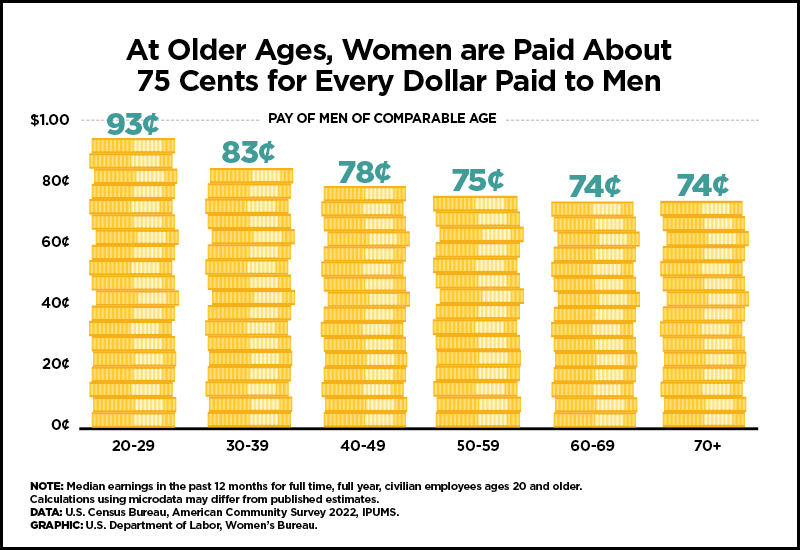
" A graph using gold coins as bars to highlight the comparable pay of men to women. Text: At Older Ages, Women are Paid About 75 Cents for Every Dollar Paid to Men. Median earnings in th epast 12 months for full time, full year, civilian employees ages 20 and older. Data: U.S. Census Bureau, American Community Survey 2022, IPUMS.

Older women are losing out

President Biden recently identified older workers as the “Backbone of the Nation.”
While that may be the case, older women workers – who comprise 47% of the labor force ages 55 and older – are plagued by a gender wage gap that is even larger than the one their younger counterparts experience.

Among workers ages 50 or older, women working full-time and year-round are paid about 75 cents for each dollar their male counterparts make. 

In 2022, the most recent year for which data are available, women 50-59 working full-time, year-round were paid about $56,000 annually – $18,300 less than their male counterparts. Women 60-69 were paid about $18,800 less than men in their 60s and women 70 or older were paid about $16,000 less than men in their 70s. To put this in perspective, among people ages 20-29, women were paid a median of $39,200 and men a median of $42,100 – an annual difference of about $3,000.
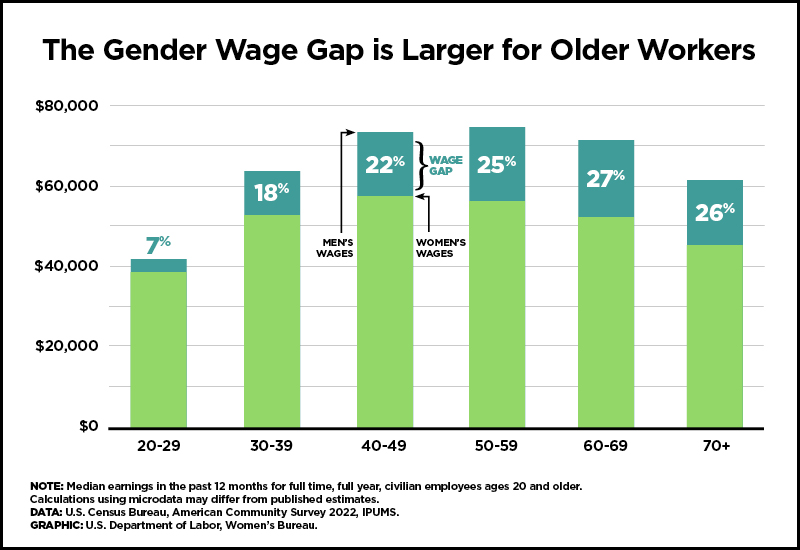
A stacked bar graph showing the median earnings in the past 12 months for full time, full year, civilian employees ages 20 and older. Text: The Gender Wage Gap is Larger for Older Workers. Data: U.S. Census Bureau, American Community Survey 2022, IPUMS.

These annual wage losses add up. Estimates suggest that over the course of their careers, women lose an average of nearly $400,000relative to white non-Hispanic men due to gender and racial wage gaps. Hispanic and Native American and Pacific Islander women make $1 million less than white non-Hispanic men, while Black women make nearly $900,000 less. These earnings deficits mean less purchasing power for women and their families and less financial security for older women (65+), 11.2% of whom live in poverty. In addition, lower wages can impact Social Security benefits and other sources of retirement income such as IRAs and 401(k)s.

Research from the Women’s Bureau and the U.S. Census Bureau shows that 70% of the gender pay gap remains unexplained after adjusting for gender differences in education, occupation, industry, work experience, hours worked and other worker characteristics. This remaining unexplained wage gap is due to a combination of unobservable worker characteristics and discrimination.

Solutions

Salary history bans are one solution that can help alleviate pay disparities. The federal government now bans the use of non-federal salary history to determine wages for federal employees, and the Biden-Harris Administration has proposed a similar rule for federal contractors.

Given the outsized role that occupational segregation plays in the gender wage gap, programs that provide pathways for women into high-paying nontraditional occupations, such as the Women’s Bureau’s Women in Apprenticeship and Nontraditional Occupations (WANTO) grant program, can help reduce pay disparities and increase economic security.

Furthermore, eliminating discrimination is key to closing gender wage gaps. The federal government is playing a role: Since Fiscal Year 2022, the Department of Labor’s Office of Federal Contract Compliance Programs, the Equal Employment Opportunity Commission and the Department of Justice have collectively recovered over $20 million in monetary relief for women who have experienced pay discrimination in the workplace.
Older Workers and Gender Pay 

Sunday, October 25, 2015

Working in America: New Tables Detail Demographics of Work Experience

"More than seven in 10 people of traditional working age (16 to 64 years old) worked in 2014; for people 65 and over, at least one in five had worked in the past 12 months. In fact, 12.4 percent of people 70 and over continued to work.
Of these older workers, many worked full time, year round; nearly half of workers age 65 to 69 and nearly a third of workers 70 and over worked full time, year round. Among workers 65 and over, men worked longer hours each week than women; 57.6 percent of men compared with 45.5 percent of women 65 and over clocked in 35 or more hours per week..."
Work experience

Monday, November 22, 2010

EEOC Explores Plight Of Older Workers In Current Economic Climate
"At a meeting held today, the U.S. Equal Employment Opportunity Commission heard testimony that age discrimination is causing the nation’s older workers to have a difficult time maintaining and finding new employment, a problem exacerbated by the downturn in the economy. The number and percentage of age discrimination charges filed with the EEOC have grown, rising from 16,548 charges — 21.8 percent of all charges — filed in fiscal year 2006, to 22,778 —24.4 percent — in fiscal year 2009.

The Commission heard testimony from a number of experts on the impact of the economic crisis on older workers, the legal issues surrounding age discrimination today, and best practices to retain older workers. Dr. William Spriggs, Assistant Secretary for Policy, U.S. Department of Labor, testified that the rate of unemployment for people age 55 and over “rose from a pre-recession low of 3.0 percent (November 2007) to reach 7.3 percent in August, 2010, making the past 22 months the longest spell of high unemployment workers in this age group have experienced in 60 years.” Older workers also spend far more time searching for work and are jobless for far longer periods of time compared to workers under 55.

Assistant Secretary Spriggs’ testimony reflected the experience of Jessie Williams, who had worked for 31 years in Las Vegas at Republic Services, a multi-million dollar waste disposal company. After more than three decades of stellar employment, he was terminated along with four other foremen over 40. He testified, “I was told that I wasn’t needed any longer . . . [and] that they were going to ‘get rid of the old foremen and get some new blood.’” Following his discharge, Mr. Williams had to move out of state to find employment. He later became part of the EEOC’s suit against Republic filed on behalf of more than 20 workers discharged due to their age. The case was ultimately settled for nearly $3 million..."

Monday, September 28, 2009

Older Workers: Employment and Retirement Trends
"As the members of the “baby boom” generation—people born between 1946 and
1964— approach retirement, the demographic profile of the U.S. workforce will
undergo a substantial shift as a large number of older workers will be joined by relatively few new entrants to the labor force. According to the Census Bureau,
there will be 204 million Americans aged 25 or older in 2010. By 2030, this number will increase by 23% to more than 251 million. Most of this growth will occur among people aged 65 and older. The Census Bureau estimates that while the number of
people between the ages of 25 and 64 will increase by 15.5 million (9.4%) between 2010 and 2030, the number of people aged 65 and older is projected to grow by 31.7 million, or 79.2%.

Labor force participation begins to fall after age 55. In 2008, 91% of men and 76%
of women aged 25 to 54 participated in the labor force. In contrast, just 70% of
men and 59% of women aged 55 to 64 were either working or looking for work in 2008.
Labor force participation among persons aged 55 and older is influenced by general economic conditions, eligibility for Social Security benefits, the availability of health insurance, and the prevalence and design of employer sponsored pensions. For example, labor force participation among people 55 and older may increase due to the trend away from defined-benefit pension plans that offer a monthly annuity for life to defined contribution plans that typically pay a lump-sum benefit. The declining percentage of employers that offer retiree health insurance also may result in more people continuing to work until they are eligible for Medicare at 65..."

Friday, April 4, 2008

The Geographic Distribution and Characteristics of Older Workers in Wisconsin: 2004
"The statistics about older workers in Wisconsin in 2004 show this group’s
proportion of the state’s labor force has increased. Changes in the size and composition of age groups may affect government program and policy choices and the options available to businesses..."