Wednesday, January 27, 2021
Family Farms Continue to Power U.S. Agriculture
Saturday, December 5, 2020
Farms, tables and revealing the vast impacts between and beyond
"Bountiful harvests in one location can mean empty water reservoirs and environmental woes far from farmlands. A study published in Nature Communications examines how food, energy, water and greenhouse gases create a vast front in the battle to feed the planet.
Scientists at Michigan State University and their colleagues used new sustainability science tools to understand how irrigating farm fields to grow food reverberates through the biggest drivers of sustainability.
It's not just the farmlands that shoulder environmental impacts. Sometimes, it's places that have no major stake in the plant-water-food game that end up paying an environmental price.
"Ensuring food security, while safeguarding the environment, is one of the greatest challenges for the world today, yet as the world has become globalized, it is an incredibly complicated process, and misunderstanding it or missing impacts can allow major setbacks in achieving sustainability," said Jianguo "Jack" Liu, an ecologist at MSU. "We need to find new ways of looking at the world in a way that embraces its complexity."
The U.S. National Science Foundation-funded scientists used the framework of metacoupling, which helps look not only at irrigated farmlands, but also at massive projects to move water from one region to another. The framework allows scientists from different disciplines to look at the interactions between socioeconomics and environmental forces -- such as climate change, diet change, irrigation technologies, crop planting strategies and water diversion -- within and across borders.
"This study demonstrates the importance of understanding our increasingly connected world in a way that quantifies the often-missed and unrecognized connections involved in feeding the world," said Elizabeth Blood, a program director in NSF's Division of Environmental Biology..."
Farms and tables
Thursday, September 24, 2020
Farm Safety and Health
"America’s hardworking farmers provide food security for our citizens. Many of our meals, clothes and medicines are made with homegrown products. Agriculture employs millions of Americans, and that work involves some unique challenges. The storage silos, heavy equipment and chemicals that are necessary for agricultural work can be dangerous, which is why the Occupational Safety and Health Administration (OSHA) encourages all agricultural workers to be aware of potential hazards and how to avoid them.
Farm Safety and Health Week, observed every year during the third week of September, provides an opportunity to reflect on practices to keep agricultural workers safe and healthy all year round.
OSHA has guidance on avoiding hazards related to agricultural operations, including grain bins and silos, hazardous equipment, extreme heat, and pesticides. This year the agency also released tips on reducing the risk of contracting COVID-19, including:
- Staying 6 feet or more away from other people, if possible.
- Wearing a cloth face covering and gloves.
- Washing your hands often with soap and water, or using hand sanitizer.
- Avoiding sharing tools, if possible.
- Disinfecting tools before and after using them.
Public service announcements are available in English and Spanish to raise awareness about farmworker safety..."
Farm safety and health
Thursday, February 27, 2020
Keeping Farmers Safe
FACTS ABOUT FARMER SAFETY
- Farm life can be demanding and stressful. Action steps to help someone in emotional distress include: (1) Ask; (2) Keep them safe; (3) Be there; (4) Help them connect; and (5) Stay connected.
- Tractors are an important tool on the farm, but they are also the number one cause of death. It’s important to make sure tractors are equipped with seat belts and roll over protection.
- Being prepared for an emergency can be the difference between life and death. Work with family, employer and employees to create an Emergency Action Plan (EAP) for orderly evacuation and quick response.
- Confined spaces can stir up dust and dangerous fumes. Ensure proper ventilation and use the correct mask to keep safe.
- Your skin is the largest organ on your body. Make it one of your top priorities by wearing sunglasses, a long sleeve shirt and pants and using sunscreen while in the sun..."
Farmers
Friday, January 24, 2020
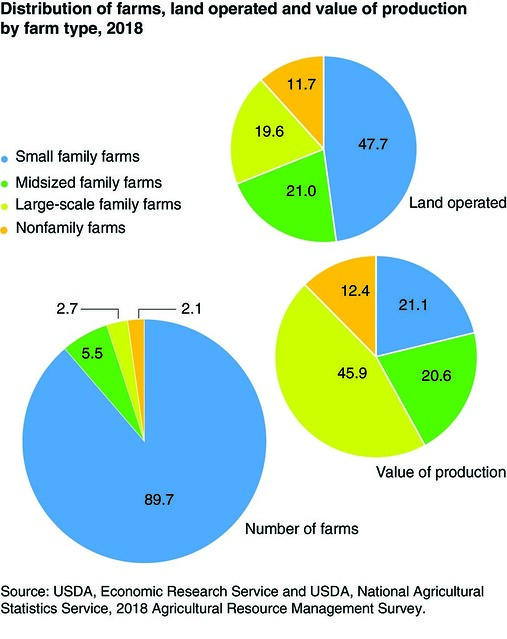
A Look at America’s Family Farms
Family farms
Thursday, February 20, 2014
U.S. Farm Income
Tuesday, October 22, 2013
Farm to School Census
Farm to school
Monday, June 17, 2013
Budget Issues Shaping a Farm Bill in 2013
Budget Issues Facing the Farm Bill in 2013
Tuesday, April 30, 2013
Characteristics of Women Farm Operators and Their Farms
Friday, September 7, 2012
U.S. Farm Income
indicator of U.S. farm well-being—is forecast at a record $122.2 billion in 2012, up 3.7% from
last year’s record. Record gross revenues from crop sales (forecast at $222.1 billion), coupled
with record revenues (forecast at $34.1 billion) from farm-related income—a category that
includes crop insurance indemnity payments as well as income from custom work, machine hire,
etc.—pushed total gross cash income to a record $433.6 billion (up 5.5%). This more than offset
flat revenues from livestock markets ($165.8 billion), and a 6.6% increase in input costs (forecast
at $294.2 billion) to account for the record forecast for overall net returns..."
Friday, March 9, 2012
U.S. Farm Income
indicator of U.S. farm well-being—is forecast at $91.7 billion in 2012, down $6.5 billion (6.5%) from the record total of $98.1 billion achieved in 2011. Record revenues from crop markets (forecast up 0.7%, from 2011’s record level), coupled with continued strength in livestock markets (down 0.1% from 2011’s record), are expected to be offset a 4% ($12.5 billion) increase in input costs to account for the lower forecast for overall net returns.
The major drivers behind a second year of strong farm income projections are the outlook for near-record U.S. agricultural exports of $132 billion in 2012, following record exports in 2011 (projected at a record $136.3 billion), and continued strong crop prices driven in part by sustained demand from the U.S. corn ethanol industry..."
Thursday, August 18, 2011
From USGA blog:
"Earlier this week, President Obama along with Secretary Vilsack and members of the White House Rural Council hosted the White House Rural Economic Forum in Peosta, Iowa where the President announced new jobs initiatives focused on increasing access to capital, job training and health care services. The forum, part of President Obama’s three-day economic bus tour, brought together farmers, small business owners, private sector leaders, rural stakeholders and government officials to discuss ways to improve economic growth and create jobs in rural communities nationwide. The White House Rural Council, of which Secretary Vilsack is the chair, was created on June 9, 2011 by an executive order and is focused on finding ways to increase economic growth and infrastructure in rural communities..."
Saturday, August 29, 2009
"State fact sheets provide information on population, employment, income, farm characteristics, farm financial indicators, and top commodities, exports, and counties for each state in the United States."
Friday, January 2, 2009
"Million-dollar farms—those with annual sales of at least $1 million—accounted for about half of U.S. farm sales in 2002, up from a fourth in 1982 (with sales measured in constant 2002 dollars). By 2006, million-dollar farms, accounting for 2 percent of all U.S. farms, dominated U.S. production of high-value crops, milk, hogs, poultry, and beef. The shift to million-dollar farms is likely to continue because they tend to be more profitable than smaller farms, giving them a competitive advantage. Most million-dollar farms (84 percent) are family farms, that is, the farm operator and relatives of the operator own the business. The million-dollar farms organized as nonfamily corporations tend to have no more than 10 stockholders."