Showing posts with label young_adults. Show all posts

Wednesday, September 16, 2020

A majority of young adults in the U.S. live with their parents for the first time since the Great Depression

[Pew Research Center]
"The coronavirus outbreak has pushed millions of Americans, especially young adults, to move in with family members. The share of 18- to 29-year-olds living with their parents has become a majority since U.S. coronavirus cases began spreading early this year, surpassing the previous peak during the Great Depression era.
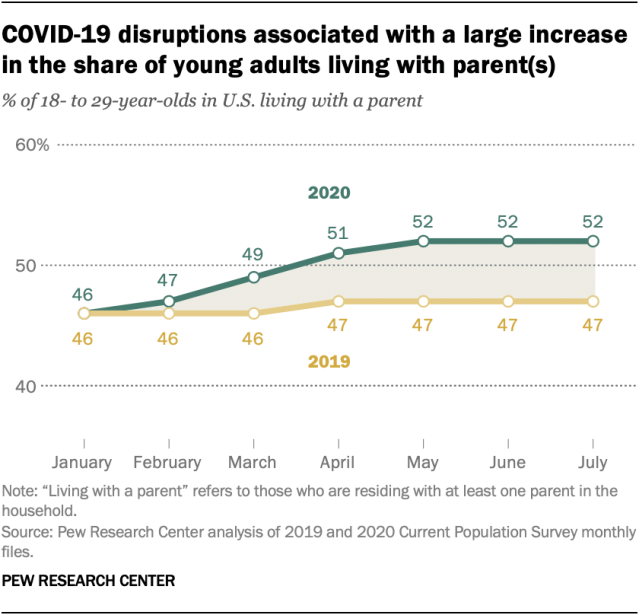
COVID-19 disruptions associated with a large increase in the share of young adults living with parent(s)

In July, 52% of young adults resided with one or both of their parents, up from 47% in February, according to a new Pew Research Center analysis of monthly Census Bureau data. The number living with parents grew to 26.6 million, an increase of 2.6 million from February. The number and share of young adults living with their parents grew across the board for all major racial and ethnic groups, men and women, and metropolitan and rural residents, as well as in all four main census regions. Growth was sharpest for the youngest adults (ages 18 to 24) and for White young adults..."
Young adults living arrangement

Thursday, September 10, 2020

Protecting Young People From E-cigarettes

"As back-to-school season begins—whether that means in-person or virtual classes—parents and teachers must juggle many roles and many different concerns about students’ health. Protecting youth and young adults from the harms of using e-cigarettes is one important way you can help keep them healthy.

E-cigarette liquid that contains nicotine (the same addictive drug in other tobacco products like cigarettes) is unsafe for youth and young adults. Nicotine can harm brain development, and young people’s brains continue to develop up to about age 25. In 2018, the U.S. Surgeon General called it an epidemicexternal icon, meaning an outbreak of a health threat in a specific group of people.

E-Cigarette Use and Young People

E-cigarettes came onto the market in the United States in 2007, and by 2014, they were the tobacco product most often used by youth. In 2020, about 3.6 million youth nationwide reported currently using e-cigarettes, including 1 in 5 high school students.

Nicotine addiction is part of what has caused the youth e-cigarette epidemic. Newer types of e-cigarettes, sometimes called “pod mods,” use a liquid containing nicotine salts, which lets the user breathe in even more nicotine, with less irritation to the throat and lungs, than older types of e-cigarettes.

Other factors have also played a part in youth e-cigarette use. Companies that make e-cigarettes use advertising tactics like animated ads, young actors, and celebrities to appeal to younger audiences. In one study of e-cigarette ads shown on TV in the U.S., more than 70% showed e-cigarette users in positive moods—happy, smiling, having fun—while using.

The fact that e-cigarette liquid is available in flavors also attracts youth. Most youth who use e-cigarettes use flavored products, and flavors are among the most common reasons youth say they first try e-cigarettes..."
E-cigarettes
 

Tuesday, December 9, 2014

Are Today’s Young Adults Better Off Than Their Parents? Yes and No

"Compared with prior generations, young people today, those 18 to 34 years old, are more educated and, in some parts of the country, earn more. However, they are also less likely to be employed and more likely to live in poverty than their counterparts were in 1980..."
Todays young 
 

Wednesday, September 3, 2014

America's Young Adults: Special Issue, 2014

"The well-being of young adults in the United States today remains an area of key interest to the public and policy-makers alike. This age group faces the well-known challenges of achieving financial and social independence while forming their own households at a time of greater economic uncertainty than in the past. Better understanding of the achievements and needs of these young adults will inform approaches to best support this exciting and challenging transition to adulthood..."
America's Young Adults

Tuesday, April 29, 2014

Young-Adult Voting: An Analysis of Presidential Elections, 1964–2012

"Traditionally in American elections, young people have stood out for their consistently low levels of electoral participation, but a shift has appeared in some years, at least in part, in the direction of greater engagement. The main questions addressed in this analysis concern how important
young-adult voting has been in the past, particularly recent presidential elections, and how important it may
become in the future..."
Young Adult Voting