Showing posts with label E-cigarettes. Show all posts

Monday, February 7, 2022

Exposure to electronic cigarettes in indoor workplaces

"Electronic cigarettes can negatively affect indoor air quality and pose a risk of secondhand exposure in workplaces. Learn more about what employers can do to eliminate exposures.

Electronic cigarettes are also called “e-cigarettes” or “e-cigs.” Some e-cigarettes look like regular traditional cigarettes but some look like USB flash drives, pens, and other everyday items. When a user breathes in on an e-cigarette, it heats a liquid to form a mixture of very small liquid droplets and gases in the air that are inhaled directly into their lungs. These droplets are approximately one to two micrometers in size (the diameter of a human hair is around 100 micrometers). Both the droplets and gases can contain harmful chemicals.1 When the user breaths out, a portion of this mixture is released into their surroundings, which can negatively impact indoor air quality.

Using e-cigarettes is common in some U.S. workplaces. Employees in indoor workplaces that allow using e-cigarettes are at risk of involuntary secondhand exposure to these harmful chemicals. Further, many non-user employees perceive that using electronic cigarettes at work contributes to reduced productivity.2 Examples of these workplaces include:

  • Homes
  • Vehicles
  • Buildings
    • E-cigarette retailers
    • Bars
    • Nightclubs

Potential harmful effects

The very small size of particles given off by e-cigarettes means that they can deposit in the mouth, nose, and deep in the lungs of user and non-user employees.3 Additionally, NIOSH researchers report concerns for primary users such as:

  • Cavities and gum diseases
  • Upper and lower respiratory tract irritations as well as lung cancer
  • Irritation and toxicity (short- and long- term) to the skin, urinary tract, and liver4

Prevent exposures in the workplace

Employers can:

  • Establish a smoke-free indoor workplace, including free of e-cigarettes, to protect employees from involuntary, secondhand exposures.
  • Promote smoking cessation programs as part of an overall tobacco-free workplace.

Employees can:

  • Where possible, choose employment at a tobacco-free workplace.
  • Encourage co-workers or personally seek resources for e-cigarette (and tobacco smoking) cessation, for example by calling the free smoking quitline at 1-800-QUIT-NOW..."
    E-Cigarettes
     

Monday, August 23, 2021

Talking to Youth and Young Adults to Prevent E-cigarette Use

"As students go back to school, parents, teachers, administrators, and coaches can help them make smart choices for their health, including avoiding e-cigarettes.

About 1 in 5 high school students and 1 in 20 middle school students reported using e-cigarettes in 2020. Now is an important time to help students understand the serious health risks of e-cigarette use.

Why It Matters
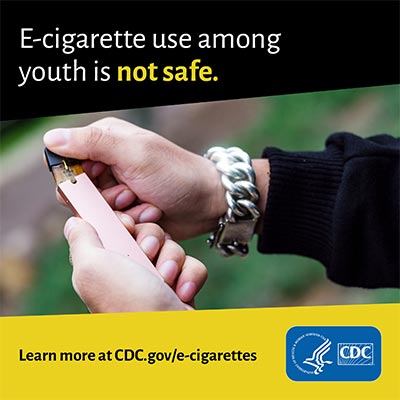
E-cigarette use among youth is not safe.

Any tobacco use by youth and young adults, including e-cigarettes, is unsafe.

Nearly all e-cigarette products sold contain nicotine, which is the same addictive drug found in other tobacco products, including cigarettes and cigars. The nicotine content information on e-cigarette packaging is often misleading or inaccurate.

Nicotine is highly addictive and can harm adolescent brain development, which continues into the mid-20s. Compared with older adults, the brains of youth and young adults are more vulnerable to nicotine’s harmful health effects. These include nicotine addiction and potentially reduced impulse control, mood disorders, and poor attention and thinking skills.

Many youth and young adults who use e-cigarettes also smoke regular cigarettes or use other tobacco products. Young people who use e-cigarettes may be more likely to smoke regular cigarettes later in life. E-cigarette use can also increase the risk for future addiction to other drugs.
Top of Page

Youth E-cigarette Use

Parents, teachers, counselors, and coaches should know that in 2020:

  • About 3.6 million US youth reported current e-cigarette use.
  • E-cigarettes were the most commonly used tobacco product among US middle and high school students.
  • 1 in 5 high school students and nearly 1 in 10 middle school students who used e-cigarettes reported using them every day..."
    Youth and E-cigarette use
     

Thursday, September 10, 2020

Protecting Young People From E-cigarettes

"As back-to-school season begins—whether that means in-person or virtual classes—parents and teachers must juggle many roles and many different concerns about students’ health. Protecting youth and young adults from the harms of using e-cigarettes is one important way you can help keep them healthy.

E-cigarette liquid that contains nicotine (the same addictive drug in other tobacco products like cigarettes) is unsafe for youth and young adults. Nicotine can harm brain development, and young people’s brains continue to develop up to about age 25. In 2018, the U.S. Surgeon General called it an epidemicexternal icon, meaning an outbreak of a health threat in a specific group of people.

E-Cigarette Use and Young People

E-cigarettes came onto the market in the United States in 2007, and by 2014, they were the tobacco product most often used by youth. In 2020, about 3.6 million youth nationwide reported currently using e-cigarettes, including 1 in 5 high school students.

Nicotine addiction is part of what has caused the youth e-cigarette epidemic. Newer types of e-cigarettes, sometimes called “pod mods,” use a liquid containing nicotine salts, which lets the user breathe in even more nicotine, with less irritation to the throat and lungs, than older types of e-cigarettes.

Other factors have also played a part in youth e-cigarette use. Companies that make e-cigarettes use advertising tactics like animated ads, young actors, and celebrities to appeal to younger audiences. In one study of e-cigarette ads shown on TV in the U.S., more than 70% showed e-cigarette users in positive moods—happy, smiling, having fun—while using.

The fact that e-cigarette liquid is available in flavors also attracts youth. Most youth who use e-cigarettes use flavored products, and flavors are among the most common reasons youth say they first try e-cigarettes..."
E-cigarettes
 

Thursday, January 2, 2020

Outbreak of Lung Injury Associated with the Use of E-Cigarette, or Vaping, Products

"CDC, the U.S. Food and Drug Administration (FDA), state and local health departments, and other clinical and public health partners are investigating a national outbreak of e-cigarette, or vaping, product use-associated lung injury (EVALI).
On This Page
 Lung injury and e-cigarettes

Tuesday, October 8, 2019

Outbreak of Lung Injury Associated with E-Cigarette Use, or Vaping

"CDC, the U.S. Food and Drug Administration (FDA), state and local health departments, and other clinical and public health partners are investigating a multistate outbreak of lung injury associated with use of e-cigarette, or vaping, products.
If you have questions about CDC’s investigation into the lung injuries associated with use of electronic cigarette, or vaping, products, contact CDC-INFO or call 800-232-4636.
What we know
  • As of October 1, 2019, 1,080* lung injury cases associated with using e-cigarette, or vaping, products have been reported to CDC from 48 states and 1 U.S. territory.
  • Eighteen deaths have been confirmed in 15 states.
  • All patients have reported a history of using e-cigarette, or vaping, products.
  • Most patients report a history of using THC-containing products. The latest national and regional findings suggest products containing THC play a role in the outbreak.
  • Approximately 70% of patients are male.
  • Approximately 80% of patients are under 35 years old.

Thursday, October 3, 2019

FTC to Study E-Cigarette Manufacturers’ Sales, Advertising, and Promotional Methods

"The Federal Trade Commission has issued orders to six e-cigarette manufacturers seeking information to study the companies’ sales, advertising, and promotional methods. The orders were sent to: JUUL Labs, Inc.; R.J. Reynolds Vapor Company; Fontem US, Inc.; Logic Technology Development LLC; Nu Mark LLC; and NJOY, LLC.

The FTC study will complement similar FTC studies on cigarettes and smokeless tobacco products. The orders will collect information about e-cigarette sales, advertising, and promotional practices in the U.S. for the calendar years 2015, 2016, 2017, and 2018. The goal is to assist the Commission, policy makers, and the public to better understand the rapidly growing e-cigarette market.

Among other things, the Commission orders seek: annual data on the sales and give-aways of e-cigarette products; information about the characteristics of the companies’ e-cigarette products, such as product flavors; annual amounts the companies spent on advertising and promoting e-cigarette products; and information about e-cigarette product placement, the websites and social media accounts used to advertise or sell e-cigarettes, affiliate programs, influencer marketing, and college campus programs..."
E-Cigarettes

Tuesday, August 20, 2019

E-Cigarettes: Talk to Youth About the Risks

"If anyone can speak firsthand about the significant rise in e-cigarette use by kids, teens, and young adults, it’s someone who works with them every day. Lauren W., a high school teacher in Pennsylvania, often hears her students talking about using e-cigarettes. But when it comes to the dangers of nicotine and addiction for young people, she does not believe they really understand how dangerous e-cigarettes are for their health.
“I talk to them about the risks all the time,” she says, “and those talks reveal that they have never really thought about it.”
As someone who can influence young people, Lauren is doing what she can to teach them about the harms e-cigarette use can have on them. “They are always interested when I pull up research and start listing off findings,” she says.
This fall, as young people get ready to return to school, you have the power to start the conversation. Whether you are a parent, a teacher, a coach—or even a health care professional helping to make sure kids start the new school year in good health—you have an important part to play when it comes to talking to kids about the harms of e-cigarettes.
Since 2014, e-cigarettes have been the most commonly used tobacco product pdf icon[PDF–808 KB] among US middle and high school students. Between 2017 and 2018 alone, the number of youth who used e-cigarettes went up by 1.5 million. In fact, the US Surgeon Generalexternal icon has called e-cigarette use by youth an “epidemic,” and warned that it threatens decades of progress toward making sure fewer young people use tobacco.
Research also shows that e-cigarette advertising uses many of the same themes that have led to cigarette smoking among young people. In 2016, nearly 7 out of 10 US middle and high school students saw ads for e-cigarettes pdf icon[PDF–3.69 MB] in stores, on the Internet, on TV, or in magazines or newspapers.
Advertising can also make e-cigarette use look harmless for young people. Lauren, the high school teacher, says that most of her students know that regular cigarettes cause disease and even death. However, she says most of them don’t know that nicotine in e-cigarettes can harm brain development, or that e-cigarettes can be dangerous to youth for other reasons, too..."
E-Cigarettes

Monday, February 25, 2019

2016 Surgeon General's Report: E-Cigarette Use Among Youth and Young Adults

"E-Cigarette Use Among Youth and Young Adults: A Report of the Surgeon General is the first report issued by a Federal agency that comprehensively reviews the public health issue of electronic cigarettes and their impact on our nation’s young people. It is the 33rd Report of the Surgeon General on tobacco..."
2016 Surgeon General's Report

Wednesday, September 12, 2018

Warning Letters and Civil Money Penalties Issued to Retailers for Selling JUUL and Other E-Cigarettes to Minors

"June 2018 – September 2018
In the largest coordinated enforcement effort in the FDA's history, the agency issued more than 1,300 warning letters and civil money penalty complaints (fines) to retailers who illegally sold JUUL and other e-cigarette products to minors during a nationwide, undercover blitz of brick-and-mortar and online stores this summer:
April 2018 – June 2018
FDA issued warning letters (PDF) and civil money penalties (CMPs) in April - June 2018 as part of a concerted effort to ensure youth are not able to access these products. These retailers sold e-cigarettes—including JUUL products—to minors..."
E-Cigarettes

Monday, August 20, 2018

Keep Kids E-Cigarette Free

"Know the risks of e-cigarettes for kids.
Have you seen your kid’s USB flash drive lately? It could actually be an electronic cigarette (e-cigarette) containing nicotine. E-cigarettes are the most commonly used tobacco product among U.S. middle and high school students, and USB-shaped e-cigarettes are increasing in popularity. As parents prepare to send their kids back to school, take time to learn more about the dangers of e-cigarettes for young people.

What are e-cigarettes?

E-cigarettes are electronic devices that produce an aerosol by heating a liquid. E-cigarettes come in many shapes and sizes. Most have a battery, a heating element, and a place to hold a liquid. Some e-cigarettes are made to look like regular cigarettes, while some look like USB flash drives, pens, and other everyday items. Larger e-cigarettes such as tank systems, or “mods,” do not resemble other tobacco products. E-cigarettes are known by many different names. They are sometimes called “e-cigs,” “e-hookahs,” “mods,” “vape pens,” “vapes,” “tank systems,” and “electronic nicotine delivery systems.” Using an e-cigarette is sometimes called “vaping” or “JUULing.”

Flavored e-cigarettes are very popular, especially among young people. More than 8 of every 10 youth aged 12-17 years who use e-cigarettes said they use flavored e-cigarettes. More than 9 of every 10 young adult e-cigarette users said they use e-cigarettes flavored to taste like menthol, alcohol, candy, fruit, chocolate, or other sweets

How do e-cigarettes work?

E-cigarettes produce an aerosol by heating a liquid that usually contains nicotine, flavorings, and other chemicals that help to make the aerosol. Users inhale this aerosol into their lungs. Bystanders can also breathe in this aerosol when the user exhales it into the air. E-cigarette devices can also be used to deliver marijuana and other drugs...."
E-Cigarettes

Tuesday, January 31, 2017

E-Cigarettes and Young People: A Public Health Concern

"Talk with teens and young adults you know about the dangers of e-cigarette use.
E-cigarettes, devices that typically deliver nicotine, flavorings, and other additives to users through an inhaled aerosol, are a rapidly emerging trend, and are especially popular among youth and young adults. These devices are referred to by a variety of names, including "e-cigs," "e-hookahs," "mods," "vape pens," "vapes," and "tank systems." E-cigarettes can also be used to deliver other drugs besides nicotine, such as marijuana.
Scientists are still learning more about how e-cigarettes affect health. However, there is already enough evidence to justify efforts to prevent e-cigarette use by young people. We know that the vapor from e-cigarettes is harmful because it contains harmful ingredients, including nicotine. Nicotine exposure during adolescence can cause addiction and can harm the developing brain..."
E-cigarettes and Teens

Tuesday, August 9, 2016

FDA’s New Regulations for E-Cigarettes, Cigars, and All Other Tobacco Products

"Tobacco use is the single largest preventable cause of disease and death in the United States. Since 2009, FDA has regulated cigarettes, smokeless, and roll-your-own tobacco. FDA finalized a rule, effective August 8, 2016, to regulate all tobacco products. For background information on this milestone in consumer protection, see The Facts on the FDA’s New Tobacco Rule.

Read the FDA Voice blog post by Center Director Mitch Zeller on Protecting the Public and Especially Kids from Tobacco Products, Including E-Cigarettes, Cigars and Hookah Tobacco..."
E-Cigarettes

Friday, April 17, 2015

E-cigarette use triples among middle and high school students in just one year

"Current e-cigarette use among middle and high school students tripled from 2013 to 2014, according to data published by the Centers for Disease Control and Prevention and the U.S. Food and Drug Administration’s Center for Tobacco Products (CTP) in today’s Morbidity and Mortality Weekly Report (MMWR). Findings from the 2014 National Youth Tobacco Survey show that current e-cigarette use (use on at least 1 day in the past 30 days) among high school students increased from 4.5 percent in 2013 to 13.4 percent in 2014, rising from approximately 660,000 to 2 million students. Among middle school students, current e-cigarette use more than tripled from 1.1 percent in 2013 to 3.9 percent in 2014—an increase from approximately 120,000 to 450,000 students.

This is the first time since the survey started collecting data on e-cigarettes in 2011 that current e-cigarette use has surpassed current use of every other tobacco product overall, including conventional cigarettes. E-cigarettes were the most used tobacco product for non-Hispanic whites, Hispanics, and non-Hispanic other race while cigars were the most commonly used product among non-Hispanic blacks..."
E-cigarette