Showing posts with label antibiotics. Show all posts

Tuesday, November 14, 2023

Antibiotic Awareness

"About U.S. Antibiotic Awareness Week (USAAW)

U.S. Antibiotic Awareness Week (USAAW) is observed November 18-24, annually. The purpose is to raise awareness of the importance of appropriate antibiotic and antifungal use and the threat of antimicrobial resistance across the One Health spectrum. One Heath is an approach that recognizes that the health of people is closely connected to the health of animals and plants and their shared environment.

Any time antibiotics or antifungals are used, they can cause side effects and contribute to the development of antimicrobial resistance, one of the most urgent threats to the public’s health. Antimicrobial resistance happens when germs, like bacteria and fungi, develop the ability to defeat the drugs designed to kill them. More than 2.8 million antimicrobial-resistant infections occur in the United States each year, and more than 35,000 people die as a result. Many more die from complications from antimicrobial-resistant infections. Preventing infections from happening in the first place is one of the best ways to improve antibiotic and antifungal use and protect populations who are disproportionately affected by antimicrobial resistance.

During USAAW 2023, CDC is focusing on the connection between appropriate antibiotic prescribing and use and health equity. CDC defines health equity as the state in which everyone has a fair and just opportunity to attain their highest level of health. Health inequities resulting from less- than-optimal antibiotic or antifungal prescribing practices may impact health outcomes, resulting in an increase in drug-related adverse events or an increase antimicrobial resistance.1 Disparities related to antimicrobial resistance [PDF – 2 Pages] can be impacted by socioeconomic factors such as household income, type of health insurance, access to health care, and education level.,,"
Antibiotic Awareness 

Tuesday, November 9, 2021

Antibiotic Resistance, Food, and Food Animals

"The American food supply is among the safest in the world, but people can still get food poisoning by eating contaminated foods. Some food poisoning is caused by antibiotic-resistant bacteria. Symptoms of infection with antibiotic-resistant bacteria are like other food poisoning symptoms, which can be mild to life-threatening and include diarrhea, nausea, and vomiting.

Antibiotics are medicines that kill or stop the growth of bacteria. Antibiotic resistance happens when bacteria develop the ability to survive or grow despite being exposed to antibiotics designed to kill them.

Antibiotics save lives, but any time antibiotics are used, they can contribute to the development and spread of antibiotic resistance. Antibiotic resistance spreads to bacteria through people, animals, and the environment. Improving antibiotic use, including reducing unnecessary use, can help stop resistance from spreading.

Learn what CDC is doing to help stop antibiotic-resistant infections from food and animals, and how you can protect yourself and your family.

Antibiotic Resistance and Food Poisoning

If bacteria that cause food poisoning are antibiotic resistant, some antibiotics might not effectively treat the illness, which can lead to more costly treatments and higher risks for side effects.

People with symptoms of mild food poisoning usually do not need antibiotics to get better. However, people with severe infection may need to see a doctor, take antibiotics, or be hospitalized.

Mild symptoms may include nausea, diarrhea, and vomiting.

Severe symptoms include:

  • Bloody diarrhea
  • High fever (temperature over 102°F, measured by mouth)
  • Frequent vomiting that prevents keeping liquids down (which can lead to dehydration)
  • Signs of dehydration, including little or no urination, a very dry mouth and throat, or feeling dizzy when standing up
  • Diarrhea that lasts more than 3 days

Who Is at Higher Risk for Food Poisoning

Those at higher risk include adults aged 65 and older, children younger than 5 years, people who have health problems or take medicines that lower the body’s ability to fight germs and sickness, and pregnant women. These groups are at risk for severe symptoms or complications from food poisoning, including illnesses caused by antibiotic resistant bacteria..."
Antibiotic resistance
 

Tuesday, November 17, 2020

Be Antibiotics Aware: Smart Use, Best Care

"Be Antibiotics Aware is the Centers for Disease Control and Prevention’s (CDC) national educational effort to help improve antibiotic prescribing and use and combat antibiotic resistance.

Antibiotic resistance is one of the most urgent threats to the public’s health. Antibiotic resistance happens when germs, like bacteria and fungi, develop the ability to defeat the drugs designed to kill them. That means the germs are not killed and continue to grow. More than 2.8 million antibiotic-resistant infections occur in the United States each year, and more than 35,000 people die as a result.

Antibiotics can save lives, but any time antibiotics are used, they can cause side effects and contribute to the development of antibiotic resistance. Each year, approximately 28% of antibiotics are prescribed unnecessarily in doctors’ offices and emergency rooms (ERs), which makes improving antibiotic prescribing and use a national priority.

Helping healthcare professionals improve the way they prescribe antibiotics, and improving the way we take antibiotics, helps keep us healthy now, helps fight antibiotic resistance, and ensures that these life-saving drugs will be available for future generations.

When Antibiotics Are Needed

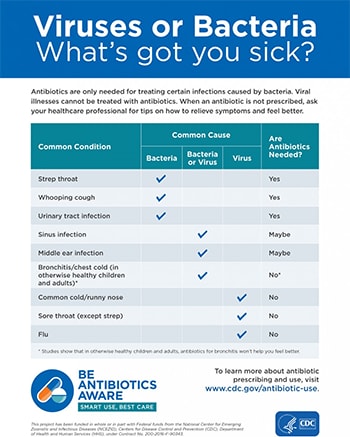
Antibiotics are only needed for treating certain infections caused by bacteria. We rely on antibiotics to treat serious, life-threatening conditions such as pneumonia and sepsis, the body’s extreme response to an infection. Effective antibiotics are also needed for people who are at high risk for developing infections. Some of those at high risk for infections include patients undergoing surgery, patients with end-stage kidney disease, or patients receiving cancer therapy (chemotherapy).

When Antibiotics Aren’t Needed

Antibiotics do not work on viruses, such as those that cause colds, flu, bronchitis, or runny noses, even if the mucus is thick, yellow, or green.

Antibiotics are only needed for treating certain infections caused by bacteria, but even some bacterial infections get better without antibiotics. Antibiotics aren’t needed for many sinus infections and some ear infections. Antibiotics can save lives, and when a patient needs antibiotics, the benefits usually outweigh the risks of side effects and antibiotic resistance. When antibiotics aren’t needed, they won’t help you, and the side effects could still cause harm. Common side effects of antibiotics can include:

  • rash
  • dizziness
  • nausea
  • diarrhea
  • yeast infections

More serious side effects include Clostridioides difficile infection (also called C. difficile or C. diff), which causes severe diarrhea that can lead to severe colon damage and death. People can also have severe and life-threatening allergic reactions, such as wheezing, hives, shortness of breath, and anaphylaxis (which also includes feeling like your throat is closing or choking, or your voice is changing).."
Antibiotics
 

Thursday, November 8, 2018

Antibiotic Resistance, Food, and Food-Producing Animals

"More than 400,000 Americans get sick every year from infections caused by antibiotic-resistant foodborne bacteria, according to CDC estimates. People who are infected with antibiotic-resistant bacteria may experience more severe illness, including hospitalization and death, because these infections can be harder to treat. Learn what CDC is doing and how you can protect yourself and your loved ones from these types of infections.

Antibiotic Resistance and Food Production

Antibiotic resistance is the ability of bacteria to resist the effects of an antibiotic. This means that bacteria are not killed by the antibiotic and can continue to grow. About one in five resistant infections are caused by germs, such as Salmonella and Campylobacter, from food and animals.
Improving antibiotic use can help slow antibiotic resistance. 
Antibiotics are medicines that kill bacteria.  They are extremely important in treating serious bacterial infections in people.  However, bacteria can become resistant to antibiotics when these drugs are given unnecessarily to people or animals who don’t require them.  Improving antibiotic prescribing and use is critical to ensure that bacteria don’t become resistant to antibiotics. Prescribers should only treat people and animals with antibiotics when they need them for medically sound reasons.
All humans and animals have bacteria in their gut. When they are given antibiotics, many of these bacteria are killed, but the resistant ones may survive and multiply. This is why the responsible use of antibiotics is so important in both humans and animals..."
Antibiotic resistance

Wednesday, September 19, 2018

Antibiotic Resistance: A Global Threat

"Antibiotic resistance requires a collaborative approach across countries to detect, prevent, and respond to these threats. Global leaders are joining CDC’s AMR Challenge by committing to action across healthcare, food, communities, and the environment (soil and water) to accelerate the fight.
Antibiotic resistance, when germs (i.e., bacteria, fungi) develop the ability to defeat the drugs designed to kill them, is a top threat to the public’s health and a priority across the globe. In the U.S. alone, it causes more than 2 million infections and 23,000 deaths per year. Worldwide, antibiotic resistance threatens our progress in healthcare, food production, and ultimately life expectancy.
Antibiotic resistance has been found in all regions of the world. Modern travel of people, animals, and goods means antibiotic resistance can easily spread across borders and continents. Collaborative, coordinated efforts will help slow the development and spread of antibiotic resistance and protect people.

CDC Collaborates to Support Global Action

Through CDC’s Antibiotic Resistance Solutions Initiative, the agency collaborates with countries throughout the world to improve antibiotic use, track resistance, and implement infection prevention and control activities in healthcare settings, where antibiotic resistance can emerge and amplify the spread.
CDC shares expertise and deploys experts to investigate and contain resistance outbreaks, and assists other countries as they:
  • Implement infection prevention and control programs, and antibiotic stewardship programs in healthcare settings
  • Establish or strengthen national tracking systems to respond rapidly to outbreaks, identify emerging pathogens, and track trends
  • Enhance laboratory capacity to detect and report resistance
  • Develop and implement national action plans to address the threat of antibiotic resistance..."
    Antibiotics

Wednesday, November 15, 2017

Be Antibiotics Aware: Smart Use, Best Care

"The Centers for Disease Control and Prevention (CDC), along with national and international partners, will observe the tenth annual U.S. Antibiotic Awareness Week (formerly Get Smart About Antibiotics Week) November 13–19, 2017. This year’s observance coincides with the release of CDC’s Be Antibiotics Aware, a national effort to help improve antibiotic prescribing and use and to help combat antibiotic resistance.
Antibiotic resistance is one of the most urgent threats to the public’s health. Antibiotic resistance occurs when bacteria develop the ability to defeat the drugs designed to kill them. Each year in the United States, at least 2 million people get infected with antibiotic-resistant bacteria, and at least 23,000 people die as a result.
Antibiotics save lives but any time antibiotics are used, they can cause side effects and lead to antibiotic resistance. About 30 percent of antibiotics, or 47 million prescriptions, are prescribed unnecessarily in doctors’ offices and emergency departments in the United States, which makes improving antibiotic prescribing and use a national priority.
Antibiotics
.."

Wednesday, July 26, 2017

Antibiotic Resistance, Food, and Food-Producing Animals

"More than 400,000 Americans get sick every year from infections caused by antibiotic-resistant foodborne bacteria, according to CDC estimates. People who are infected with antibiotic-resistant bacteria may experience more severe illness, including hospitalization and death, because these infections can be harder to treat. Learn what CDC is doing and how you can protect yourself and your loved ones from these types of infections.

Antibiotic Resistance and Food Production

Antibiotic resistance is the ability of bacteria to resist the effects of an antibiotic. This means that bacteria are not killed by the antibiotic and can continue to grow. About one in five resistant infections are caused by germs, such as Salmonella and Campylobacter, from food and animals..."

Antibiotic resistance

Wednesday, August 5, 2015

Making Health Care Safer Stop Spread of Antibiotic Resistance

"We're at a tipping point: an increasing number of germs no longer respond to the drugs designed to kill them. Inappropriate prescribing of antibiotics and lack of infection control actions can contribute to drug resistance and put patients at risk for deadly diarrhea (caused by C. difficile). Even if one facility is following recommended infection controls, germs can be spread inside of and between health care facilities when patients are transferred from one health care facility to another without appropriate actions to stop spread. Lack of coordination between facilities can put patients at increased risk. Now more than ever is the time for public health authorities and health care facilities to work together, sharing experiences and connecting patient safety efforts happening across the state..."
Antibiotic resistance

Saturday, September 20, 2014

Report to the President on Combating Antibiotic Resistance

"This report offers practical recommendations to the Federal government for strengthening the
Nation’s ability to combat the rise in antibiotic ‐resistant bacteria. PCAST finds
that without rapid and coordinated action, the Nation risks losing the tremendous
public health progress made over the last century from the discovery and development of antibiotic drugs, thereby threatening patient care, economic growth, public health, agriculture, economic security, and national security.."

Antibiotic_resistance

Saturday, January 25, 2014

Get Smart: Know When Antibiotics Work

"Antibiotics cure bacterial infections, not viral infections such as:
  • Colds or flu;
  • Most coughs and bronchitis;
  • Sore throats not caused by strep; or
  • Runny noses..."
Antibiotics

Thursday, November 21, 2013

Antibiotics Aren't Always the Answer

"Colds and many other upper respiratory infections, as well as some ear infections, are caused by viruses, not bacteria. If antibiotics are used too often for things they can't treat—like colds or other viral infections—they can stop working effectively against bacteria when you or your child really needs them. Antibiotic resistance—when antibiotics can no longer cure bacterial infections—has been a concern for years and is considered one of the world's most critical public health threats..."
Antibiotics

Wednesday, November 20, 2013

New guidance limits antibiotics for common infections in children

 "Every year as many as 10 million U.S. children risk side effects from antibiotic prescriptions that are unlikely to help their upper respiratory conditions. Many of these infections are caused by viruses, which are not helped by antibiotics.
This overuse of antibiotics, a significant factor fueling antibiotic resistance, is the focus of a new report  Principles of Judicious Antibiotic Prescribing for Bacterial Upper Respiratory Tract Infections in PediatricsExternal Web Site Iconby the American Academy of Pediatrics (AAP) in collaboration with the Centers for Disease Control and Prevention (CDC)..." antibiotics guidelines

Monday, September 16, 2013

Antibiotic resistance threats in the United States, 2013


"This report, Antibiotic resistance threats in the United States, 2013 gives a first-ever snapshot of the burden and threats posed by the antibiotic-resistant germs having the most impact on human health..." 
Drug resistance threat

Tuesday, January 22, 2013

Antibiotic Resistance Questions & Answers

Find recent information on the correct usage of antibiotics from the  U.S. Centers for Disease prevention and Control.
Antibiotic Resistance: Questions and Answers

Friday, November 18, 2011

Get Smart About Antibiotics


Video giving tips on safe and effective use of antibiotics