Showing posts with label antibiotic_resistant_bacteria. Show all posts

Tuesday, November 17, 2020

Be Antibiotics Aware: Smart Use, Best Care

"Be Antibiotics Aware is the Centers for Disease Control and Prevention’s (CDC) national educational effort to help improve antibiotic prescribing and use and combat antibiotic resistance.

Antibiotic resistance is one of the most urgent threats to the public’s health. Antibiotic resistance happens when germs, like bacteria and fungi, develop the ability to defeat the drugs designed to kill them. That means the germs are not killed and continue to grow. More than 2.8 million antibiotic-resistant infections occur in the United States each year, and more than 35,000 people die as a result.

Antibiotics can save lives, but any time antibiotics are used, they can cause side effects and contribute to the development of antibiotic resistance. Each year, approximately 28% of antibiotics are prescribed unnecessarily in doctors’ offices and emergency rooms (ERs), which makes improving antibiotic prescribing and use a national priority.

Helping healthcare professionals improve the way they prescribe antibiotics, and improving the way we take antibiotics, helps keep us healthy now, helps fight antibiotic resistance, and ensures that these life-saving drugs will be available for future generations.
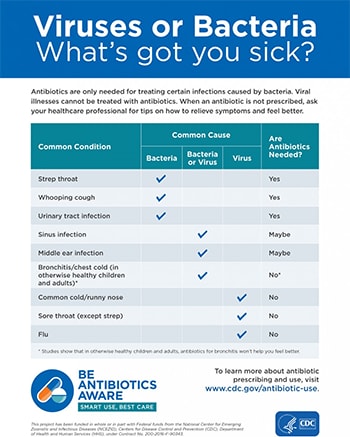
When Antibiotics Are Needed

Antibiotics are only needed for treating certain infections caused by bacteria. We rely on antibiotics to treat serious, life-threatening conditions such as pneumonia and sepsis, the body’s extreme response to an infection. Effective antibiotics are also needed for people who are at high risk for developing infections. Some of those at high risk for infections include patients undergoing surgery, patients with end-stage kidney disease, or patients receiving cancer therapy (chemotherapy).

When Antibiotics Aren’t Needed

Antibiotics do not work on viruses, such as those that cause colds, flu, bronchitis, or runny noses, even if the mucus is thick, yellow, or green.

Antibiotics are only needed for treating certain infections caused by bacteria, but even some bacterial infections get better without antibiotics. Antibiotics aren’t needed for many sinus infections and some ear infections. Antibiotics can save lives, and when a patient needs antibiotics, the benefits usually outweigh the risks of side effects and antibiotic resistance. When antibiotics aren’t needed, they won’t help you, and the side effects could still cause harm. Common side effects of antibiotics can include:

  • rash
  • dizziness
  • nausea
  • diarrhea
  • yeast infections

More serious side effects include Clostridioides difficile infection (also called C. difficile or C. diff), which causes severe diarrhea that can lead to severe colon damage and death. People can also have severe and life-threatening allergic reactions, such as wheezing, hives, shortness of breath, and anaphylaxis (which also includes feeling like your throat is closing or choking, or your voice is changing).."
Antibiotics
 

Wednesday, September 16, 2015

Establishment of the Presidential Advisory Council on Combating Antibiotic-Resistant Bacteria

"The U.S. Department of Health and Human Services, the U.S. Department of Agriculture (USDA), and the U.S. Department of Defense (DoD) announce the appointment of nationally recognized experts to the Presidential Advisory Council on Combating Antibiotic-Resistant Bacteria (the Advisory Council).
“Antibiotic resistance is a growing public health threat across our country. That’s why it’s so important that we work together to address this challenge,” said HHS Secretary Burwell. “Work is underway to implement a National Action Plan for Combating Antibiotic-Resistant Bacteria, a research-driven plan to identify and coordinate action across the administration to prevent and control outbreaks of resistant pathogens. We have made progress including CDC’s new recommendations for nursing homes to improve antibiotic prescribing. But there is still more to do. I know this council will be important to this effort and provide invaluable advice on our programs, policies and plans to continue our work to combat this growing global threat.”

Antibiotics reduce illness and death from infectious diseases. However, an increasing number of bacterial infections no longer respond to our most powerful antibiotics, putting patients at risk for severe infections and even death. Detecting, preventing, and controlling antibiotic resistance requires a strategic, coordinated, and sustained effort.  The work of the Advisory Council complements other federal efforts, including the National Strategy for Combating Antibiotic-Resistant Bacteria and the National Action Plan for Combating Antibiotic-resistant Bacteria. Together, these efforts provide a roadmap to preserve the effectiveness of antibiotics, strengthen surveillance, prevent the transmission of antibiotic-resistant bacteria, further new research, and improve international coordination..."
Antibiotic-Resistance Bacteria

Tuesday, March 31, 2015

Our Plan to Combat and Prevent Antibiotic-Resistant Bacteria

"Antibiotics save millions of lives every year. Today, however, the emergence of drug resistance in bacteria is undermining the effectiveness of current antibiotics and our ability to treat and prevent disease. The Centers for Disease Control and Prevention (CDC) estimates that drug-resistant bacteria cause two million illnesses and approximately 23,000 deaths each year in the United States alone. Antibiotic resistance also limits our ability to perform a range of modern medical procedures, such as chemotherapy, surgery, and organ transplants. That’s why fighting antibiotic resistance is a national priority.
Over the past year, the Administration has taken important steps to address the threat of antibiotic resistance. In September 2014, the President issued Executive Order (EO) 13676: Combating Antibiotic-Resistant Bacteria, which outlines steps for implementing the National Strategy on Combating Antibiotic-Resistant Bacteria and addressing the policy recommendations of the President’s Council of Advisors on Science and Technology (PCAST)’s report on Combating Antibiotic Resistance. Furthermore, the President’s FY 2016 Budget released earlier this year proposed nearly doubling the amount of Federal funding for combating and preventing antibiotic resistance to more than $1.2 billion.
Combating and preventing antibiotic resistance, however, will be a long-term effort. That’s why, today, the Administration is releasing the National Action Plan for Combating Antibiotic Resistant Bacteria (NAP). The NAP outlines a whole-of-government approach over the next five years targeted at addressing this threat..."
Antibiotic resistant bacteria