Saturday, March 12, 2022

House of Commons Library. Ukraine Crisis

[UK Parliament. House of Commons Library]

"This page features Commons Library  publications revelant to the current crisis in Ukraine.

On 24 February 2022 Russia launched military action in Ukraine, with forces crossing into the country from Belarus in the north, Russia in the east and Crimea in the south.

President Putin has said Russia, acting in self defence, was launching a special military operation in the Donbas and called on Ukrainian forces to lay down their weapons. However, a full-scale assault on the country is currently underway. 

Russia’s actions came days after President Putin officially recognised the self-declared independence of the Donetsk People’s Republic (DPR) and Luhansk People’s Republic (LPR), the regions of eastern Ukraine that are under the control of Russian-backed separatist forces, and deployed forces to the region, under the guise of peacekeeping operations. Russia had previously denied that it was planning to invade Ukraine and said its build up of forces was in response to provocative actions by NATO. 

Russia’s invasion of Ukraine has been met with international condemnation.

An “unprecedented” package of sanctions has been imposed on Russia by the US, EU, UK and other allies and partners around the world. 

NATO has moved to shore up the defence of eastern Europe with the deployment of additional ships, fighter aircraft and troops to the region. Military assistance is also being provided to Ukraine, although NATO troops will not be deployed on the ground as Ukraine is a partner country of the Alliance and not party to NATO’s Article V mutual defence clause. NATO allies have also ruled out imposing a no-fly zone over Ukraine.."
Ukraine 

Thursday, March 10, 2022

Cluster Munitions: Background and Issues for Congress

"Cluster munitions are air-dropped or ground-launched weapons that release a number of smaller submunitions intended to kill enemy personnel or destroy vehicles. Cluster munitions were developed in World War II and are part of many nations’ weapons stockpiles. Cluster munitions have been used frequently in combat, including the early phases of the current conflicts in Iraq and Afghanistan. Cluster munitions have been criticized internationally for causing a significant number of civilian deaths, and efforts have been undertaken to ban and regulate their use. The Department of Defense (DOD) continues to view cluster munitions as a military necessity but in 2008 instituted a policy to reduce the failure rate of cluster munitions (a major contributor to civilian casualties) to 1% or less after 2018.

In November 2017, DOD issued a new DOD policy that essentially reversed the 2008 policy. Under the new policy, combatant commanders can use cluster munitions that do not meet the 1% or less unexploded submunitions standard in extreme situations to meet immediate warfighting demands. In addition, the new policy does not establish a deadline to replace cluster munitions exceeding the 1% rate and states that DOD “will retain cluster munitions currently in active inventories until the capabilities they provide are replaced with enhanced and more reliable munitions.”

In February 2022, Russia allegedly used cluster munitions during its invasion of Ukraine. Although the allegations have apparently not been officially verified, a reported pending International Criminal Court (ICC) investigation of war crimes in the Ukraine might provide insights.

Potential issues for Congress include potential policy impacts of allegations of Russian cluster munitions use in Ukraine, cluster munitions in an era of precision weapons, other weapons in lieu of cluster munitions, and the potential impact of DOD’s 2017 revised cluster munitions policy..."
Cluster munitions 

Monday, March 7, 2022

Test Your Knowledge of Bleeding Disorders

"What Is A Bleeding Disorder?

Bleeding disorders are conditions in which the blood does not clot normally because certain proteins in the blood are missing or do not work properly.

Von Willebrand Disease

Von Willebrand disease (VWD) is a disorder in which the blood does not clot properly. Blood contains many proteins that help the blood clot when needed. One of these proteins is called von Willebrand factor (VWF). People with VWD either have a low level of VWF in their blood or the VWF protein doesn’t work the way it should. There are three types of VWD: type 1 (the most common and mildest form of VWD), type 2, and type 3 (the most severe form of VWD).

The signs and symptoms of VWD include:

Hemophilia

Hemophilia is an inherited bleeding disorder in which the blood does not clot properly due to a lack or decrease in a protein called clotting factor. The two most common types of hemophilia are hemophilia A, which is due to a lack of clotting factor VIII (8) and hemophilia B, which is due to a lack of clotting factor IX (9).

The signs and symptoms of hemophilia include:

  • Frequent or hard-to-stop nosebleeds.
  • Easy bruising.
  • Longer-than-normal bleeding after injury, surgery, and dental work.
  • Bleeding into the joints. This can cause swelling and pain or tightness in the joints; it often affects the knees, elbows, and ankles.
  • Bleeding into the skin (which is bruising) or muscle and soft tissue causing a build-up of blood in the area (called a hematoma).

Who Is Affected by Bleeding Disorders?

VWD is the most common bleeding disorder, found in up to 1% of the U.S. population. This means that 3.2 million (or about 1 in every 100) people in the United States have the disease. Although VWD occurs among men and women equally, women are more likely to notice the symptoms because of heavy or abnormal bleeding during their menstrual periods and after childbirth.

The exact number of people with hemophilia is unknown.

The majority of hemophilia and VWD cases are inherited and there is a known family history of the disorder. However, about one-third of families with babies who are diagnosed with hemophilia report having no known history of the disorder. Hemophilia can also be caused by a spontaneous (random) change in a mother or child’s gene.

Read personal stories from people who have VWD and hemophilia to learn more about their experiences. Living with the complications of a bleeding disorder can be challenging; however, with treatment, people with bleeding disorders can manage their bleeding symptoms..."
Bleeding disorders 

Rethink Your Drink

"The next time you go grocery shopping, read the nutrition labels on the items in your cart to see which ones have the most added sugars. You may be surprised to see that the beverages have more added sugars than the food.

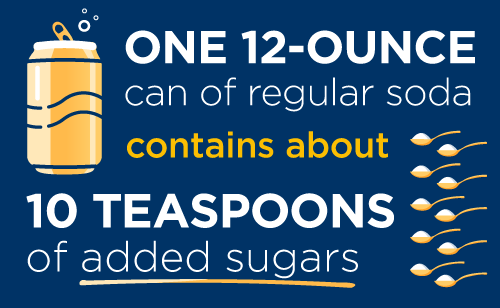
Sugary drinks are the leading source of added sugars in the American diet. These sweetened liquids include regular soda, fruit drinks, sports drinks, energy drinks, and sweetened waters. The flavored coffees we grab on the way to work and the sweetened tea we make at home also count as sugary drinks.

Added sugar
Sugar in drinks
Drink (12-ounce serving)Teaspoons of SugarCalories
Tap or Unsweetened Bottled Water0 teaspoons0
Unsweetened Tea0 teaspoons0
Sports Drinks2 teaspoons75
Lemonade6 ¼  teaspoons105
Sweet Tea8 ½ teaspoons120
Cola10 ¼ teaspoons150
Fruit Punch11 ½ teaspoons195
Root Beer11 ½ teaspoons170
Orange Soda13 teaspoons210
Adapted from We Can! pdf icon[PDF-305KB]external icon

Why should I be concerned about sugary drinks?

People who often drink sugary drinks are more likely to face health problems, such as weight gain, obesity, type 2 diabetes, heart disease, kidney diseases, non-alcoholic liver disease, cavities, and gout, a type of arthritis.1-4

Tricks to Rethink Your Drink


  • Choose water (tap or unsweetened, bottled, or sparkling) over sugary drinks.
  • Need more flavor? Add berries or slices of lime, lemon, or cucumber to water.
  • Missing fizzy drinks? Add a splash of 100% juice to plain sparkling water for a refreshing, low-calorie drink.
  • Need help breaking the habit? Don’t stock up on sugary drinks. Instead, keep a jug or bottles of cold water in the fridge.
  • Water just won’t do? Reach for drinks that contain important nutrients such as low fat or fat free milk; unsweetened, fortified milk alternatives; or 100% fruit or vegetable juice first.
  • At the coffee shop? Skip the flavored syrups or whipped cream. Ask for a drink with low fat or fat free milk, an unsweetened milk alternative such as soy or almond, or get back to basics with black coffee.
  • At the store? Read the Nutrition Facts label to choose drinks that are low in calories, added sugars, and saturated fat.
  • On the go? Carry a reusable water bottle with you and refill it throughout the day.
  • Still thirsty? Learn how to drink more water..."
    Drinks
     

Kidney Testing: Everything You Need to Know

"If you have diabetes, you have a higher risk for chronic kidney disease. Your doctor will likely recommend you have one or more kidney tests to check the health of your kidneys. The sooner you know the health of your kidneys, the sooner you can take steps to protect them. Knowledge is power—learn about what these tests do and what your results could mean.

Chronic kidney disease (CKD) is a condition in which the kidneys become damaged over time and cannot filter blood as well as they should. Diabetes is a leading cause of CKD, which often causes no symptoms until your kidneys are badly damaged.

The good news is that if you find and treat kidney disease early, you may be able to keep CKD from getting worse and prevent other health problems such as heart disease. But the only way to know how well your kidneys are working is to get tested.

If you have diabetes, you know how important it is to prevent complications like CKD. Your doctor will want to check your kidney health, usually by testing your urine and blood.

Urine Tests

One of the earliest signs of kidney disease is when protein leaks into your urine (called proteinuria). To check for protein in your urine, a doctor will order a urine test. There are two types of urine tests that can check your protein levels.

Dipstick urine test. This test is often done as part of an overall urinalysis, but it can also be done as a quick test to look for albumin (a protein produced by your liver) in your urine. It does not provide an exact measurement of albumin but does let your doctor know if your levels are normal. A dipstick (a chemically treated paper) is placed in a urine sample you provide and if levels are above normal, the dipstick changes color. If you have abnormal albumin levels, your doctor may want to run further tests.

Urine albumin-to-creatinine ratio (UACR). This test measures the amount of albumin and compares it to the amount of creatinine (a waste product that comes from the normal wear and tear of muscles in the body) in your urine. A UACR test lets the doctor know how much albumin passes into your urine over a 24-hour period. A urine albumin test result of 30 or above may mean kidney disease.

It’s important to know that:

  • The test may be repeated once or twice to confirm the results.
  • If you do have kidney disease, the amount of albumin in your urine helps your doctor know which treatment is best for you.
  • A urine albumin level that stays the same or goes down means that your treatment is working..."
    Kidney testing
     

Wednesday, March 2, 2022

Russia’s Nuclear Weapons: Doctrine, Forces, and Modernization

"Russia’s nuclear forces consist of both long-range, strategic systems—including intercontinental ballistic missiles (ICBMs), submarine-launched ballistic missiles (SLBMs), and heavy bombers—and shorter- and medium-range delivery systems. Russia is modernizing its nuclear forces, replacing Soviet-era systems with new missiles, submarines and aircraft while developing new types of delivery systems. Although Russia’s number of nuclear weapons has declined sharply since the end of Cold War, it retains a stockpile of thousands of warheads, with more than 1,500 warheads deployed on missiles and bombers capable of reaching U.S. territory.

Doctrine and Deployment

During the Cold War, the Soviet Union valued nuclear weapons for both their political and military attributes. While Moscow pledged that it would not be the first to use nuclear weapons in a conflict, many analysts and scholars believed the Soviet Union integrated nuclear weapons into its warfighting plans. After the Cold War, Russia did not retain the Soviet “no first use” policy, and it has revised its nuclear doctrine several times to respond to concerns about its security environment and the capabilities of its conventional forces. When combined with military exercises and Russian officials’ public statements, this evolving doctrine seems to indicate that Russia has potentially placed a greater reliance on nuclear weapons and may threaten to use them during regional conflicts. This doctrine has led some U.S. analysts to conclude that Russia has adopted an “escalate to de-escalate” strategy, where it might threaten to use nuclear weapons if it were losing a conflict with a NATO member, in an effort to convince the United States and its NATO allies to withdraw from the conflict. Russian officials, along with some scholars and observers in the United States and Europe, dispute this interpretation; however, concerns about this doctrine have informed recommendations for changes in the U.S. nuclear posture.

Russia’s current modernization cycle for its nuclear forces began in the early 2000s and is likely to conclude in the 2020s. In addition, in March 2018, Russian President Vladimir Putin announced that Russia was developing new types of nuclear systems. While some see these weapons as a Russian attempt to achieve a measure of superiority over the United States, others note that they likely represent a Russian response to concerns about emerging U.S. missile defense capabilities. These new Russian systems include, among others, a heavy ICBM with the ability to carry multiple warheads, a hypersonic glide vehicle, an autonomous underwater vehicle, and a nuclear-powered cruise missile. The hypersonic glide vehicle, carried on an existing long-range ballistic missile, entered service in late 2019.

Arms Control Agreements

Over the years, the United States has signed bilateral arms control agreements with the Soviet Union and then Russia that have limited and reduced the number of warheads carried on their nuclear delivery systems. Early agreements did little to reduce the size of Soviet forces, as the Soviet Union developed and deployed missiles with multiple warheads. However, the 1991 Strategic Arms Reduction Treaty, combined with financial difficulties that slowed Russia’s nuclear modernization plans, sharply reduced the number of deployed warheads in the Russian force. The 2010 New START Treaty added modest reductions to this record but still served to limit the size of the Russian force and maintain the transparency afforded by the monitoring and verification provisions in the treaty.

Congressional Interest

Some Members of Congress have expressed growing concerns about the challenges Russia poses to the United States and its allies. In this context, Members of Congress may address a number of questions about Russian nuclear forces as they debate the U.S. nuclear force structure and plans for U.S. nuclear modernization. Congress may review debates about whether the U.S. modernization programs are needed to maintain the U.S. nuclear deterrent, or whether such programs may fuel an arms race with Russia. Congress may also assess whether Russia will be able to expand its forces in ways that threaten U.S. security if the United States and Russia do not continue to limit their forces under the New START Treaty. Finally, Congress may review the debates within the expert community about Russian nuclear doctrine when deciding whether the United States needs to develop new capabilities to deter Russian use of nuclear weapons..."
Russia's nuclear weapons 

U.S. Census Bureau Releases Key Stats in Honor of Women's History Month

"National Women’s History Month traces its roots to March 8, 1857, when women from various New York City factories staged a protest over poor working conditions. The first Women's Day celebration in the United States was in 1909, also in New York City. More than seven decades later, Congress in 1981 established National Women's History Week to be commemorated annually the second week of March. In 1987, Congress expanded the week to a month and every year since has passed a resolution (and the president has issued a proclamation) designating March Women’s History Month.

As we celebrate Women’s History Month 2022, we reflect upon advances women have made over the last decade. Women have increased their earnings, education and fields of occupation, and continue to have longer average life spans than men. Below are some Census Bureau stats highlighting these and other changes over the years. We appreciate the public’s cooperation in helping us measure America’s people, places and economy. 

Did You Know?

164.8 million

The number of females of all ages in the United States. There were 159.9 million males of all ages. 

2 to 1

The approximate ratio of women to men ages 85 and older (4.1 million to 2.2 million) in the United States. 

20.7%

In 2019, the percentage of women 25 and older with a bachelor’s degree as their highest degree; 19.9% of men had a bachelor’s degree as their highest degree.

80.8%

Women's median earnings as a percentage of men's median earnings, for full full-time, year-round workers 16 years and older.

More Stats

Tuesday, March 1, 2022

Dane County Face Covering Order to Expire March 1

"posted 

Effective at 12:00am on March 1, 2022, Public Health Madison & Dane County will no longer require face coverings in public indoor spaces in light of steadily decreasing COVID-19 case rates and hospitalizations.

The seven-day average of cases peaked on January 12 when 1,491 people were diagnosed with COVID-19. The seven-day average of hospitalizations peaked on January 15 with an average of 195 people hospitalized with COVID-19. Today, cases have fallen to a seven-day average of 340 cases, less than 25% of peak levels and are continuing to decline. Hospitalizations are also down substantially to a seven-day average of 110, which is 44% lower than the peak 7-day average of hospitalizations in January 2022 caused by Omicron.

Additionally, high case levels did not translate to as high of hospitalization levels as they did before vaccination was readily available. Currently, an estimated 58% of Dane County residents are up to date  on their vaccines, meaning a person has received all recommended COVID-19 vaccines, including boosters, when eligible.

“Letting the face covering order expire doesn’t mean that the pandemic is over. Rather, it signals that we have made it through the Omicron surge and are entering a new stage of the pandemic,” said Janel Heinrich, Director of Public Health Madison & Dane County. “The most important thing you can do now is to stay up-to-date on our vaccines as they have proven to be highly effective in protecting you from becoming severely ill, ending up in the hospital, or dying from COVID-19.”

Vaccines are safe, free, and widely available throughout Dane County, including the community vaccination clinic at the Alliant Energy Center, recurring mobile clinics , local pharmacies, or at your healthcare provider. Everyone ages 5 and older are now eligible to receive a COVID-19 vaccine, and many are eligible for boosters, with approval for children ages 6 months-4 years expected this Spring.

“As we move forward in this pandemic, community testing and vaccination options will remain readily available to those who need them, and people are encouraged to continue to wear masks if it makes them feel more comfortable,” said Satya Rhodes-Conway, City of Madison Mayor. “Wearing masks, especially well-fitting masks in indoor public settings, has been proven to reduce the risk of contracting or spreading COVID-19.”

Dane County’s public health order expiration does not affect the federal requirement for face coverings on public transportation , including public transit networks, airplanes, buses and school buses, trains, taxis, Ubers and Lyfts.

“I want to thank everyone in the community for your commitment to keeping yourselves and your neighbors safe throughout the pandemic,” said Dane County Executive Joe Parisi. “It hasn’t been easy, that’s for sure; but your diligence, combined with the amazing work of Public Health and our many community partners, is the reason we have come through the pandemic with one of the lowest per-capita death rates in the nation. Thank you.”

Public Health will continue case investigation efforts to prevent spread and strongly encourages everyone to stay home when sick, and follow the latest isolation and quarantine guidance to prevent transmission, which can include masking recommendations.

“Together, healthcare workers and Public Health staff have worked tirelessly to meet the ever-changing demands of this pandemic by following the latest science and applying it to their response,” said Jerry Halverson, MD, Chair of the Board of Health. “This decision is no different. Now is the time we rely on folks to make good decisions when it comes to their own health, and the health of their neighbors.”

For more information about COVID-19 in Dane County, visit publichealthmdc.com/coronavirus. You can also follow @publichealthmdc on Facebook , Twitter , and Instagram ..."
Face coverings
 

COVID-19 Vaccine

"Options for Where to Get Vaccinated

  • Everyone 5+ is eligible for vaccine in Wisconsin.
  • Many people are eligible for vaccine boosters

Mass Vaccination Clinics

BOOK AN APPOINTMENT

Public Health Madison & Dane County 

  • Vaccine appointments for people 5+ are available at our East Washington Office and our South Madison Office.
  • We recommend appointments at our South Madison & East Washington clinics. We accept walk-ins, but availability is not guaranteed. If you need help booking an appointment, please call (608) 242-6328.
  • Free rides are available to Public Health Madison & Dane County offices for vaccination appointments. This is not an on-demand service; call (608) 243-0420 to schedule a ride.
  • People under 18 must have a parent or guardian with them when they arrive to be vaccinated. If this is not possible, they must be reachable by phone.
  • If you have a COVID-19 vaccine card, please bring it with you to your vaccination appointment, so that we can add additional/booster dose information. 


The Arena at Alliant Energy Center 

  • Vaccine appointments for people 5+ are available at the Arena at Alliant Energy Center, which is now run by AMI Expeditionary Healthcare. AMI is a healthcare support organization that is contracted by the Wisconsin Department of Health Services to operate vaccination clinics across the state.
  • Appointments are recommended but not required. To book an appointment, visit our appointments page
  • Free rides are available to the Arena for vaccination appointments. Call (608) 243-0420 to schedule a ride. This is not an on-demand service; you will be scheduling an appointment to get a free ride.

Other Vaccination Options

  • Local businesses and sites. VaccineFinder  allows you to easily find vaccine near you offered at pharmacies, healthcare providers, and community sites.

  • Your healthcare provider. Some providers will vaccinate you, even if you are not their patient. Call your provider, or check a local healthcare provider’s website.

  • UW-Madison. UW–Madison  is vaccinating all eligible students and employees. See website  for details.
  • Vaccine for homebound residents. For Dane County residents who are homebound, the ADRC can assist with getting you vaccinated! Call ADRC at (608) 240-7400 for more information.

  • Pop-up vaccination clinics. We are teaming up with community partners to host pop-up vaccination clinics. Find details by clicking a pin on the map  below:.."
    COVID-19 vaccination
     

Climate Change 2022: Impacts, Adaptation and Vulnerability

[United Nations]

"The Working Group II contribution to the IPCC Sixth Assessment Report assesses the impacts of climate change, looking at ecosystems, biodiversity, and human communities at global and regional levels. It also reviews vulnerabilities and the capacities and limits of the natural world and human societies to adapt to climate change.

Summary for Policymakers

The Summary for Policymakers (SPM) provides a high-level summary of the key findings of the Working Group II Report and is approved by the IPCC member governments line by line.

Download (https://report.ipcc.ch/ar6wg2/pdf/IPCC_AR6_WGII_FinalDraft_FullReport.pdf)
Climate Change 2022 

Russia’s Invasion of Ukraine: Overview of U.S. and Allied Responses

"Russia launched a full-scale air, land, and sea attack on the independent and democratic state of Ukraine on February 24, 2022. The United States and its allies around the world have condemned Russia’s “unprecedented military aggression” as “unprovoked and unjustified.” On February 24, President Biden said,

"Now the entire world sees clearly what [Vladimir] Putin and his Kremlin allies are really all about. This was never about genuine security concerns.... It was always about naked aggression, about Putin’s desire for empire by any means necessary—by bullying Russia’s neighbors through coercion and corruption, by changing borders by force, and, ultimately, by choosing a war without a cause. Putin’s actions betray his sinister vision for the future of our world—one where nations take what they want by force."

Moscow’s objectives appear to include a broad seizure of territory across Ukraine and replacement of Ukraine’s democratically elected government with a nondemocratic satellite regime. Russia also may be seeking to annex a greater part of eastern and southern Ukraine, leaving a rump Ukraine to serve as a puppet state. Reports show many incidents of Ukrainian armed forces’ resistance to the Russian invasion. Many civilians have fled their homes, and Ukraine’s government has ordered a general military mobilization. Russian troops reportedly entered Ukraine’s capital, Kyiv, on February 25, 2022.

Since December 2021, the United States and allies had warned Russian officials they were prepared to impose severe new sanctions on Russia if it launched a new invasion of Ukraine, a country Russia first invaded and partially occupied in 2014. The United States and allies imposed an initial round of sanctions on February 21-23, 2022, in response to Russia’s purported recognition of two Russia-occupied regions in eastern Ukraine as independent states. The United States and allies imposed more sanctions on February 24, 2022, after Russia launched its attack. Members of Congress are considering additional sanctions on Russia and other actions in response to Russia’s invasion of Ukraine..."
Russia's invasion Ukraine 

Working Women: A Snapshot

"At the Labor Department, we like to brag about Frances Perkins, who was both the first woman to serve in the Cabinet (starting in 1933) and the longest serving, since she held the position for 12 years. Moreover, we’ve had more women leaders (seven) than any other department. The women who have led the department all made meaningful improvements to the lives of America’s workers – as have countless working women who have advocated for themselves and their coworkers, and had a lasting impact on work in America.  

Despite decades of progress, we know that too many women still aren’t enjoying equity at work. Women – and women of color in particular – are overrepresented in jobs with lower wages and fewer benefits. And even within specific industries and jobs, gender and racial wage gaps persist.  

As we celebrate Women’s History Month, we recognize the progress women have made and reflect on the current status of working women in America – and the work that remains to be done. Here are some interesting facts about working women. 

Women are critical to America’s economy. 

Women have been disproportionately affected by the pandemic. 

  • The unemployment rate for women 20 and older is currently 3.6% - down from a peak of 15.5% in April 2020, but still higher than it was in the months leading up to the pandemic. 

  • For women of color in particular, the recovery has been even slower. In January 2022, the unemployment rate for Black women was 5.8% and for Hispanic women it was 4.9%.."
    Working women