Showing posts with label water. Show all posts

Monday, March 7, 2022

Rethink Your Drink

"The next time you go grocery shopping, read the nutrition labels on the items in your cart to see which ones have the most added sugars. You may be surprised to see that the beverages have more added sugars than the food.

Sugary drinks are the leading source of added sugars in the American diet. These sweetened liquids include regular soda, fruit drinks, sports drinks, energy drinks, and sweetened waters. The flavored coffees we grab on the way to work and the sweetened tea we make at home also count as sugary drinks.
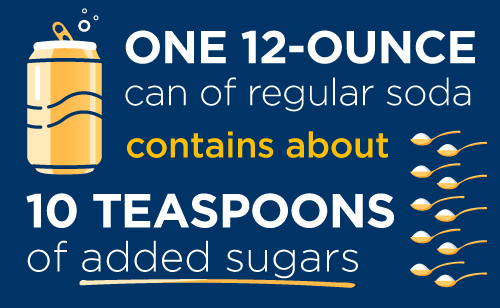
Added sugar
Sugar in drinks
Drink (12-ounce serving)Teaspoons of SugarCalories
Tap or Unsweetened Bottled Water0 teaspoons0
Unsweetened Tea0 teaspoons0
Sports Drinks2 teaspoons75
Lemonade6 ¼  teaspoons105
Sweet Tea8 ½ teaspoons120
Cola10 ¼ teaspoons150
Fruit Punch11 ½ teaspoons195
Root Beer11 ½ teaspoons170
Orange Soda13 teaspoons210
Adapted from We Can! pdf icon[PDF-305KB]external icon

Why should I be concerned about sugary drinks?

People who often drink sugary drinks are more likely to face health problems, such as weight gain, obesity, type 2 diabetes, heart disease, kidney diseases, non-alcoholic liver disease, cavities, and gout, a type of arthritis.1-4

Tricks to Rethink Your Drink


  • Choose water (tap or unsweetened, bottled, or sparkling) over sugary drinks.
  • Need more flavor? Add berries or slices of lime, lemon, or cucumber to water.
  • Missing fizzy drinks? Add a splash of 100% juice to plain sparkling water for a refreshing, low-calorie drink.
  • Need help breaking the habit? Don’t stock up on sugary drinks. Instead, keep a jug or bottles of cold water in the fridge.
  • Water just won’t do? Reach for drinks that contain important nutrients such as low fat or fat free milk; unsweetened, fortified milk alternatives; or 100% fruit or vegetable juice first.
  • At the coffee shop? Skip the flavored syrups or whipped cream. Ask for a drink with low fat or fat free milk, an unsweetened milk alternative such as soy or almond, or get back to basics with black coffee.
  • At the store? Read the Nutrition Facts label to choose drinks that are low in calories, added sugars, and saturated fat.
  • On the go? Carry a reusable water bottle with you and refill it throughout the day.
  • Still thirsty? Learn how to drink more water..."
    Drinks
     

Monday, March 5, 2018

Ground Water Awareness Week

"Much of the water we use comes from the ground. Learn more about ground water, the threats to its safety, and how to protect its sources during Ground Water Awareness Week.
Clean water is one of the world’s most precious resources. People use water every day for many activities, such as drinking, bathing, recreation, agriculture, cooling, manufacturing, and medical uses. Although water plays an essential role in everyone’s life, many people don’t realize that much of their water comes from the ground. An estimated 139 million Americans get their tap water from a ground water source.
National Ground Water Awareness Week, an annual observance sponsored by the National Ground Water Association (NGWA), is March 11-17, 2018. This observance highlights how important ground water is to people’s health and the environment..."
Ground water

Friday, March 3, 2017

Ground Water Awareness Week

"Much of the water we use comes from the ground. Learn more about ground water, the threats to its safety, and how to protect its sources during Ground Water Awareness Week.
Clean water is one of the world's most precious resources. People use water every day for many activities, such as drinking, bathing, recreation, agriculture, cooling, manufacturing, and medical uses. Although water plays an essential role in everyone's life, many people don’t realize that much of their water comes from the ground.
National Ground Water Awareness Week, an annual observance sponsored by the National Ground Water Association (NGWA), is March 5–11, 2017. This observance highlights how important ground water is to people’s health and the environment..."
Ground water


Tuesday, February 23, 2016

Drinking Water Mapping Application to Protect Source Waters

"What is the Drinking Water Mapping Application to Protect Source Waters (DWMAPS)?
The Drinking Water Mapping Application to Protect Source Waters or DWMAPS is EPA’s online mapping tool to help you find information about drinking water in your community. This user-friendly tool provides answers to questions like:
  • Who supplies my drinking water?
  • Is the source of my drinking water polluted?
  • Are there possible sources of pollution near my drinking water that might be affecting my community's water supply?
  • How can I get involved in protecting sources of drinking water in my community?..."
    Drinking water

Thursday, May 28, 2015

Clean Water Rule Protects Streams and Wetlands Critical to Public Health, Communities, and Economy

 "In an historic step for the protection of clean water, the U.S. Environmental Protection Agency and the U.S. Army finalized the Clean Water Rule today to clearly protect from pollution and degradation the streams and wetlands that form the foundation of the nation’s water resources.
The rule ensures that waters protected under the Clean Water Act are more precisely defined and predictably determined, making permitting less costly, easier, and faster for businesses and industry. The rule is grounded in law and the latest science, and is shaped by public input. The rule does not create any new permitting requirements for agriculture and maintains all previous exemptions and exclusions.
“For the water in the rivers and lakes in our communities that flow to our drinking water to be clean, the streams and wetlands that feed them need to be clean too,” said EPA Administrator Gina McCarthy. “Protecting our water sources is a critical component of adapting to climate change impacts like drought, sea level rise, stronger storms, and warmer temperatures – which is why EPA and the Army have finalized the Clean Water Rule to protect these important waters, so we can strengthen our economy and provide certainty to American businesses.”..."Clean water

Thursday, May 7, 2015

Community Water Fluoridation 70th Anniversary

"This year, the United States marks the 70th anniversary of community water fluoridation, one of public health's greatest success stories.
Almost all water contains some naturally-occurring fluoride, but usually at levels too low to prevent tooth decay. Water fluoridation is the process of adding a small amount of fluoride to public water supplies to a level known to make teeth stronger and prevent cavities. In 1945, Grand Rapids, Michigan, was the first city in the U.S. to fluoridate its water, and by the early 1950's, results were clear: Compared to school children from nearby areas that did not fluoridate their water, children in Grand Rapids had fewer cavities..."
Fluoride and water

Thursday, March 20, 2014

World Water Day 2014

"Each year on March 22, World Water Day attracts international attention to the conservation and development of freshwater resources.

Water and energy are closely linked. Energy has different forms, and water is crucial to produce, transport, and use all forms of energy to some degree, and these activities have different impacts on water resources..."

World Water Day

Saturday, July 20, 2013

Reducing Wildfire Risk and Protecting Our Drinking Water in a Changing Climate

"Agriculture Secretary Tom Vilsack and Interior Secretary Sally Jewell this week announced an historic agreement between the Department of Agriculture's Forest Service and the Department of the Interior’s Bureau of Reclamation to focus on proactively restoring forest lands around important watersheds and preventing costly, destructive wildfires in these areas..."
Reducing Firefire Risk and Drinking Water

Tuesday, August 14, 2012

Emergency Disinfection of Drinking Water

Find information on how to disinfect water for drinking in emergency conditions.

Monday, January 30, 2012

EPA Releases New Tool with Information about Water Pollution Across the U.S.

"The U.S. Environmental Protection Agency (EPA) announced the release of a new tool that provides the public with important information about pollutants that are released into local waterways. Developed under President Obama’s transparency initiative, the Discharge Monitoring Report (DMR) Pollutant Loading Tool brings together millions of records and allows for easy searching and mapping of water pollution by local area, watershed, company, industry sector, and pollutant. Americans can use this new tool to protect their health and the health of their communities..."
View full report.

Monday, May 2, 2011

Clean Water:Foundation of Healthy Communities and a Healthy Environment
"Recognizing the importance of clean water for healthy people, a healthy economy, and a healthy environment, the Obama Administration is working hard on a broad array of programs and initiatives to protect and enhance the Nation’s waters. The purpose of this document is to highlight important, ongoing initiatives at the Environmental Protection Agency (EPA), the U.S. Army Corps of Engineers (USACE), the U.S. Department of Agriculture (USDA), and the Department of the Interior (DOI), together with their other Federal partners, to protect our vital water resources. It also shows some important new initiatives, including updated draft guidance regarding Clean Water Act jurisdiction and modernization of the Principles and Guidelines which guide Federal investments in water resources. Taken together, these actions demonstrate a strong commitment by the Obama Administration to build on past progress and work with state, local and tribal governments, communities, and other private and not-forprofit partners across the Nation to design and deploy innovative approaches that directly address today’s clean water challenges..."

Saturday, December 4, 2010

Water Infrastructure Projects Designated in EPA Appropriations: Trends and Policy Implication
"
Congressional action to designate funds within appropriations legislation for specified projects or
locations has been increasing in recent years as a way to help communities meet needs to build
and upgrade water infrastructure systems, whose estimated future funding needs exceed $630
billion. Such legislative action has often been popularly referred to as earmarking. This report
discusses appropriations for water infrastructure programs of the Environmental Protection
Agency (EPA), focusing on such designations in the account that funds these programs.
Information on the programmatic history of EPA involvement in assisting wastewater treatment
and drinking water projects is provided in two appendixes.

Congressional appropriators began the practice of supplementing appropriations for the primary
Clean Water Act (CWA) and Safe Drinking Water Act (SDWA) assistance programs with grants
for individually designated projects in FY1989. These designated project grants are often referred
to as earmarks or as STAG grants. Since 1989, of the $56.8 billion appropriated to EPA for water
infrastructure assistance, more than 13% ($7.4 billion) has gone to designated project grants.
Notably since FY2000, appropriators have awarded such grants to a larger total number of
projects, resulting in more communities receiving such assistance, but at the same time receiving
smaller amounts of funds, on average..."

Monday, November 22, 2010

PUBLIC SPENDING ON TRANSPORTATION AND WATER INFRASTRUCTURE
"In fiscal year 2007—the most recent year for which data on combined spending by the federal government and by state and local governments are available—total public spending for transportation and water infrastructure was $356 billion, or 2.4 percent of the nation’s economic output as measured by its gross domestic product. For the purposes of this study, transportation and water infrastructure encompasses infrastructure for all forms of surface transportation (highways, mass transit, rail, and waterways), aviation, water resources (such as dams and levees), and water distribution and wastewater treatment..."

Wednesday, August 25, 2010

EPA Releases Draft Strategy for Clean Water
"The U.S. Environmental Protection Agency (EPA) is inviting the public to comment on the agency’s draft strategy to protect and restore our nation’s lakes, streams and coastal waters. The strategy, “Coming Together for Clean Water: EPA’s Strategy for Achieving Clean Water,” is designed to chart EPA’s path in furthering EPA Administrator Lisa P. Jackson’s key priority of protecting America’s waters.

The strategy was developed by considering the input and ideas generated at the April “Coming Together for Clean Water” forum as well as comments received through the online discussion forum. Participants shared their perspectives on how to advance the EPA’s clean water agenda focusing on the agency’s two priority areas: healthy watersheds and sustainable communities. EPA is now inviting the public to consider and provide their comments on the approaches outlined in the strategy..."

Thursday, July 15, 2010

We're for Water
"The U.S. Environmental Protection Agency’s (EPA’s) WaterSense program today is kicking off its national “We’re for Water” campaign to encourage Americans to make simple choices that save water. The program, in collaboration with its partner, American Water, will spread the word about saving water by traveling cross-country, stopping at national landmarks and educating consumers about WaterSense labeled products. WaterSense products use about 20 percent less water than standard models.

“Whether by replacing an old, inefficient plumbing fixture with a WaterSense labeled product or adopting more water-efficient behaviors, together we can help save water for future generations,” said Peter Silva, assistant administrator for EPA’s Office of Water. "WaterSense offers consumers simple tips that can help the environment and keep money in their pockets.".."

Friday, May 14, 2010

Legislative Approaches to Defining “Waters of the United States”
"In the 111th Congress, legislation has been introduced that seeks to clarify the scope of
the Clean Water Act(CWA) in the wake of Supreme Court decisions in 2001 and 2006 that
interpreted the law’s jurisdiction more narrowly than prior case law. The Court’s narrow interpretation involved jurisdiction over some geographically isolated wetlands, intermittent streams, and other waters. The two cases are Solid Waste Agency of Northern Cook County v.
Army Corps of Engineers(SWANCC) and Rapanos v. United States.

Bills to nullify the Court’s rulings have been introduced repeatedly since the 107th Congress,
but none had advanced until the 111th Congress. In June 2009, a Senate committee approved
S. 787, the Clean Water Restoration Act. Companion legislation in the House, H.R. 5088
(America’s Commitment to Clean Water Act), was introduced in April 2010.

Under current law, the key CWA phrase which sets the act’s reach is the phrase “navigable
waters,” defined to mean “the waters of the United States, including the territorial seas.”
Proponents of the current legislation contend that the Court misread Congress’ intent when
it enacted the CWA, and consequently the Court’s ruling unduly restricted the scope of the
act’s water quality protections. Both S. 787 and H.R. 5088 would replace the phrase “navigable
waters” in the CWA with “waters of the United States” and would install a definition of
“waters of the United States,” not found in the law now. The bills differ in how they would
define the phrase. The Senate committee bill includes a definition drawn from one paragraph
of existing federal regulatory text, while H.R. 5088 includes a longer definition based on
the same regulatory language, but with some modifications. Both bills also include provisions affirming the constitutional basis for the act’s jurisdiction. These provisions address the concern that the Court’s rulings, while decided on statutory grounds, raised related questions about the outer limits of Congress’s power to regulate waters with little or no connection to traditional navigable waters under the Commerce Clause of the Constitution..."

Tuesday, March 23, 2010

A New Approach to Protecting Drinking Water and Public Health
"EPA is seeking a new approach to expand public health protection for drinking water by going beyond the traditional framework that addresses contaminants one at a time. The Agency is initiating a national conversation to identify better ways to address contaminants in groups, improve drinking water technology, and more effectively address potential risks to give Americans greater confidence in the quality of their drinking water.
EPA will focus on four principles that will provide greater protection of drinking water. The four principles are:

Address contaminants as a groups rather than one at a time so that enhancement of drinking water protection can be achieved cost-effectively.

Foster development of new drinking water technologies to address health risks posed by a broad array of contaminants.

Use the authority of multiple statutes to help protect drinking water.

Partner with states to share more complete data from monitoring at public water systems (PWS)..."

Friday, March 19, 2010

Coming Together for Clean Water Discussion Forum
"Nearly 40 years ago, Congress passed a truly remarkable piece of legislation—the Clean Water Act. This document outlined sweeping commitments to restore and maintain the integrity of our nation’s waters, rid them of pollution, and make them safe for humans and wildlife alike.

For even longer, the Environmental Protection Agency has worked to fulfill these ambitious and important goals. Our efforts have made our water resources cleaner and safer in many ways, but new challenges arise everyday. This April, Administrator Lisa Jackson and I are inviting 100 leaders in water issues to help us sharpen our thinking during a one-day event, Coming Together for Clean Water, on how we can meet these challenges.

Specifically, we’ll discuss what we can do about the most significant pollution problems facing our waters. These evolving issues pose complex challenges to restoring healthy watersheds and creating sustainable communities across the country.

These priorities are important to all of us, and cannot be achieved in one day. That’s why Administrator Jackson and I are asking you to participate in this discussion forum, which was designed around the questions we’ll tackle during the Coming Together for Clean Water conference. I encourage you to share your thoughts and experiences on these topics, so we can use them to inform our discussion..."

Saturday, December 19, 2009

EPA Releases National Water Program Research Strategy to Advance and Broaden Research Partnerships
"The U.S. Environmental Protection Agency (EPA) released its National Water Research Strategy to engage a broader range of researchers in meeting the challenges of protecting and improving our nation’s water resources. The strategy identifies and promotes the research needs of EPA’s national water program to potential partners.

The strategy outlines the water program’s four research priorities: healthy watersheds and coastal waters, safe drinking water, sustainable water infrastructure and water security. Each priority also focuses on five technical areas: aquatic life health effects, human health effects, method development, occurrence and exposure, and treatment technologies and effectiveness.

The objective of the strategy is to diversify the science the water program uses to develop its regulatory and non-regulatory water management tools and decisions. Expanding the science base will expedite the production of the needed tools and help achieve faster and better-quantified water quality outcomes.

More information: http://www.epa.gov/waterscience/strategy"

Monday, March 30, 2009

2007 Drinking Water Infastructure Needs Survey and Assessment
"Local water utilities must make significant investments to install, upgrade, or replace equipment in order to deliver safe drinking water and protect public health. Every four years, EPA conducts a survey of the anticipated costs of these investments and reports the results to Congress. The results are also used to help determine the amount of funding each state receives for its Drinking Water State Revolving Fund program, which funds the types of projects identified in the survey.

The third report to Congress, released in 2009, is based on data collected from utilities in 2007. EPA found that the nation's 53,000 community water systems and 21,400 not-for-profit noncommunity water systems will need to invest an estimated $334.8 billion between 2007 and 2027."