Showing posts with label women_wages. Show all posts

Tuesday, March 14, 2023

5 Fast Facts: The Gender Wage Gap

"5 Fast Facts: The Gender Wage Gap
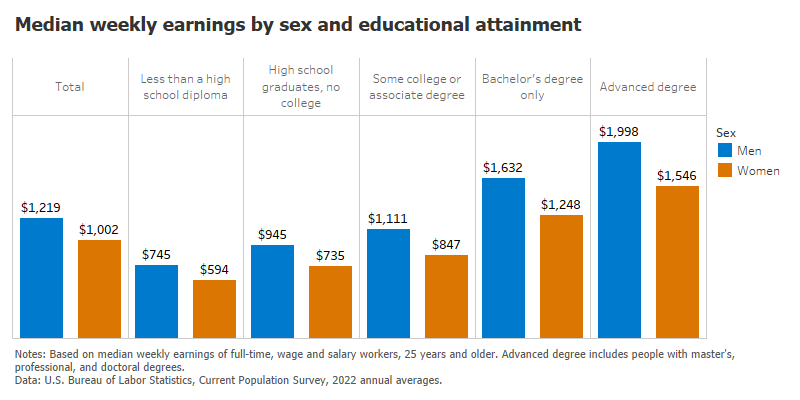
Median weekly earnings by sex and educational attainment. A bar chart shows that while average wages rise for men and women with education, men are paid more than women at every educational level.
On average, men are paid $1,219 per week and women $1,002. Earnings increase with education. With less than a high school diploma, men receive $745/week and women $594. With an advanced degree, men are paid $1,998 and women $1,546. 

March 14 is Equal Pay Day. Here are five fast facts about the gender wage gap.

  1. Stats. Overall, women are not paid as much as men, even when working full time and year round. On average, women working full time, year round are paid 83.7% of what men are paid. This inequity is even greater for Black and Hispanic women.

  2. Causes. Women’s labor is undervalued. Most of the disparity in women and men’s pay cannot be explained by measurable differences between them. Out of the causes of the wage gap that we can measure, the main contributor is that women are more likely than men to work in low-paying jobs that offer fewer benefits.

  3. Education. Education is not enough to eliminate the gender wage gap. On average, women have more years of education and are more likely than men to have completed Associate’s, Bachelor’s or Master’s degrees. Yet there is a significant gender wage gap at every level of education. Overall, women must complete one additional degree in order to be paid the same wages as a man with less education.

  4. Age. The gender wage gap does not resolve itself as women age and develop further in their careers. In fact, the wage gap for older women workers is larger than for younger women, and older Black and Hispanic women have the most extreme differences in pay.

  5. Occupations. The largest identifiable causes of the gender wage gap are differences in the occupations and industries where women and men are most likely to work. Women are 2 out of every 3 full-time workers in occupations that pay less than $30,000 per year, and fewer than 1 in 3 full-time workers in jobs paying an average of $100,000 or more. However, even within the same occupations, women earn less on average than men..."
    Gender Wage Gap
     

Thursday, March 9, 2023

Wage Gaps, Equity and Economic Growth

"Equity at work is about justice, fairness and living up to the values of our nation. In 1963, when the Equal Pay Act became law in the United States, women working full-time, year-round made 59 cents on average for every dollar earned by men. Today, that gap has shrunk, and women make 84 cents on the dollar. That’s progress, but it’s not enough.

The wage gap for many women of color is much larger.  We know that Black women, for example, lose around $3.9 billion dollars each year due to wages lost while on leave. Families where women are the primary breadwinners are disproportionately impacted when women’s work is undervalued. And there are so many benefits to eliminating wage gaps: Equity means greater equality in opportunities, more widespread protection against economic shocks, and a more inclusive, resilient economy generally.

And true workplace equity involves more than just fair pay. It’s about making sure everyone benefits from the laws and policies that protect workers. It means making sure all people can access the services they’re entitled to and ensuring that everyone can get good jobs.

We’re proud to support policies and programs that advance the interests of working women and their families. Here are a few ways the U.S. Department of Labor is embracing equity at work.

Gathering Data to Make Smarter Decisions

In 2020, our Women’s Bureau worked with the U.S. Census Bureau to conduct a comprehensive analysis of the gender wage gap. Among other things, the data showed that outdated attitudes toward “women’s work” and “men’s work” result in certain occupations being undervalued and undercompensated – and that women are often paid less on average than men in the same job.

More recently, we released the National Database of Childcare Prices, which shows that childcare is so expensive, relative to family income, that it prices many families out of paid childcare – and that mothers’ employment drops in areas with more expensive childcare.  

And in 2022, our Office of Disability Employment Policy produced an accessible, interactive map that allows users to explore disability employment statistics on median annual earnings by state and sex for people with disabilities. The data show that, across states, women with disabilities have lower median wages than disabled men.

We’ve also funded research to help us better understand the impact of our work and create more equitable programs and policies.

By gathering this data and making it publicly available, we’re not just improving the quality of our own work, we’re helping policymakers make informed decisions around the country..."
Wage Gaps and Equity 

Tuesday, March 22, 2022

Connecting the Dots: “Women’s Work” and the Wage Gap

"Most of us know that women are sometimes paid less than their male colleagues. But what you may not know is just how much the difference adds up. 

The gender wage gap is a calculation that reflects the fact that, on average, women are paid less than men. In 2020, the latest year with available data, when comparing the median wages of women who worked full-time, year-round to the wages of men who worked full-time, year-round: 

  • All women were paid, on average, 83% of what men were paid. Or put another way, women were paid 83 cents to every dollar paid to men.  

  • Many women of color were paid even less. For example, Black women were paid 64%, and Hispanic women (of any race) were paid 57% of what white non-Hispanic men were paid. 

These figures are calculated by looking at the median wages of all workers who were employed full-time for at least 50 weeks out of the year, so these figures reflect many notable differences between working women and men. These are useful numbers to help identify a distinct pattern of lower pay, but by themselves these figures do little to help us understand why women’s pay is lower.  

In 2020, the Women’s Bureau collaborated with the U.S. Census Bureau to conduct what is currently the most comprehensive analysis of the gender wage gap to date. The data shows that the majority of the gap between men and women’s wages cannot be explained through measurable differences between workers, such as age, education, industry or work hours. It is highly likely that at least some of this unmeasured portion is the result of discrimination, but it is impossible to capture exactly in a statistical model..."
Women's work 

Monday, November 28, 2016

Highlights of women’s earnings in 2015

"In 2015, women who were full-time wage and salary workers had median usual weekly earnings that were 81 percent of those of male full-time wage and salary workers. In 1979, the first year for which comparable earnings data are available, women’s earnings were 62 percent of men’s. Since 2004, the women’s-to-men’s earnings ratio has ranged from 80 to 83 percent. (See chart 1 and tables 1 and 12.)
This report presents earnings data from the Current Population Survey (CPS), a national monthly survey of 60,000 eligible households conducted by the U.S. Census Bureau for the U.S. Bureau of Labor Statistics (BLS). The weekly and hourly earnings estimates in Highlights of Women’s Earnings reflect information collected from one-fourth of the CPS monthly sample and averaged for the calendar year. These data are distinct from the annual earnings estimates for full-time, year-round workers collected separately in the Annual Social and Economic Supplement (ASEC) to the CPS and published by the U.S. Census Bureau..."
Women's wages

Wednesday, October 30, 2013

Highlights of Women’s Earnings in 2012

"In 2012, women who were full-time wage and salary workers had median usual weekly earnings of $691. On average in 2012, women made about 81 percent of the median earnings of male full-time wage and salary workers($854). In 1979, the first year for which comparable earnings data are available, women earned 62 percent of what men earned..."
Women's earnings