Showing posts with label Womens_Bureau. Show all posts

Tuesday, July 2, 2024

Older and wiser, but not richer: The gender pay gap for older workers

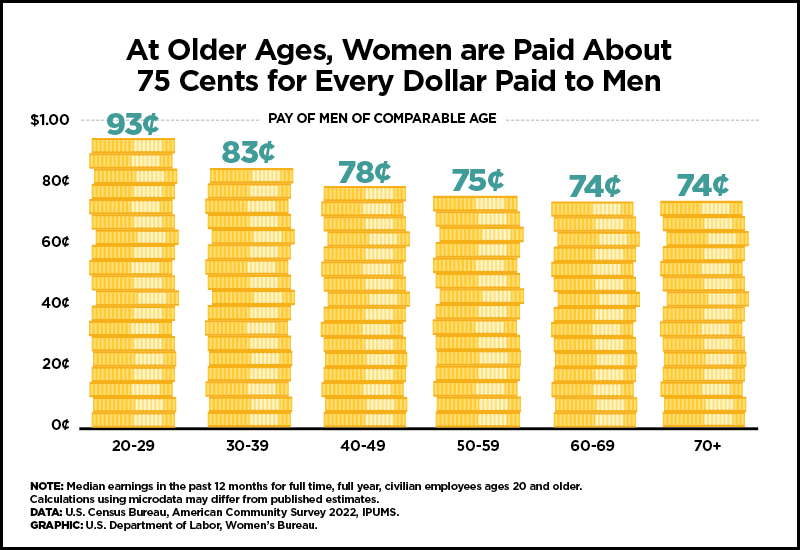
" A graph using gold coins as bars to highlight the comparable pay of men to women. Text: At Older Ages, Women are Paid About 75 Cents for Every Dollar Paid to Men. Median earnings in th epast 12 months for full time, full year, civilian employees ages 20 and older. Data: U.S. Census Bureau, American Community Survey 2022, IPUMS.

Older women are losing out

President Biden recently identified older workers as the “Backbone of the Nation.”
While that may be the case, older women workers – who comprise 47% of the labor force ages 55 and older – are plagued by a gender wage gap that is even larger than the one their younger counterparts experience.

Among workers ages 50 or older, women working full-time and year-round are paid about 75 cents for each dollar their male counterparts make. 

In 2022, the most recent year for which data are available, women 50-59 working full-time, year-round were paid about $56,000 annually – $18,300 less than their male counterparts. Women 60-69 were paid about $18,800 less than men in their 60s and women 70 or older were paid about $16,000 less than men in their 70s. To put this in perspective, among people ages 20-29, women were paid a median of $39,200 and men a median of $42,100 – an annual difference of about $3,000.
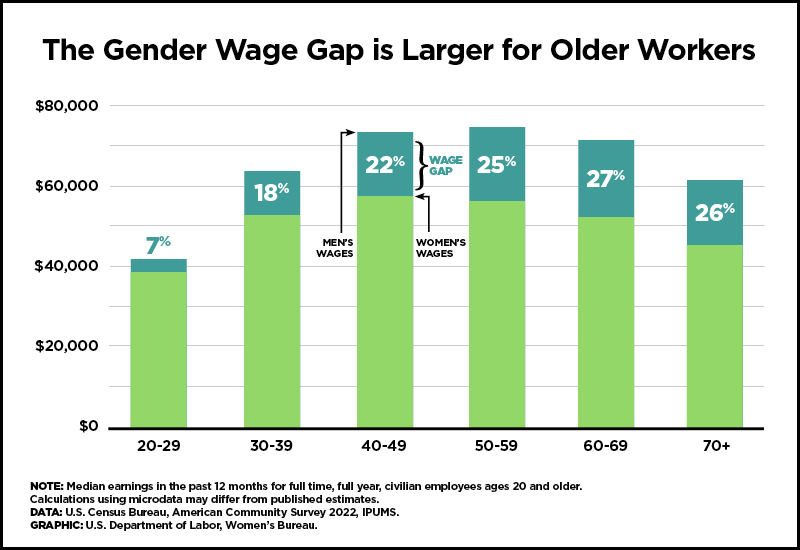
A stacked bar graph showing the median earnings in the past 12 months for full time, full year, civilian employees ages 20 and older. Text: The Gender Wage Gap is Larger for Older Workers. Data: U.S. Census Bureau, American Community Survey 2022, IPUMS.

These annual wage losses add up. Estimates suggest that over the course of their careers, women lose an average of nearly $400,000relative to white non-Hispanic men due to gender and racial wage gaps. Hispanic and Native American and Pacific Islander women make $1 million less than white non-Hispanic men, while Black women make nearly $900,000 less. These earnings deficits mean less purchasing power for women and their families and less financial security for older women (65+), 11.2% of whom live in poverty. In addition, lower wages can impact Social Security benefits and other sources of retirement income such as IRAs and 401(k)s.

Research from the Women’s Bureau and the U.S. Census Bureau shows that 70% of the gender pay gap remains unexplained after adjusting for gender differences in education, occupation, industry, work experience, hours worked and other worker characteristics. This remaining unexplained wage gap is due to a combination of unobservable worker characteristics and discrimination.

Solutions

Salary history bans are one solution that can help alleviate pay disparities. The federal government now bans the use of non-federal salary history to determine wages for federal employees, and the Biden-Harris Administration has proposed a similar rule for federal contractors.

Given the outsized role that occupational segregation plays in the gender wage gap, programs that provide pathways for women into high-paying nontraditional occupations, such as the Women’s Bureau’s Women in Apprenticeship and Nontraditional Occupations (WANTO) grant program, can help reduce pay disparities and increase economic security.

Furthermore, eliminating discrimination is key to closing gender wage gaps. The federal government is playing a role: Since Fiscal Year 2022, the Department of Labor’s Office of Federal Contract Compliance Programs, the Equal Employment Opportunity Commission and the Department of Justice have collectively recovered over $20 million in monetary relief for women who have experienced pay discrimination in the workplace.
Older Workers and Gender Pay 

Thursday, March 9, 2023

Wage Gaps, Equity and Economic Growth

"Equity at work is about justice, fairness and living up to the values of our nation. In 1963, when the Equal Pay Act became law in the United States, women working full-time, year-round made 59 cents on average for every dollar earned by men. Today, that gap has shrunk, and women make 84 cents on the dollar. That’s progress, but it’s not enough.

The wage gap for many women of color is much larger.  We know that Black women, for example, lose around $3.9 billion dollars each year due to wages lost while on leave. Families where women are the primary breadwinners are disproportionately impacted when women’s work is undervalued. And there are so many benefits to eliminating wage gaps: Equity means greater equality in opportunities, more widespread protection against economic shocks, and a more inclusive, resilient economy generally.

And true workplace equity involves more than just fair pay. It’s about making sure everyone benefits from the laws and policies that protect workers. It means making sure all people can access the services they’re entitled to and ensuring that everyone can get good jobs.

We’re proud to support policies and programs that advance the interests of working women and their families. Here are a few ways the U.S. Department of Labor is embracing equity at work.

Gathering Data to Make Smarter Decisions

In 2020, our Women’s Bureau worked with the U.S. Census Bureau to conduct a comprehensive analysis of the gender wage gap. Among other things, the data showed that outdated attitudes toward “women’s work” and “men’s work” result in certain occupations being undervalued and undercompensated – and that women are often paid less on average than men in the same job.

More recently, we released the National Database of Childcare Prices, which shows that childcare is so expensive, relative to family income, that it prices many families out of paid childcare – and that mothers’ employment drops in areas with more expensive childcare.  

And in 2022, our Office of Disability Employment Policy produced an accessible, interactive map that allows users to explore disability employment statistics on median annual earnings by state and sex for people with disabilities. The data show that, across states, women with disabilities have lower median wages than disabled men.

We’ve also funded research to help us better understand the impact of our work and create more equitable programs and policies.

By gathering this data and making it publicly available, we’re not just improving the quality of our own work, we’re helping policymakers make informed decisions around the country..."
Wage Gaps and Equity 

Thursday, August 5, 2021

5 Facts About Black Women in the Labor Force

"Black women are an integral part of the American labor force but have long faced a pay gap due to longstanding inequities in education and the labor market. In addition, they have been disproportionately impacted by the pandemic. Black women workers are overrepresented in low-paying service sector jobs, which were among the hardest hit, in terms of job losses.

Aug. 3, 2021, marks Black Women’s Equal Pay Day, a symbolic representation of the number of additional days Black women working full-time, year-round, must work, on average, to earn what white, non-Hispanic men earned the year before.

Here are five facts about Black women in the labor force:

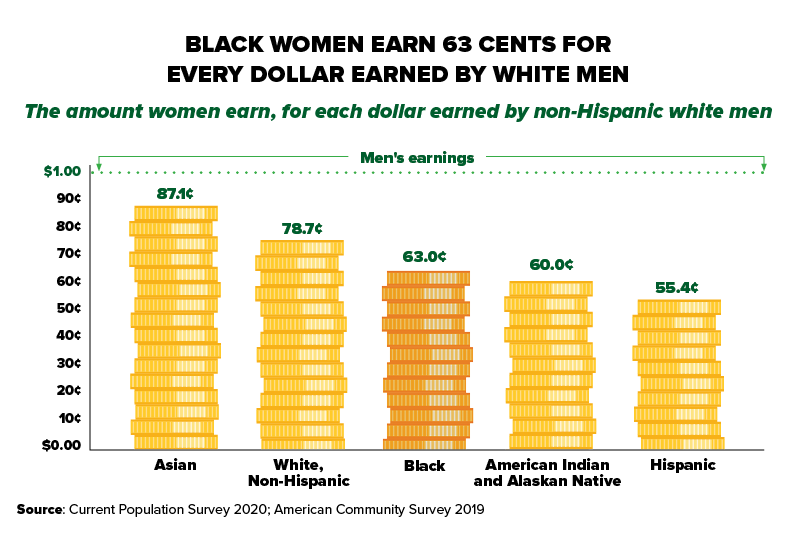
1. Black women earn 63 cents for every dollar earned by white, non-Hispanic men

Black women’s earnings are 63.0% of white, non-Hispanic men’s earnings – the third-widest gap after Native women (60%) and Hispanic women (55.4%). In comparison, white, non-Hispanic women earn 78.7% of white, non-Hispanic men’s earnings, and Asian women earn 87.1%.

Black women’s earnings are 63.0% of white, non-Hispanic men’s earnings – the third-widest gap after Native women (60%) and Hispanic women (55.4%). In comparison, white, non-Hispanic women earn 78.7% of white, non-Hispanic men’s earnings, and Asian women earn 87.1%.

2. This wage gap is not just driven by educational differences

Even controlling for education, Black women still earn less than their white male counterparts. Among those with a bachelor’s degree, Black women only earn 65% of what comparable white men do, for instance. And among people with advanced degrees, Black women earn 70% of what white men do. In fact, Black women with advanced degrees have median weekly earnings less than white men with only a bachelor’s degree..."
Black women and labor force 

Thursday, September 10, 2020

7 Stats About Working Women to Celebrate the Women’s Bureau Centennial

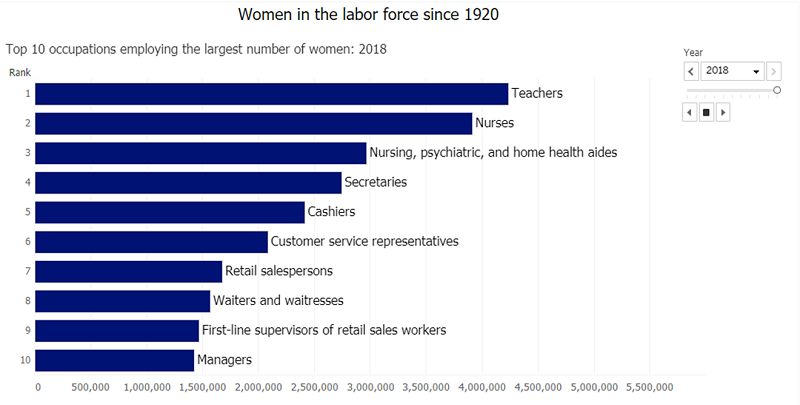
"Screenshot of data visualization tool

On June 5, 1920, the Women’s Bureau was established in the U.S. Department of Labor with the duty to “formulate standards and policies which shall promote the welfare of wage-earning women, improve their working conditions, increase their efficiency, and advance their opportunities for profitable employment.”

Today, the Women’s Bureau honors its centennial. For 100 years, the Women’s Bureau has been championing working women and the issues they care about most.

As we look ahead, it is important to highlight the accomplishments women have made in the workforce over the last 100 years. Using data from the Census and the American Community Survey, the Women’s Bureau published an interactive visualization to display how the landscape for working women has changed over time. The interactive features data on the top 10 occupations employing the largest number of women, the number of women in the workforce, and the share of women employed in the top 10 occupations for each decade from 1920 to 2018. View the interactive on the Women’s Bureau’s interactive visualization on women in the labor force since 1920..."

Working women