Showing posts with label swimming. Show all posts

Tuesday, May 23, 2023

Summer Swim Safety

"Drowning is preventable. Follow these key prevention steps:

  • Properly fence home swimming pools,
  • learn how to swim and teach children how to swim,
  • supervise children closely and constantly when they are in or near water, and
  • wear a properly fitted life jacket as these steps can all reduce the risk of drowning.

    Drowning Is a Leading Cause of Death for Children

    Keeping children safe in and around water, especially as Memorial Day Weekend kicks off, allows everyone to enjoy summer water activities. Drowning is the leading cause of death for children 1 to 4 years old, and the second leading cause of unintentional injury death for children 5 to 14 years old. Drowning can happen in seconds and is often silent. It can happen to anyone, any time there is access to water. This includes pools and lakes, and also smaller water bodies like bathtubs and water-filled buckets. However, drowning is preventable..."
    Swim Safety 

Monday, May 24, 2021

Diarrhea and Swimming

"When someone swallows contaminated recreational water—water in pools, hot tubs, water playgrounds, or oceans, lakes, and rivers— they can get sick with diarrhea. In fact, diarrhea is the most common illness spread through recreational water.

Which germs in recreational water cause diarrhea?

Diarrhea can be caused by germs such as Crypto (short for Cryptosporidium), Giardia, Shigella, norovirus, and E. coli O157:H7. Some of these germs can survive in properly chlorinated water for almost an hour, or even days.

How do germs that cause diarrhea spread in recreational water?

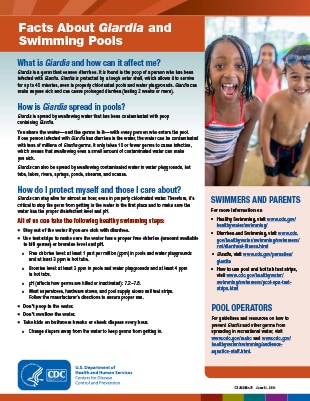
Tiny amounts of poop are rinsed off swimmers’ bottoms as they swim through the water. If someone with infectious diarrhea (which can contain up to one billion germs) gets in recreational water, germs can be washed off their bottom and contaminate the water. These germs can make someone else sick if they swallow even a small amount of contaminated water.

In public pools, water playgrounds, and hot tubs, disinfection of the water (with chlorine or bromine) and filtration work together to help kill germs. Chlorine and bromine kill most germs within minutes, and filters remove debris (e.g., leaves, sticks), which use up the needed chlorine or bromine. Swimmers may still be exposed to germs during the time it takes for the chlorine or bromine to the kill germs or for the water to be recycled through filters. And certain germs, like Crypto, can stay alive for days, even in pools with proper filtration and disinfection.

Many facilities use one filtration system for multiple pools, which causes water from multiple pools to mix. This means germs from one person’s body could contaminate the water in multiple pools.

How do I protect myself and those I care about?

We all share the water we swim, play, or relax in, so each of us plays a key role in helping to protect ourselves, our families, and our friends from germs that can cause diarrhea.

All of us can take the following healthy swimming steps:

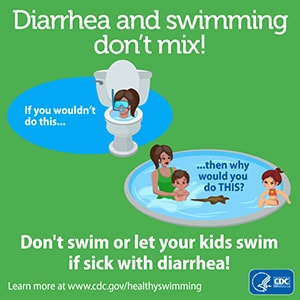
Diarrhea and swimming don't mix
  • Stay out of the water if you are sick with diarrhea.
    • If you have been diagnosed with Crypto, don’t go back in the water until 2 weeks after diarrhea has completely stopped.
  • Use test strips to make sure the water has a proper free chlorine (amount of chlorine available to kill germs) or bromine level and pH.
    • Free chlorine level: at least 1 part per million (ppm) in pools and water playgrounds and at least 3 ppm in hot tubs.
    • Bromine level: at least 3 ppm in pools and water playgrounds and at least 4 ppm in hot tubs.
    • pH (affects how effectively germs are killed or inactivated): 7.2–7.8.
    • Most superstores, hardware stores, and pool supply stores sell test strips. Follow the manufacturer’s directions to ensure proper usage.
  • Shower before you get in the water.
    • Rinsing off in the shower for just 1 minute removes most of the dirt or anything else on your body that uses up chlorine or bromine needed to kill or inactivate germs.
  • Don’t poop in the water.
  • Don’t swallow the water.
  • Take kids on bathroom breaks and check diapers every hour.
    • Change diapers away from the waterside to keep germs from getting in the water..."
      Diarrhea and swimming
       

Monday, May 20, 2019

Healthy and Safe Swimming

"Pools, hot tubs/spas, and water playgrounds are great places to have fun, be active, or just relax. Learn how to stay healthy and safe when in the water this summer!
Swimming is one of the most popular sports activities in the United States. Just 2.5 hours of physical activity per week, including water-based activity, has health benefits, no matter our age.
As with any form of physical activity, we increase the health benefits when we each do our part to decrease the risks of illness and injury.

Share the Fun, Not the Germs!

Swimming is a fun way to be healthy and spend time with family and friends. However, it’s important not to swim or let your kids swim if  they have diarrhea. Just one diarrheal incident in the water can release millions of diarrhea-causing germs like Crypto (short for Cryptosporidium), Giardia, Shigella, norovirus, and E. coli. This can make other swimmers sick if they swallow a mouthful of contaminated water..."
Healthy swimming

Wednesday, May 23, 2018

Healthy and Safe Swimming

"Pools, hot tubs, and water playgrounds are great places to have fun, be active, or just relax. Learn how to stay healthy and safe when in the water this summer! 
Swimming is one of the most popular sports activities in the United States. Just 2.5 hours of physical activity per week, including water-based activity, has health benefits, no matter our age. As with any form of physical activity, we maximize the health benefits of swimming when we each do our part to minimize the chance of illness and injury.

Swim Healthy, Stay Healthy!

Swimming is a fun and a great way to stay healthy and spend time with family and friends. However, it’s important not to swim or let your kids swim if they have diarrhea. Just one diarrheal incident in the water can release millions of diarrhea-causing germs like Crypto (short for Cryptosporidium), Giardia, Shigella, norovirus, and E. coli O157:H7. This can make other swimmers sick if they swallow a mouthful of contaminated water.

Most germs are killed within minutes by common pool disinfectants like chlorine or bromine, but Crypto is a germ that can survive in properly chlorinated water for more than 7 days. This is why Crypto is the leading cause of outbreaks  linked to swimming in the United States..."
Swimming

Sunday, September 6, 2015

Healthy Swimming Year-Round

"Stay healthy and avoid recreational water illnesses (RWIs) when you swim or use the hot tub/spa by following a few simple steps.
Even though it is frequently associated with summer, swimming is a physical activity many people enjoy all year long. Indoor pools, hot tubs, and even outdoor pools in warm climates are popular year round.
Swimming is a fun activity for people of all ages and offers many health benefits; however, recreational water (water from pools and hot tubs) can also spread germs that cause recreational water illnesses (RWIs). The germs that cause RWIs are spread by swallowing, breathing in the mists or aerosols of, or having contact with contaminated water in swimming pools, hot tubs, water parks, water play areas, interactive fountains, lakes, rivers, or oceans. RWIs can also be caused by chemicals in the water or chemicals that vaporize from the water and cause indoor air quality problems..."
Healthy swimming

Monday, July 16, 2012

Healthy Swimming/Recreational Water

Find safety tips on swimming and recreational water activities from the U.S. Centers for Disease Control and Prevention.