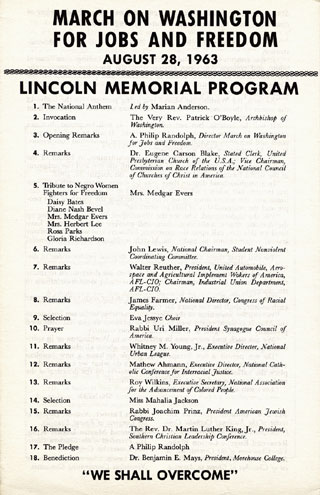
"This program listed the events scheduled at the Lincoln Memorial during the August 28, 1963, March on Washington for Jobs and Freedom. The highlight of the march, which attracted 250,000 people, was Martin Luther King’s "I Have a Dream" speech..."
March on Washington
Showing posts with label Martin_Luther_King_Jr.. Show all posts
Showing posts with label Martin_Luther_King_Jr.. Show all posts
Saturday, August 28, 2021
Official Program for the March on Washington


Thursday, March 22, 2018
Dr. Martin Luther King, Jr. and Community on the Move for Equality invite you to March for Justice and Jobs
"In his final campaign before his death, civil rights leader Martin Luther King, Jr. lent his support to a strike by sanitation workers in Memphis, Tennessee. This flyer was distributed to sanitation workers in Memphis, Tennessee, asking them to "March for Justice and Jobs" on March 22, 1968. Included are directions for the route to be followed and instructions to the marchers to use "soul-force which is peaceful, loving, courageous, yet militant.".."
ML King March for Justice and Jobs
Monday, January 15, 2018
FBI's Complete File on MLK
via[The MemoryHole]
"Martin Luther King’s entire FBI file (16,000+ pages), as posted by the original Memory Hole
Martin Luther King Jr.'s main FBI file is more than 16,000 pages long. Due to a Freedom of Information Act request, the Bureau released the entire file in 1984. It was on paper, of course.
"Martin Luther King’s entire FBI file (16,000+ pages), as posted by the original Memory Hole
Martin Luther King Jr.'s main FBI file is more than 16,000 pages long. Due to a Freedom of Information Act request, the Bureau released the entire file in 1984. It was on paper, of course.
For over two decades, if you wanted to view the whole thing, you had to pay the FBI FOIA office over $1,600 (10 cents/page) to get a paper copy, which is a highly inconvenient format for a huge file, never mind the exorbitant expense. Or you had to go to a library that had it on microform, or you could view it in the reading room at FBI HQ in Washington, DC.
Here in the digital age, the FBI has chosen to post a tiny fraction of MLK's file, without mentioning that it's only a tiny fraction. Go to the Martin Luther King Jr. page at the FBI's Vault. You'll find 1 part of the file (confusingly divided into two PDFs), totaling 226 pages. The file actually has 121 parts, totaling 16,659 pages..."
FBI and MLKSunday, January 15, 2017
Portrait of Dr. Martin Luther King, Jr. By Betsy G. Reyneau
"Born on January 15, 1929, Martin Luther King, Jr. was a key leader of the civil rights movement of the 1950s and 1960s in the United States. King and his followers fought for the equal rights and equal justice that the United States Constitution ensures for all its citizens. The great legal milestones achieved by this movement were the Civil Rights Act of 1964 and the Voting Rights Act of 1965. In the later 1960s, the targets of King's activism were less often the legal and political obstacles to the exercise of civil rights by blacks, and more often the underlying poverty, unemployment, lack of education, and blocked avenues of economic opportunity confronting black Americans..."
M.L. King, Jr. Portrait
M.L. King, Jr. Portrait
Wednesday, March 23, 2016
Dr. Martin Luther King, Jr. and Community on the Move for Equality invite you to March for Justice and Jobs
"In his final campaign before his death, civil rights leader Martin Luther King, Jr. lent his support to a strike by sanitation workers in Memphis, Tennessee. This flyer was distributed to sanitation workers in Memphis, Tennessee, asking them to "March for Justice and Jobs" on March 22, 1968. Included are directions for the route to be followed and instructions to the marchers to use "soul-force which is peaceful, loving, courageous, yet militant." ..."
Martin Luther King, Jr.
Martin Luther King, Jr.
Saturday, January 16, 2016
A Rare and Important Sculpture of Martin Luther King Comes to the Smithsonian
"Less than two years after Martin Luther King, Jr was assassinated, the African-American artist Charles Alston received a commission from Rev. Donald Harrington for the Community Church of New York to create a bust of the Civil Rights leader for $5,000. Alston, who was active in the Harlem Renaissance, was better known as both an abstract and representational painter. He had been the first African-American supervisor for the Works Progress Administration’s Federal Art Project. But his 1970 bust of MLK, of which he made five casts, became one of his most prominent pieces. The Smithsonian’s National Portrait Gallery commissioned one of the 1970 castings and lent the work to the White House, where it has stood in the library since 1990, the first image of an African American on display at 1600 Pennsylvania Avenue.
When Barack Obama became the first black President in 2009, he brought the work into the Oval Office, replacing a bust of Winston Churchill that had been returned to the British Embassy. There it became a prominent work, seen in official portraits with visiting dignitaries and heads of state.
Now a second copy of the famous King bust comes to Washington for all the public to see close up..."When Barack Obama became the first black President in 2009, he brought the work into the Oval Office, replacing a bust of Winston Churchill that had been returned to the British Embassy. There it became a prominent work, seen in official portraits with visiting dignitaries and heads of state.
Martin Luther King, Jr.
Martin Luther King, Jr. Day Speech Resources: Fact Sheet
"Martin Luther King, Jr. Day is a federal holiday observed annually on the third Monday in
January. It celebrates the life and legacy of the birthday of Martin Luther King, Jr. in honor of his
birthday and achievements. The day is also referred to as the Martin Luther King, Jr. Federal
Holiday; MLK Day; Martin Luther King Day; the King Holiday; and the King Day of Service. In
2016, this holiday is celebrated on January 18, and it marks the 30th anniversary of the first
observance of King’s birthday as a federal holiday.
This guide assists congressional offices with work related to Martin Luther King, Jr. Day. It contains links to legislation, CRS reports, sample speeches and remarks from the Congressional Record, and presidential proclamations and remarks. It also contains links to additional government web resources and selected educational, cultural, and advocacy organizations..."
Martin Luther King, Jr.
This guide assists congressional offices with work related to Martin Luther King, Jr. Day. It contains links to legislation, CRS reports, sample speeches and remarks from the Congressional Record, and presidential proclamations and remarks. It also contains links to additional government web resources and selected educational, cultural, and advocacy organizations..."
Martin Luther King, Jr.
Friday, January 15, 2016
Court Documents Related to Martin Luther King, Jr., and Memphis Sanitation Workers
"The name of Martin Luther King, Jr., is intertwined with the history of the civil rights movement of the 1950s and 1960s in the United States. The Montgomery bus boycott, the freedom rides, the Birmingham campaign, the March on Washington, the Selma march, the Chicago campaign, and the Memphis boycott are some of the more noteworthy battlefields where King and his followers--numerous in numbers, humble and great in name-- fought for the equal rights and equal justice that the United States Constitution ensures for all its citizens. King, building on the tradition of civil disobedience and passive resistance earlier expressed by Thoreau, Tolstoy, and Gandhi, waged a war of nonviolent direct action against opposing forces of racism and prejudice that were embodied in the persons of local police, mayors, governors, angry citizens, and night riders of the Ku Klux Klan. The great legal milestones achieved by this movement were the Civil Rights Act of 1964 and the Voting Rights Act of 1965.
In the later 1960s, the targets of King's activism were less often the legal and political obstacles to the exercise of civil rights by blacks, and more often the underlying poverty, unemployment, lack of education, and blocked avenues of economic opportunity confronting black Americans. Despite increasing militancy in the movement for black power, King steadfastly adhered to the principles of nonviolence that had been the foundation of his career. Those principles were put to a severe test in his support of a strike by sanitation workers in Memphis, Tennessee. This was King's final campaign before his death..."Martin Luther King, Jr.
Subscribe to:
Posts (Atom)

