"Economists and financial markets closely monitor interest rates in hopes of gleaning information about
the path of the economy. One measure of particular interest is the “yield curve.” Recently, the yield curve
associated with U.S. Treasuries inverted. This Insight discusses possible explanations for the inversion,
including whether the inversion is signaling that the economy will enter a recession.
What Is the Yield Curve?
A yield curve plots the interest rates on various short-term, medium-term, and long-term bonds by the
same issuer. Normally, short-term interest rates are lower than longer-term interest rates for a variety of
reasons, producing an upward-sloping yield curve. For example, Figure 1 shows the Treasury bond yield
curve on February 5, 2015; as the maturity date lengthens, the yield is higher at each point on the curve..."
Yield curve
Showing posts with label recession. Show all posts
Showing posts with label recession. Show all posts
Thursday, May 9, 2019


Wednesday, February 7, 2018
What causes a recession
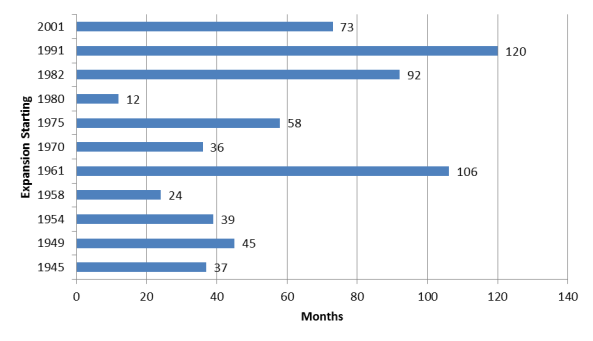
"At 104 months, the current economic expansion is already the third longest on record, and it will equal the secondlongest if it persists until April. This expansion, like all previous ones, will eventually end and be followed by a recession. Few economists are forecasting a recession in 2018, but recessions are notoriously hard to predict even a few months beforehand. For background, see CRS In Focus IF10411, Introduction to U.S. Economy: The Business Cycle and Growth, by [author name scrubbed].
As can be seen in Figure 1, previous expansions vary greatly in length but have recently been longer. Dating back to the 1850s, only five have lasted over five years, including the last three.
|
 .."".
.."".Recession
Thursday, June 5, 2014
The Recession and Recovery in Perspective
"The 2007-2009 recession officially ended in June of 2009 (the second quarter). How bad was this recession, and how quickly is the economy recovering? How does this recession and recovery compare to previous cycles?.."
Recession and Recovery
Recession and Recovery
Wednesday, February 19, 2014
The Slow Recovery of the Labor Market
"The deep recession that began in December 2007, when the economy began to contract, and ended in June 2009, when the economy began to expand again, has had a lasting effect on the labor market. More than four and a half years after the end of the recession, employment has risen sluggishly—much more slowly than it grew, on average,during the four previous recoveries that lasted more than one year..."
Labor Maket Recovery
Labor Maket Recovery
Friday, April 24, 2009
The 2009 Economic Landscape:How the Recession Is Unfolding across Four U.S. Regions
"...The following series of articles takes a closer look at the distinct way that this recession is playing out in four major regions of the country. The first article describes how the latest downturn is exacerbating long-term problems in the manufacturing sector of the Industrial Midwest. In the second article, we explore how
formerly booming housing markets in Arizona, California, Florida, and Nevada have given way to a housing bust that has sharply reversed the momentum of the regional economy. The third article focuses on the impact of financial market turmoil on New York City and other financial centers along the East Coast, while the fourth article outlines why a number of states in the nation’s midsection have fared better than most thus far because of their high dependence on energy and agricultural
production."
"...The following series of articles takes a closer look at the distinct way that this recession is playing out in four major regions of the country. The first article describes how the latest downturn is exacerbating long-term problems in the manufacturing sector of the Industrial Midwest. In the second article, we explore how
formerly booming housing markets in Arizona, California, Florida, and Nevada have given way to a housing bust that has sharply reversed the momentum of the regional economy. The third article focuses on the impact of financial market turmoil on New York City and other financial centers along the East Coast, while the fourth article outlines why a number of states in the nation’s midsection have fared better than most thus far because of their high dependence on energy and agricultural
production."
Thursday, February 12, 2009
Recession in Perspective
An analysis from the Federal Reserve of Minneapolis comparing the current recession with historical recessions dating back to 1946.
An analysis from the Federal Reserve of Minneapolis comparing the current recession with historical recessions dating back to 1946.
Subscribe to:
Posts (Atom)

