Showing posts with label pertussis. Show all posts

Tuesday, February 12, 2019

Whooping Cough Vaccination

"Whooping cough, or pertussis, can be a serious disease for people of all ages but especially for babies. Whooping cough vaccines offer the best protection against this very contagious disease. Make sure you and your loved ones are up to date with your whooping cough vaccines.
Two vaccines in the United States help prevent whooping cough: DTaP and Tdap. These vaccines also provide protection against tetanus and diphtheria. Children younger than 7 years old get DTaP, while older children, teens, and adults get Tdap.

CDC Recommends Whooping Cough Vaccines for People of All Ages

The vaccine recommended for someone depends on their age. The graphic below gives information, by age, about CDC’s whooping cough vaccine recommendations.
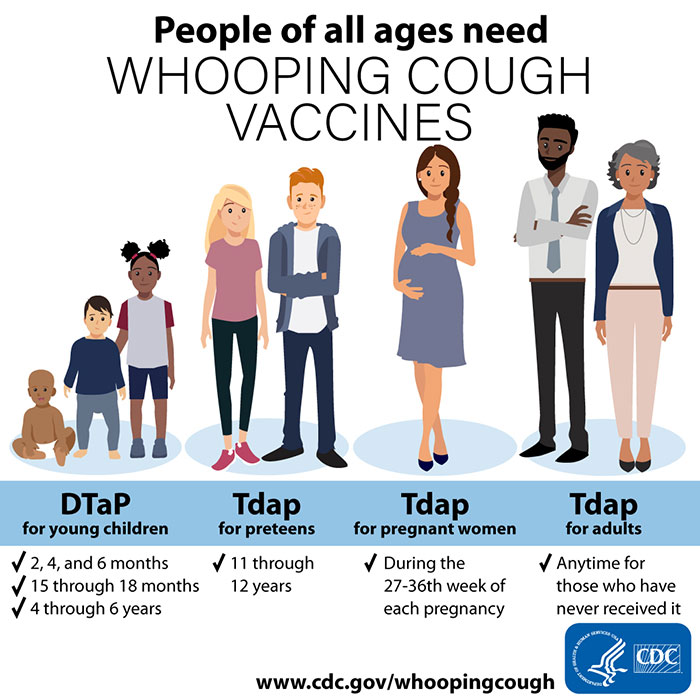
Graphic depicting young children, preteens, pregnant women, and adults, all of which need whooping cough vaccines...."

Whooping cough

Monday, February 10, 2014

Protect Babies from Whooping Cough (Pertussis)

 "Whooping cough is very contagious and most severe for babies. People with whooping cough usually spread the disease by coughing or sneezing while in close contact with others, who then breathe in the bacteria that cause the disease. Many babies who get whooping cough are infected by parents, older siblings, or other caregivers who might not even know they have the disease.."
Whooping cough-(Pertussis)

Tuesday, January 24, 2012

Pertussis (Whooping Cough) – What You Need To Know

"Pertussis (whooping cough) is a very contagious disease caused by a type of bacteria called Bordetella pertussis. Among vaccine-preventable diseases, pertussis is one of the most commonly occurring ones in the United States.

Pertussis Vaccine Protection
There is high pertussis vaccine coverage for children nationwide. However, protection from the childhood vaccine decreases over time. Preteens, teens and adults need to be revaccinated, even if they were completely vaccinated as children..."

Wednesday, October 20, 2010

Tetanus and Pertussis Vaccination Coverage Among Adults Aged ≥18 Years --- United States, 1999 and 2008
"In 2005, the Advisory Committee on Immunization Practices (ACIP) recommended that the newly licensed tetanus, diphtheria, and acellular pertussis (Tdap) vaccine replace a single decennial dose of tetanus diphtheria (Td) vaccine for persons aged 10--64 years. According to these recommendations, Tdap may be used to protect against pertussis even when <10 years have passed since the most recent tetanus vaccination. For adults with infant contact and health-care personnel (HCP) with direct patient contact (two groups at increased risk for transmitting pertussis to those who are most susceptible), the single recommended Tdap dose is suggested to be administered as soon as 2 years after the last tetanus vaccination (1). To assess changes in tetanus vaccination coverage and the use of Tdap among U.S. adults, CDC analyzed data from the National Health Interview Survey (NHIS) for 1999 and 2008. This report summarizes the results of that analysis, which indicated that self-reported tetanus vaccination coverage (vaccination within the preceding 10 years) was 60.4% in 1999 and 61.6% in 2008. Among adults aged 18--64 years, Tdap coverage was estimated to be 5.9% in 2008. Of those who reported receiving a tetanus vaccination during 2005--2008, 52.0% reported receiving Tdap. Tdap vaccination coverage among adults with infant contact was 5.0% and among HCP was 15.9%. Of those adults with infant contact and HCP who had received a tetanus vaccination during 2005--2008, 60.0% and 60.3% reported receiving Tdap, respectively. Health-care providers should recommend Tdap vaccination to adults aged 18--64 years whose most recent tetanus vaccination was ≥10 years prior; the interval for HCP and persons with infant contact can be as short as 2 years..."