Wednesday, September 12, 2018

Keeping Children Safe

"School is back in session. As you stock up on pencils, take first-day pictures, and adjust to new bus schedules, take a few, quick steps that can keep your child safer during an emergency.
From tornadoes to water main breaks, emergencies can occur with little or no warning—even during the school day. As children head back to school, take a few steps to help protect your child from an emergency and to reunite with your child quickly and safely.

Protecting Your Child Is as Easy as A-B-C

Ask how you would be reunited with your child in an emergency or evacuation
  • If students had to evacuate, where should you go to pick them up?
  • How would the school notify you in the event of emergency?
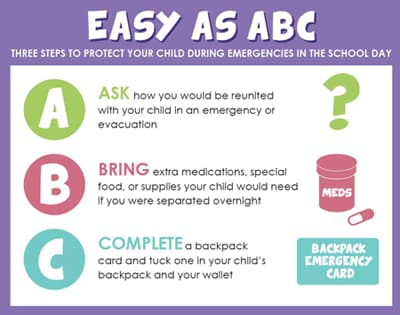
Easy as ABC. Ask how you would be reunited with your child in an emergency or evacuation. Bring extra medications, special food, or supplies your child would need if you were separated overnight. Complete a backpack card and tuck one in your child's backpack and your wallet
Follow these three steps to help protect your child during emergencies in the school day. View larger version and text description.
Bring extra medication, special foods, or supplies your child would need if you were separated overnight
  • What essential supplies would your child need if separated from you overnight? (Medications? Inhaler? Milk? Diapers? Battery pack for special equipment?)
  • Does the school have an emergency stockpile of these items or could you bring extras to be kept at school?
  • What is the school policy for how and when medicine can be administered to your child?
Complete a backpack contact information card[171 KB] and tuck one in your child’s backpack and your wallet
  • Emergencies are chaotic! Make sure your child or their school knows how to reach you, and who should be called if your phone isn’t working.
  • Download and complete your own backpack card.."
    Child safety and school

Monday, September 10, 2018

Disaster Preparedness for Your Pet

"Pets are family – do you have a plan for your pet in an emergency? Including pets in emergency plans helps your family’s ability to respond to an emergency. Be prepared: make a plan and prepare a disaster kit for your pet.
Leaving pets out of evacuation plans can put pets, pet owners, and first responders in danger. Even if you try to create a safe place for them, pets left behind during a disaster are likely to be injured, lost, or worse. Before a disaster strikes, find out what type of shelters and assistance are available in your area to accommodate pets and include pets in your family disaster plan to keep them safe during an emergency.
Don’t wait until it’s too late. Start today by including your pet in your family’s preparedness plans to protect the health of yourself, your family, and your pet.

Make a Plan

To get started, familiarize yourself with the types of disasters that could affect your area and consider your options for providing care for your pet(s).
Disasters can happen without warning, so be prepared:
  • Make sure your pet(s) wear collars and tags with up-to-date contact information and other identification.
  • Microchip your pet(s) – this is one of the best ways to ensure that you and your pet are reunited if you are separated. Always be sure to register the microchip with the manufacturer and keep your contact information up to date with the microchip company.
  • Purchase a pet carrier for each of your pets (write your pet’s name, your name, and contact information on each carrier).
    • Familiarize your pet with its carrier before a crisis.
    • Practice transporting your pet by taking them for rides in a vehicle similar to one you would be evacuating in.
    • Practice catching your pet, if needed.
  • Keep a leash and/or carrier near the exit.
  • Make sure you have proper equipment for pets to ride in the car (carriers, harnesses, pet seatbelts).
  • If you do not have a car, make arrangements with neighbors, family, and friends. You can also contact your local government to learn about transportation options during a disaster.."
    Pets and disasters

New Online Trainings on Alcohol-Free Pregnancy

"Fetal alcohol spectrum disorders (FASDs) are physical, behavioral, and intellectual disabilities that last a lifetime. They are completely preventable if a developing baby is not exposed to alcohol. Educating healthcare professionals about FASDs can offer knowledge and skills to improve the delivery of care related to FASDs and their prevention. Providers: Take free online trainings to learn about alcohol-free pregnancy!
The Centers for Disease Control and Prevention (CDC) and the Collaborative for Alcohol-Free Pregnancy announce the availability of free online courses for healthcare professionals on the prevention, identification, and management of FASDs.

Training Courses

Courses currently available are
  • FASD Primer for Healthcare Professionals
  • Preventing Alcohol-Exposed Pregnancies
  • Diagnostic Overview of FASDs: Recognition and Referral
  • Implementing Alcohol Screening and Brief Intervention in Clinical Practice.."
    Alcohol and pregnancy

Pregnant? Get Tdap in Your Third Trimester

"Only you can give your baby protection against whooping cough before your little one is even born. Talk to your doctor or midwife about getting the whooping cough vaccine (called Tdap) during your third trimester.
Whooping cough is a serious disease that can be deadly for babies. Unfortunately, babies don’t get vaccinated and start building protection against whooping cough until they are two months old. Avoid this gap in protection by getting the whooping cough vaccine during the third trimester of your pregnancy. By doing so, you pass antibodies to your baby before birth. These antibodies help protect your baby in the first few months of life.

You Need a Whooping Cough Vaccine during Each Pregnancy

CDC recommends pregnant women get the whooping cough vaccine between 27 and 36 weeks of each pregnancy, preferably during the earlier part of this time period. The American College of Obstetricians and Gynecologists and the American College of Nurse-Midwives support this recommendation.
Women need a whooping cough vaccine during each pregnancy to give each baby the greatest number of protective antibodies. Getting the vaccine during pregnancy is the best way to help protect your baby from whooping cough in early life..."
Whooping cough

Preventing Suicide

"Suicide can be prevented. September 10th is World Suicide Prevention Day, and the entire month is dedicated to suicide prevention awareness in the United States. Help prevent suicide in your community by knowing the warning signs and where to get help.
Suicide is a serious public health problem that affects people of all ages.
  • Suicide is the 10th leading cause of death for Americans overall and the second leading cause of death among young people aged 10–34.
  • Suicide rates increased more than 30 percent in half of states since 1999.
  • In 2016, nearly 45,000 lives were lost to suicide across the United States.
Deaths from suicide are only part of the problem.
  • More than 1.3 million adults self-reported a suicide attempt.
  • Almost 10 million adults self-reported serious thoughts of suicide.
Suicide is more than a mental health concern. A recent CDC study showed that a range of factors contribute to suicide among those with and without known mental health conditions. However, suicide is preventable.
States and communities, including, public health, healthcare, schools, the media, and community organizations can do a lot to prevent suicide. Research has uncovered a wealth of information about the factors that contribute to suicide risk and prevention strategies. CDC has released a technical package, Preventing Suicide: A Technical Package of Policy, Programs, and Practices[6.09 MB], to help inform decisions about prevention strategies that are based on the best available evidence.."
Suicide

It’s open season on ticks!

"Ticks can carry germs that can make you sick. Protect yourself, your family, and your pets from tick bites this hunting season.
Ticks can carry germs that cause serious and sometimes deadly diseases like tularemia, ehrlichiosis, Rocky Mountain spotted fever, and Lyme disease. While most tickborne infections occur during the summer, ticks may still be active well into the fall, or even year-round in warmer climates. Ticks live in grassy, brushy, or wooded areas, and on animals themselves, so hunting will bring you in close contact with ticks. Take the proper precautions this hunting season to keep you and your pets healthy.

Prevent Tick Bites

There are currently no vaccines to prevent tickborne disease in the United States, so avoiding tick bites and is the best way to protect yourself, your family, and your pets.."
Ticks

Sunday, September 9, 2018

How and When to Have Your Cholesterol Checked

"Getting your cholesterol levels checked is an important part of staying healthy. High cholesterol increases your risk for heart disease and stroke, two leading causes of death in the United States. Knowing your cholesterol status can help you stay in control of your health. Learn about cholesterol screening and why it is important.
Cholesterol is a waxy substance that your body needs to make hormones and digest fats. Your body makes all the cholesterol it needs, but you can also get cholesterol from eating certain foods, such as egg yolks and fatty meats. Having high blood cholesterol can lead to plaque build-up in the arteries, putting you at risk for heart disease and stroke. High blood cholesterol doesn’t have symptoms, which is why getting your cholesterol levels checked is so important. Learn more about cholesterol screenings.

At What Age Should I Get Screened?

More than 1 in 5 youths ages 6 to 19 have an unhealthy cholesterol reading, and 95 million U.S. adults age 20 or older have high cholesterol. But since high cholesterol doesn’t have symptoms, many people don’t know their levels are high. Cholesterol should be checked starting early in life—even children and adolescents should have their cholesterol checked.
Cholesterol testing should be done
  • Once between ages 9 and 11 (before puberty)
  • Once between ages 17 and 21 (after puberty)
  • Every 4 to 6 years in adulthood
If your family has a history of early heart attacks or heart disease, or if a child has obesity or diabetes, doctors may recommend screening for high cholesterol more often.."
Cholesterol

Wednesday, September 5, 2018

Helping Communities Take Action Against Opioid Crisis

"CDC is addressing the ongoing opioid overdose epidemic by working with communities to improve data collection and to implement evidence-based prevention strategies.
CDC provides the latest information to help prevent prescription and illicit drug overdoses in communities across the country. Awareness activities in August and September highlight the importance of strengthening the fight against opioid overdose.
August 31st marks International Overdose Awareness Day, a global event that aims to raise awareness of drug overdose and to reduce the stigma of a drug-related death. Prescription Opioid and Heroin Epidemic Awareness Week, which takes place on September 17th through 23rd, is a week to remember individuals, families, and communities impacted by the opioid overdose crisis. CDC observes these events by sharing resources for individuals and communities that increase awareness, help improve response, and emphasize the message that we must work together to prevent overdose deaths and save lives..."
Opiods

Guideline to Improve Care of Children with mTBI

"Mild traumatic brain injury (mTBI), also called concussion, affects millions of children each year. CDC’s Pediatric mTBI Guideline seeks to improve the care of this injury.
An mTBI can lead to short- or long-term problems affecting how a child thinks, acts, learns, and feels. CDC created the Pediatric mTBI Guideline, based on the latest science, to improve the health and safety of this vulnerable population.
The CDC Pediatric mTBI Guideline consists of 19 sets of clinical recommendations. These recommendations are designed for all healthcare providers who care for pediatric patients with this injury.

Recommendations and Tools to Improve Care

Key practice-changing recommendations from the CDC Pediatric mTBI Guideline include:
  • Do not routinely image pediatric patients to diagnose mTBI.
  • Use validated, age-appropriate symptom scales to diagnose mTBI.
  • Assess for risk factors for prolonged recovery.
  • Provide patients with instructions on returning to activity, customized to their symptoms.
  • Counsel patients to return gradually to non-sports activities after no more than 2–3 days of rest.
CDC also developed free tools to help healthcare providers use the Pediatric mTBI Guideline and resources for patients and their families..."
Mild traumatic brain injury/consussion

Preparedness for Expectant and New Parents

"Disasters, such as wildfires, hurricanes, and floods, can be unpredictable and devastating. Learn general tips to get prepared before a disaster and what to do in case of a disaster to help keep you and your family safe and healthy.

Get Prepared for an Emergency or Disaster

Disasters can be scary and stressful, especially if you’re expecting or have a baby. You can take the following steps now to help you prepare for an emergency and better cope if an emergency happens.
  • Talk to your doctor or other healthcare provider about where you will get prenatal care or deliver your baby if your doctor’s office or hospital is closed.
  • If you are close to your due date, learn the signs of labor and talk to your healthcare provider about what to do in case of an emergency.
  • Be informed—check with your local emergency management agency to find out how to get emergency alerts (such as text alerts).
  • Make a family communication plan[111 KB] for how you and your family will contact one another and what steps you will take in different types of situations.
  • Prepare an emergency kit that includes a 3-day supply of food and water, health supplies including medications, baby care and safety supplies, electronics, and important documents, such as emergency telephone numbers.
  • Plan ahead to help your baby sleep safely if you have to evacuate your home. Your baby is safest sleeping on his or her back in his or her own sleep area (e.g., a portable crib or bassinet) that does not have pillows, blankets, or toys..."
    Disaster planning

Tuesday, September 4, 2018

Prostate Cancer Awareness

"Should you get screened for prostate cancer?
The answer is different for each man. Before getting screened for prostate cancer, learn about the possible benefits and harms of screening so that you can make the best choice for you. Talk to your doctor about your personal risk for prostate cancer to figure out what is right for you.

What Is Prostate Cancer Screening?

Cancer screening means looking for cancer before it causes symptoms. The goal of screening for prostate cancer is to find cancer early that may spread if not treated.
Screening for prostate cancer begins with a blood test called a prostate specific antigen (PSA) test. PSA is a substance your prostate makes. This test measures the level of PSA in your blood. Your PSA level may be high if you have prostate cancer. Remember, your PSA level may be high for many  reasons, such as having an enlarged prostate, a prostate infection, or taking certain medicines..."
Prostate cencer

Be Ready for Radiation Emergencies

"Protect yourself, your loved ones, and your pets during a radiation emergency by getting inside, staying inside, and staying tuned.
It’s Saturday night and you’re at home with your family watching TV. A news alert announces a radiation emergency in your city. It could be an overturned truck hauling radioactive material, a nuclear power plant accident, or a “dirty bomb,” but reports are that large amounts of radiation have been released. What should you do?
Radiation can affect the body in a number of ways, and the adverse health effects of exposure may not be apparent for many years. These can range from mild effects, such as skin reddening, to serious effects such as cancer and death. This depends on the amount of radiation absorbed by the body (the dose), the type of radiation, and for how long the person was exposed. In large doses, radiation can cause acute illness or skin burns, or jeopardize a developing fetus.
Knowing the right steps to take can save lives and protect health..."
Radiation emergencies

What Parents Need to Know about Enterovirus D68

"Every year, millions of children in the United States catch enteroviruses that can cause coughing, sneezing, and fever. These viruses most often spread in the summer and fall. Enterovirus D68 is one of many enteroviruses that can make people sick. Take basic steps to protect your child and others.
Infants, children, and teenagers are at higher risk than adults for getting infected and sick with enteroviruses like enterovirus D68 (EV-D68). That’s because they may not have been exposed to these types of viruses before, and they may not yet have immunity (protection) built up to fight the disease. If your child has asthma, he or she may be at greater risk for severe respiratory illness from EV-D68.

Know the Symptoms of EV-D68

EV-D68 can cause mild to severe respiratory illness.
Mild symptoms may include:
  • fever
  • runny nose
  • sneezing
  • cough
  • body and muscle aches
Severe symptoms may include:

Get Ahead of Sepsis – Know the Risks. Spot the Signs. Act Fast

"Infections can put you and your family at risk for a life-threatening condition called sepsis.

What’s The Problem?

Sepsis is the body’s extreme response to an infection. It’s what happens when an infection you already have – in your skin, lungs, urinary tract, or somewhere else – triggers a chain reaction through your body. It’s life-threatening and without timely treatment, sepsis can rapidly cause tissue damage, organ failure, and death.
At least 1.7 million people get sepsis each year in the United States and nearly 270,000 Americans die from sepsis each year.

The Get Ahead of Sepsis Educational Effort

It’s important that patients, their families and caregivers, and healthcare professionals think about sepsis as a possibility. Get Ahead of Sepsis reminds us all of the importance of early recognition, timely treatment, and preventing infections.
  • Sepsis is a medical emergency. Time matters. If you or your loved one suspects sepsis or has an infection that’s not getting better or is getting worse, ask your doctor or nurse, “Could this infection be leading to sepsis?”
  • Anyone can get an infection, and almost any infection can lead to sepsis. Sepsis more commonly occurs in adults 65 or older, people with weakened immune systems, people with chronic conditions such as diabetes, lung disease, cancer, and kidney disease, and children younger than one.
  • A patient with sepsis might have one or more of the following signs or symptoms:
    • Confusion or disorientation
    • Shortness of breath
    • High heart rate
    • Fever, or shivering, or feeling very cold
    • Extreme pain or discomfort
    • Clammy or sweaty skin.."
      Sepsis

Text of a Letter from the President to the Speaker of the House of Representatives and the President of the Senate

"Dear Mr. Speaker:     (Dear Mr. President:)
I am transmitting an alternative plan for pay adjustments for civilian Federal employees covered by the General Schedule and certain other pay systems in January 2019.
Title 5, United States Code, authorizes me to implement alternative plans for pay adjustments for civilian Federal employees covered by the General Schedule and certain other pay systems if, because of “national emergency or serious economic conditions affecting the general welfare,” I view the increases that would otherwise take effect as inappropriate.
Under current law, locality pay increases averaging 25.70 percent, costing $25 billion, would go into effect in January 2019, in addition to a 2.1 percent across-the-board increase for the base General Schedule.  We must maintain efforts to put our Nation on a fiscally sustainable course, and Federal agency budgets cannot sustain such increases.  Accordingly, I have determined that it is appropriate to exercise my authority to set alternative across-the-board and locality pay adjustments for 2019 pursuant to 5 U.S.C. 5303(b) and 5304a.
Specifically, I have determined that for 2019, both across‑the‑board pay increases and locality pay increases will be set at zero.  These alternative pay plan decisions will not materially affect our ability to attract and retain a well‑qualified Federal workforce..."
Federal employee pay reduction